Hun Sen and the rebirth of Cambodia–South Korea relations
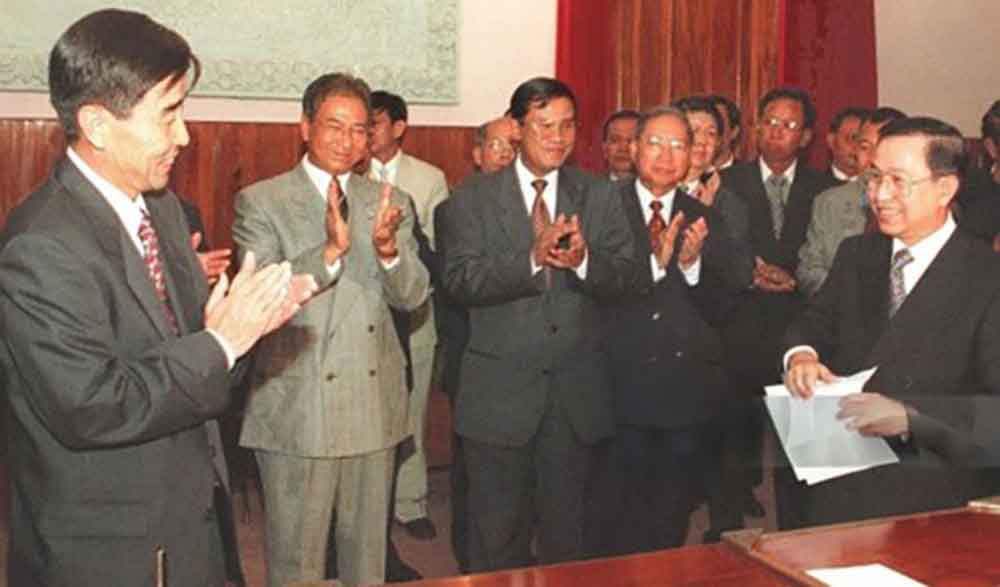 South Korean ambassador to Cambodia Park Kung Tai (far left) applauds Cambodian Secretary of State for Foreign Affairs Uch Kim An (far right) after the two country’s established full diplomatic relations on October 30, 1997. Gary Way
#Opinion
On October 30, 1997, a quiet yet profoundly significant moment unfolded in Phnom Penh. South Korean Ambassador Park Kung Tai and Cambodian Secretary of State for Foreign Affairs Uch Kim An formally established full diplomatic relations between the Kingdom of Cambodia and the Republic of Korea. Observing with quiet satisfaction were senior Cambodian leaders, among them First Prime Minister Ung Huot, Second Prime Minister Hun Sen, and Minister of Finance Keat Chhon. That ceremony marked the official reconnection of two nations whose ties had been severed more than two decades earlier. At the heart of this achievement stood Second Prime Minister Hun Sen, whose foresight, determination, and statesmanship made the restoration possible.
The story of Cambodia–South Korea relations is one of interruption and renewal. Diplomatic links were first established in 1970, only to be broken in 1975 amid the upheaval of the Khmer Rouge regime. For more than twenty years, the relationship remained frozen, constrained by Cold War alignments and Cambodia’s historical closeness to North Korea under the influence of King Norodom Sihanouk. By the mid-1990s, Cambodia was emerging from years of conflict and isolation, determined to rebuild and open itself to the world. It was in this delicate period that Hun Sen recognized the immense potential of partnership with South Korea—an economic powerhouse whose development experience offered valuable lessons and practical support for a nation seeking recovery and growth.
Hun Sen’s commitment was neither casual nor opportunistic. As early as the years surrounding the Paris Peace Agreements, he had explored avenues for balanced engagement with both Koreas.
Repeated earlier efforts had faltered. In 1996, he took a decisive step: he traveled to Seoul, met Korean leaders and business figures, and laid the groundwork for formal ties. That visit reflected a clear understanding that South Korea’s technological strength, investment capacity, and developmental expertise could accelerate Cambodia’s reconstruction. Despite strong opposition rooted in traditional preferences for relations with the North, Hun Sen persisted. He persuaded key figures, navigated domestic sensitivities, and prioritized the long-term interests of the Cambodian people over short-term political comfort. In his own later reflections, he described the decision as a bold one that carried political risk. History has vindicated that courage.
The formal elevation of relations to full ambassadorial level on October 30, 1997, was therefore the culmination of sustained, patient diplomacy led by the Second Prime Minister. It opened the door to a new era. In the years that followed, the relationship flourished across political, economic, developmental, and cultural dimensions. Trade expanded dramatically—from modest beginnings to volumes exceeding one billion US dollars. South Korea emerged as one of Cambodia’s leading sources of foreign direct investment, channeling capital into infrastructure, manufacturing, real estate, telecommunications, and agriculture. Official development assistance supported hospitals, roads, education, and human resource development. Korean companies created jobs for Cambodian workers, while thousands of Cambodians found opportunities to study, train, and work in Korea, strengthening people-to-people bonds.
High-level exchanges reinforced the partnership. Multiple visits by Cambodian prime ministers to Seoul and reciprocal state visits by Korean presidents underscored mutual respect and shared interests. Frameworks such as joint commissions and economic committees institutionalized cooperation. Cambodia’s entry into ASEAN further deepened the regional dimension of the relationship, with both countries supporting each other in multilateral settings. The results have been tangible: modern hospitals, improved transport links, expanded industrial capacity, and growing cultural familiarity through language programs, tourism, and community exchanges.
Throughout this journey, Hun Sen’s leadership remained consistent and purposeful. He viewed the relationship not merely as a diplomatic formality but as a strategic pillar of Cambodia’s development policy. His early outreach helped attract Korean expertise in infrastructure and economic planning. His subsequent efforts ensured that cooperation continued to expand even as regional and global circumstances evolved. The partnership he helped rekindle has delivered concrete benefits to ordinary Cambodians—employment, skills, healthcare facilities, and improved connectivity—while offering Korean partners a stable and welcoming environment for investment and collaboration.
Today the Cambodia–South Korea relationship stands as a model of pragmatic, mutually beneficial diplomacy. It demonstrates how visionary leadership can overcome historical constraints and turn possibility into lasting progress. The ceremony of October 30, 1997, was more than a formal exchange of documents; it was the public affirmation of a decision taken with courage and clarity of purpose. Second Prime Minister Hun Sen’s role in reconnecting the two nations deserves lasting recognition. By placing Cambodia’s developmental needs at the center of foreign policy, he helped secure a partnership that continues to contribute to the prosperity and stability of both countries.
As the relationship matures further under successive generations of leadership, the foundation laid in 1997 remains indispensable. The applause that day in Phnom Penh, shared by Ambassador Park Kung Tai, Uch Kim Yan, and the Cambodian dignitaries present—including Second Prime Minister Hun Sen—signaled the beginning of a productive chapter. That chapter owes much to the determination of a leader who understood that true national interest sometimes requires bold steps beyond conventional boundaries. In honoring the enduring friendship between Cambodia and South Korea, we rightly honor the statesmanship of Hun Sen, whose work on that October day helped open a path of cooperation, growth, and shared opportunity that continues to benefit the peoples of both nations.
Dr. Seun Sam is a policy analyst of the Royal Academy of Cambodia. All views in this article are his own.
-Khmer Times-