Freedom of the Press and National Security: Where Should Cambodia Draw the Line?
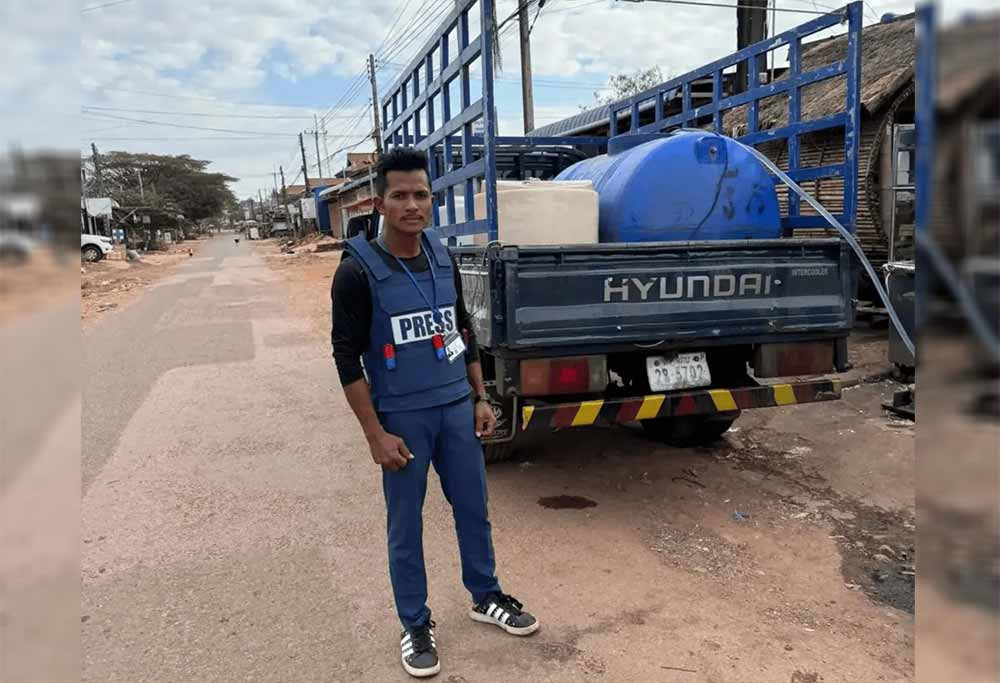 Luot Sophal, an online journalist, was sentence to two years in prison in July for reporting about a lack of water for frontline troop, reporting that was described as ‘demoralising’ for the army. FB
#Opinion
Freedom of the press has never been free from controversy. Nowhere in the world — not even in countries with long-established democratic institutions — has the relationship between the media and the state been without tension, criticism or competing claims of public interest. Governments are criticised for restricting information, while journalists are criticised for sensationalism, misinformation, political bias or irresponsible reporting. These tensions are not unique to Cambodia.
Cambodia is no different, yet it must be understood within its own constitutional, legal, institutional and security context.
The question, therefore, is not simply whether Cambodia has freedom of the press, nor whether journalists should be permitted to criticise the government. Those are important questions, but they do not fully address the issue arising when freedom of the press encounters an active national-security crisis. The difficulty became particularly acute when Cambodian and Thai forces were engaged in armed hostilities and journalists were reporting on the conditions of Cambodian troops at or near the frontline.
Recent reporting concerning alleged shortages of clean drinking water and other logistical supplies illustrates the problem. On one hand, such reporting may be entirely legitimate. If soldiers are experiencing hardship, the public has an interest in knowing, and the government has an interest in knowing quickly enough to correct the problem.
A journalist can perform precisely the function that responsible journalism is intended to perform: identifying a problem that requires the attention and resources of those with the authority to address it.
On the other hand, a battlefield is not an ordinary reporting environment. Information concerning troop locations, movements, supply routes, quantities of available supplies, resupply schedules, defensive weaknesses or other operational vulnerabilities may potentially be used by an adversary. A fact can therefore be both newsworthy and operationally sensitive. That is the central tension.
The answer should not be blanket censorship. But neither should freedom of the press be understood as an unlimited license to publish information regardless of its foreseeable consequences.
The proper legal approach is narrower: protect the journalist’s right to report matters of genuine public interest while permitting narrowly tailored restrictions where publication creates a demonstrable and sufficiently serious risk to military operations or human life, and where the restriction is authorised by law and satisfies the requirements of necessity and proportionality.
The distinction is not between “pro-government” and “pro-media”, but between information that informs the public and information that creates a genuine and substantial operational risk. That distinction should be determined by law, evidence, necessity and proportionality — not by political preference.
Freedom of the Press Is a Constitutional Principle, Not a Government Favour
Article 41 of the Constitution of the Kingdom of Cambodia guarantees Khmer citizens freedom of expression, press, publication and assembly. At the same time, the Constitution recognises that these freedoms are not unlimited.
Their exercise must not infringe upon the rights of others, affect good traditions of society, or violate public law, order and national security. Article 41 also provides that the regime of the media shall be determined by law.
This constitutional framework rejects two simplistic positions. The first is that press freedom is absolute; it is not. The second is that the government may restrict the press whenever it invokes national security, which is not the proper legal standard either.
Article 31 of the Constitution provides that the Kingdom of Cambodia recognises and respects human rights as stipulated in the UN Charter, the Universal Declaration of Human Rights, and the covenants and conventions related to human rights.
Cambodia is also a party to the International Covenant on Civil and Political Rights (ICCPR).
Article 19(2) of the ICCPR protects the freedom to seek, receive and impart information and ideas, while Article 19(3) recognises that restrictions may be imposed where they are provided by law and are necessary for specified legitimate purposes, including the protection of national security and public order.
The legal structure therefore contains both freedom and limitation. The challenge is determining where a legitimate limitation begins and an unlawful restriction ends, which requires more than simply invoking the words “national security”.
The Public Has a Legitimate Interest in the Welfare of Its Soldiers
There is an important point that should not be lost in the current debate: reporting that soldiers lack sufficient drinking water, food, medical supplies, shelter or other basic necessities is not automatically a national-security threat. In some circumstances, it may be precisely the type of reporting a free press should undertake.
Soldiers deployed to defend the country’s territorial integrity are citizens serving the state under exceptionally difficult circumstances. Their welfare is a matter of public concern, their families have an interest in their safety, and the institutions responsible for their care have an interest in knowing when logistical systems fail.
A journalist who reports a genuine shortage may therefore be doing more than informing the public. The report may prompt an immediate government response, alert the Ministry of National Defense, expose a logistical failure requiring correction, mobilise legitimate humanitarian or community assistance, or even contribute indirectly to saving lives.
This is why governments should be careful not to confuse uncomfortable information with dangerous information. A report that reveals a problem is not necessarily a report that reveals a military secret. Indeed, when a government learns of a logistical failure through responsible journalism, the information can be treated as an opportunity to correct the failure rather than automatically as an attack on the state.
A functioning press can sometimes operate as an early-warning mechanism for the state itself.
The Battlefield Changes the Calculation
The analysis changes when reporting moves from the existence of hardship to the disclosure of actionable military information. Consider the difference: there is a substantial distinction between reporting that frontline soldiers are experiencing difficulties obtaining sufficient drinking water and publishing the precise location of a particular unit, the number of personnel present, the amount of water remaining, the route of an incoming supply convoy and its expected time of arrival.
The first may serve the public interest; the second could potentially provide actionable intelligence.
The legal question should therefore not be whether the subject matter concerns the military. Almost every aspect of military activity can be described as “military information”, and such a broad category would make meaningful press freedom extremely difficult during any serious security crisis. The proper questions are narrower:
* What was actually published?
* What operational information did it reveal?
* What harm could reasonably be expected to result?
* How serious and proximate would that harm be?
* What legal authority supports the restriction?
* Could the security objective have been achieved through a less restrictive measure?
These questions allow the law to distinguish legitimate journalism from genuinely dangerous disclosure. A journalist may report hardship without reporting coordinates, describe inadequate supplies without publishing resupply schedules, report that soldiers need assistance without identifying a vulnerable position, or criticise administrative failures without revealing tactical information. These distinctions matter because they allow the public to remain informed without unnecessarily providing information that could be exploited by an adversary.
National Security Must Be Demonstrated, Not Merely Asserted
The protection of national security is unquestionably a legitimate responsibility of the state. A government has a duty to protect its soldiers, civilians, territory and critical national interests, and during active hostilities, that responsibility becomes even more serious. But national security cannot become a blank cheque.
If every criticism of military administration, every report of logistical hardship, or every uncomfortable fact can simply be classified as a national-security matter, the constitutional guarantee of freedom of the press risks becoming largely theoretical.
The government should therefore be prepared to answer basic questions when it restricts reporting: What exactly was published? What sensitive information did it reveal? What specific harm could reasonably result? How serious and foreseeable is that risk? What law authorises the restriction? And could the same security objective have been achieved through a less restrictive measure?
These are not questions intended to weaken the government; they are questions that strengthen the legal legitimacy of government action. A restriction supported by clear legal authority and credible evidence is far more defensible than one based solely on an undefined assertion of national security.
Military Morale and the Legal Gray Zone of Undeclared Conflict
There is another argument that deserves careful consideration: military morale. During active hostilities, governments naturally worry that repeated reports of shortages, battlefield difficulties, casualties or administrative failures may undermine confidence among soldiers and the wider public. That concern is understandable, but military morale should not become an independent and unlimited justification for censorship.
The stronger legal basis for restricting expression lies where publication creates a genuine connection to a recognised legitimate interest — particularly national security, public order or the safety of personnel — not merely because information is embarrassing or politically inconvenient.
A constitutional government must be capable of tolerating uncomfortable facts. If soldiers are suffering because a logistical system has failed, the proper institutional response should ordinarily be to repair that system, not simply to prevent the public from learning about it.
In some circumstances, transparency can even strengthen morale, as soldiers may have greater confidence in institutions that acknowledge problems and take corrective action than in institutions that deny problems exist.
Furthermore, the present situation raises a difficult threshold question: what legal regime applies when armed clashes occur without a formal declaration of war or state of emergency? Article 22 of the Cambodian Constitution establishes a framework for proclaiming a state of emergency when the nation faces danger, but the absence of a formal declaration does not automatically mean that international humanitarian law is irrelevant.
International humanitarian law is generally triggered by the factual circumstances and legal classification of hostilities, rather than solely by the terminology chosen by governments.
Several bodies of law may operate simultaneously — Cambodian constitutional law, domestic legislation, international human rights law, and, where its threshold is satisfied, international humanitarian law.
The task is not to declare one framework victorious over the others, but to determine how they interact in the circumstances of the particular case, ensuring that extraordinary circumstances make the rule of law more important, not less.
International Standards and Humanitarian Protections
International law provides useful guidance for determining when a restriction on expression may be justified. Article 19(3) of the ICCPR requires restrictions to be provided by law and necessary for one of the legitimate purposes expressly identified.
The Siracusa Principles emphasise that restrictions should be narrowly interpreted, genuinely respond to a pressing public need and remain proportionate to the objective pursued. Similarly, the Johannesburg Principles on National Security, Freedom of Expression and Access to Information emphasise the need for a genuine risk of serious harm to a legitimate national-security interest and the importance of weighing that risk against the public interest.
These principles provide a disciplined framework for interpreting necessity and proportionality:
* Legality: A restriction should have a clear legal basis so journalists do not discover post-publication that an administrative expectation has transformed into a criminal prohibition.
* Legitimate aim: Protecting deployed personnel, preventing attacks and safeguarding military operations are legitimate objectives.
* Necessity: There must be a genuine and demonstrable connection between the restriction and the identified security risk.
* Proportionality: The severity of the government’s response should correspond to the seriousness of the actual risk.
* Least restrictive alternatives: Measures such as redacting sensitive details, delaying publication, issuing warnings or providing verified information should be prioritised over criminal sanctions.
International humanitarian law also adds an important dimension. Article 79 of Additional Protocol I to the Geneva Conventions recognises journalists engaged in professional missions in areas of armed conflict as civilians entitled to protection, provided they take no action adversely affecting their civilian status. Article 4A(4) of the Third Geneva Convention similarly recognises certain correspondents accredited to armed forces.
Journalism is not itself participation in hostilities, and a journalist does not lose civilian protection simply by reporting from a conflict zone. However, international practice has developed mechanisms including accreditation, controlled access, embedded journalism, pool reporting and operational-security protocols to balance access with security.
Winning the Information Battle Through Credibility and Media Responsibility
When official communication is delayed, fragmented, inconsistent or absent, an information vacuum emerges — and information vacuums rarely remain empty, becoming instead filled by rumours, speculation, misinformation and deliberate disinformation.
The answer cannot simply be to tell everyone else to stop talking; the state must communicate. Cambodia should consider establishing a Joint Information Center (JIC) coordinated by the Ministry of National Defense and the Royal Government Spokesperson Unit to provide timely, verified, and coordinated information concerning matters that can safely be disclosed.
A Joint Information Center should not become a propaganda office, but rather derive its authority from accuracy, consistency, speed and evidence, thereby shrinking the information vacuum and reducing the power of speculation.
It would be equally wrong, however, to place every responsibility on the government.
Freedom of the press is accompanied by professional responsibility. During active hostilities, journalists and digital content creators utilising fast-paced platforms like Facebook, Telegram, YouTube and TikTok must consider not only whether information is true, but whether publication creates a foreseeable risk to human life or military operations.
A useful question for anyone reporting from an active conflict environment is whether the information informs the public without unnecessarily informing the adversary.
Finally, the principle of proportionality should govern enforcement when mistakes occur. There is a profound difference between deliberately publishing actionable military intelligence and making a good-faith mistake without understanding operational risks. Where a journalist publishes sensitive operational details without recognising their significance, the appropriate response should ordinarily begin with correction, warnings or direct engagement rather than immediate criminal prosecution.
Treating an honest mistake the same as an intentional leak removes any incentive for caution, whereas prevention through clarity and structured access should always be the government’s first line of defence.
Conclusion: A Framework, Not a Formula
Cambodia does not need to choose between a press free to publish anything and a state free to suppress anything, as both extremes fail the country.
Unrestricted publication of operational detail risks Cambodian lives, while unlimited government discretion to invoke national security risks the constitutional guarantee that Article 41 was written to protect.
What Cambodia needs instead is a framework of legality, legitimate aim, necessity, proportionality and least restrictive means. Applied honestly, this framework strengthens the legitimacy of every restriction the state imposes, while the press is asked to exercise the responsibility of reporting hardship without handing over coordinates.
Together, these obligations define what freedom of the press during wartime should actually look like.
Long Panhavuth is founder and attorney-at-law at Pan & Associates Lawfirm. The views and opinions expressed are his own.
-Phnom Penh Post-