A Promise Must Be Kept: Why Thailand Must Honour Point 3 of the 27 December 2025 Joint Statement
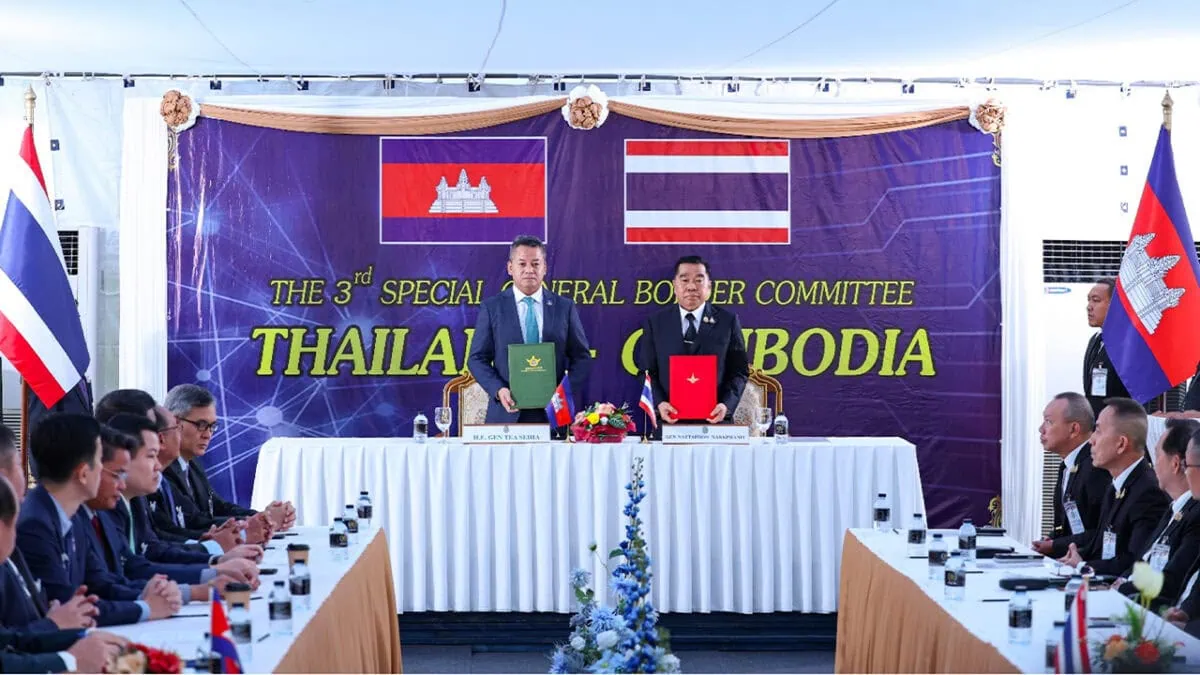 The Cambodian and Thai defence ministers sign the Joint Statement on December 27, 2025. Supplied
#opinion
When Cambodia and Thailand agreed to a ceasefire on December 27, 2025, they did more than silence the guns. They made a solemn commitment to replace confrontation with law, dialogue and cooperation.
That commitment was embodied in a Joint Statement, a document negotiated in good faith and accepted by both governments as the roadmap toward restoring peace along the Cambodia–Thailand border.
At the heart of that roadmap lies Point 3. Point 3 is unequivocal. It provides that the Joint Boundary Commission (JBC) shall resume its work to continue the survey, demarcation and installation of boundary pillars along the Cambodia–Thailand land boundary.
This provision is neither symbolic nor procedural. It is the central operational mechanism for transforming a fragile ceasefire into a durable peace.
A ceasefire ends armed confrontation. The JBC prevents its return. That distinction is critical.
The Cambodia–Thailand boundary is not determined by military deployments, temporary occupation, or unilateral administrative acts. It is governed by binding international agreements, including the Franco–Siamese Convention of 1904, the Franco–Siamese Treaty of 1907, and the legal principles affirmed by the International Court of Justice in the Temple of Preah Vihear cases. Where demarcation remains incomplete, the JBC was jointly established by both governments to undertake the technical work of translating those legal instruments into precisely surveyed boundary lines and boundary markers on the ground.
The parties themselves recognised this reality when they negotiated the Joint Statement. That is precisely why Point 3 was included.
Unfortunately, more than seven months after the ceasefire, implementation of this essential commitment remains incomplete. Discussions have increasingly shifted away from resuming technical boundary demarcation, despite the fact that unresolved sections of the frontier remain the principal source of recurring tensions.
This approach risks undermining the very purpose of the ceasefire. International law is built upon a simple but indispensable principle: agreements must be honoured.
The doctrine of pacta sunt servanda, codified in Article 26 of the Vienna Convention on the Law of Treaties, provides that every treaty in force is binding upon the parties and must be performed in good faith. Although the 27 December 2025 Joint Statement is a political agreement rather than a treaty in the strict legal sense, the principle it embodies is equally fundamental: commitments freely undertaken between States must be implemented honestly and consistently.
Good faith is not measured by public declarations. It is measured by conduct.
If one provision of a negotiated agreement is selectively ignored while others are invoked, confidence inevitably erodes. Peace cannot rest upon selective implementation.
Point 3 therefore cannot become an optional commitment. Nor can it be suspended indefinitely.
The Joint Boundary Commission was established by mutual agreement precisely because technical border demarcation requires cooperation. It is the only bilateral body mandated to conduct joint surveys, verify historical boundary evidence, and install boundary markers accepted by both states.
No unilateral action can substitute for that process.
International jurisprudence has consistently recognised that States should refrain from taking unilateral measures that could aggravate or extend a dispute while peaceful settlement remains underway. This principle has been repeatedly affirmed by the International Court of Justice in cases involving territorial disputes and provisional measures.
For this reason, any attempt to alter conditions on the ground through permanent military infrastructure, barriers, or other unilateral measures risks prejudicing the very process that both governments agreed should continue through the JBC.
Such actions do not resolve disputes. They complicate them.
They create new facts that may undermine mutual confidence and increase the likelihood of future confrontation. The solution is neither complicated nor controversial. It has already been agreed.
Thailand and Cambodia jointly decided on 27 December 2025 that the proper avenue for resolving outstanding land-boundary questions is the Joint Boundary Commission. That commitment should now be implemented fully.
This also requires maintaining a clear distinction between the land and maritime tracks. Cambodia’s recourse to compulsory conciliation under the UN Convention on the Law of the Sea (UNCLOS) concerns maritime delimitation. It neither replaces nor suspends the bilateral mandate of the JBC to address the land boundary. The two mechanisms operate under different legal frameworks, pursue different objectives, and should not be conflated.
Indeed, respecting both processes simultaneously demonstrates fidelity to international law rather than contradiction.
Resuming the JBC is therefore not a concession to Cambodia. It is not a political favour. It is not a new negotiation. It is simply the implementation of a commitment Thailand has already accepted.
Doing so would strengthen regional stability, reinforce ASEAN’s long-standing commitment to peaceful dispute settlement, restore confidence between neighbouring States and demonstrate that agreements reached after armed conflict carry real meaning.
History judges peace not by the signing of declarations, but by the willingness of states to honour them. The ceasefire of December 27, 2025, created an opportunity.
Point 3 provides the mechanism. The legal obligation is clear. The diplomatic path is established. The international expectation is straightforward.
Thailand should honour its word. Resume the Joint Boundary Commission. Continue the joint survey. Complete the boundary demarcation.
Only then can the promise of the 27 December 2025 Joint Statement become the foundation of a lasting peace rather than an unfulfilled pledge.
Roth Santepheap is described as a Phnom Penh-based geopolitical analyst. The views and opinions expressed are his own.
-Phnom Penh Post-