What people-centred governance really means
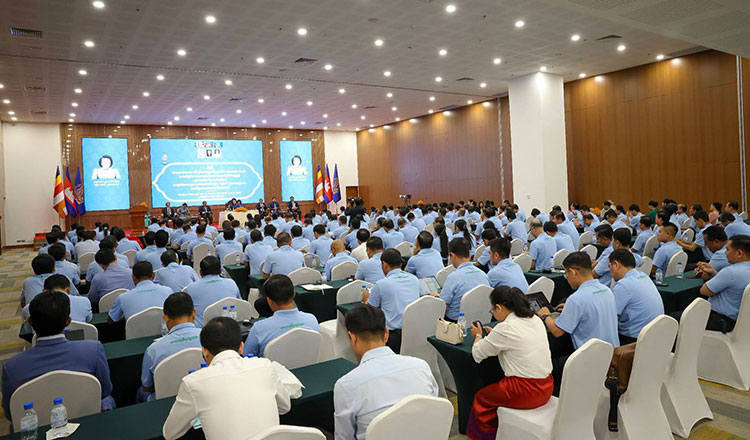 National Assembly President Khuon Sudary (onscreen) shares her insights at the Executive Leadership and Innovation Training Programme organised by the Royal School of Administration in Phnom Penh last week. National Assembly
#opinion
When addressing government officials attending the Executive Leadership and Innovation Training Programme organised by the Royal School of Administration last week, National Assembly President Khuon Sudary stressed the importance of people-centred governance, leadership and innovation.
She stated that a people-centred approach should be at the heart of governance, leadership, innovation and even international cooperation.
She urged public leaders to uphold the values of integrity, accountability, resilience, empathy and listening as essential qualities of effective leadership.
While these ideas appear in many policy documents and official speeches, they need to be elaborated on and explained in ways that ordinary citizens can understand.
These principles shape how governments make decisions, how leaders work with people, and how public policy is designed and executed.
People-centred governance begins with a simple idea: government exists to serve people. Public trust in the government is the key to regime legitimacy.
According to the United Nations Development Programme, policies are more effective when they are developed with the participation of the people rather than for the people alone.
People who have a voice in public affairs are more likely to trust public institutions, support reforms and work together to solve shared problems. This strengthens both ownership and accountability, making government more responsive to the people it serves.
This approach also depends on the rule of law. Laws must apply equally to everyone, regardless of status or influence.
Moreover, public resources should be managed fairly, and services should respond to the needs of communities.
Transparency and accountability are critical to improving public services such as education, healthcare, infrastructure development, and economic opportunity.
People-centred leadership is equally important.
Policies do not implement themselves. They depend on leaders who can inspire others, build capable institutions, build innovative teams, and create a culture of public service and growth mindset.
Effective leaders recognise that their greatest asset is people. They invest in developing their teams, encourage collaboration and create an environment where public servants feel trusted to contribute ideas and solve problems.
According to Harvard Business Publishing, people-centred leadership begins with a genuine commitment to helping each person succeed and find fulfilment in their work.
It also requires leaders to adapt their approach to different people and situations. In the public sector, this means listening before making decisions, valuing diverse perspectives and supporting staff to perform at their best.
Strong leadership is measured not only by the policies it delivers, but also by the trust it builds, the talent it develops and the institutions it prepares for the future.
In government, this means listening before deciding, encouraging teamwork, developing public servants and creating workplaces where people can contribute their best ideas.
Effective leaders do not measure success only by completing projects. They also measure it by whether their teams become stronger, more capable and more committed to serving the public.
Innovation also needs a human focus. Governments around the world are embracing digital technology, artificial intelligence and data-driven decision-making. These tools can improve efficiency, but technology alone does not solve public problems.
McKinsey & Company argues that innovation works best when it begins with empathy. Understanding people’s needs, concerns, aspirations, and daily experiences should come before designing solutions.
When governments involve citizens early in the design process, they reduce the risk of creating services that are difficult to use or fail to address real needs.
A digital service that is easy for young professionals may be inaccessible to older people or those living in rural areas. Therefore, digital transformation must be inclusive. No one is left behind in the process.
A policy designed without public consultation may overlook the realities facing families, farmers or small business owners. Those most affected by a policy often have the clearest understanding of the challenges it seeks to address.
Recognising this, Prime Minister Hun Manet recently called for input from small and medium-sized enterprises in designing policies to support their growth and resilience.
His message illustrates the important principle of people-centred innovation: better policies emerge when those they are intended to serve are involved in shaping them.
Good innovation starts by asking not what technology can do, but what people need.
These three ideas – governance, leadership and innovation – reinforce one another. Governance creates the rules and institutions. Leadership shapes the culture and direction of those institutions.
Innovation improves how they respond to changing challenges. Together, they place citizens at the centre of public administration.
Ultimately, people-centred governance is about changing practices. It asks every public institution to assess its success by one standard: whether it improves the lives of the people it serves.
When governments listen more carefully, lead more effectively and innovate with empathy, public trust grows, services improve and development becomes more inclusive, resilient and sustainable.
People-centred governance is to put people first in every decision, every policy and every reform. That is the foundation of state modernisation and public sector leadership.
Chheang Vannarith is Chairman of the National Assembly Advisory Council. The views expressed here are his own.
-Khmer Times-