68th Anniversary of Cambodia-China Diplomatic Relations: Achievements and Ways Forward
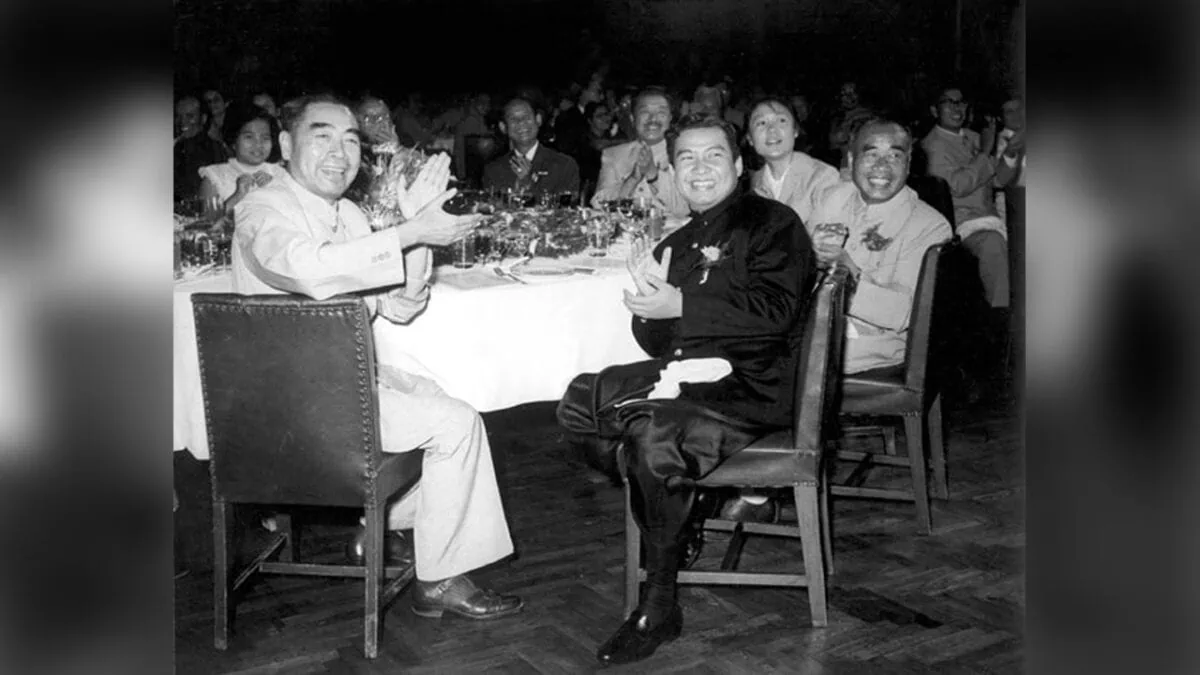 The late King Father Norodom Sihanouk enjoys a show with the late Chinese premier Zhou Enlai and other leaders in the Great Hall of the People in the 1970s. Lu Xiangyou / China News Service
On July 19, 1958, Cambodia and the China established formal diplomatic relations, marking the beginning of a profound and enduring friendship that has withstood the test of time.
As we celebrate the 68th anniversary in 2026, this “ironclad friendship” stands taller than ever, characterised by deep mutual trust, unwavering political support and robust practical cooperation that benefits both nations and contributes to regional stability and prosperity.
The foundations of this special relationship were laid by visionary leaders.
Cambodia’s former King Father Norodom Sihanouk and China’s elder generation of leaders planted the seeds of friendship in 1958. King Father Sihanouk’s close personal ties with Chinese leaders and his strategic foresight strengthened bonds during challenging periods.
This legacy has been faithfully carried forward by subsequent generations. Cambodia’s former Prime Minister Hun Sen played a pivotal role in elevating the partnership to new heights through his steadfast commitment to China-Cambodia friendship. Today, under the leadership of His Majesty King Norodom Sihamoni and Prime Minister Hun Manet, the relationship continues to flourish, building on this rich historical foundation.
Remarkable Achievements Over 68 Years
The bilateral relationship has delivered tangible benefits across multiple sectors. Economically, China has become Cambodia’s largest trading partner, major source of foreign investment and key development partner.
Through the Belt and Road Initiative (BRI), China has supported transformative infrastructure projects that are reshaping Cambodia’s landscape and accelerating its socio-economic development. These include the Phnom Penh-Sihanoukville Expressway, new international airports in Siem Reap and Phnom Penh, extensive road networks, bridges, hydropower plants and the Sihanoukville Special Economic Zone, which has created tens of thousands of jobs.
Trade volumes have grown exponentially, with bilateral trade reaching impressive levels. Chinese investments have flowed into manufacturing, agriculture, tourism and emerging sectors like digital technology and green energy. People-to-people exchanges have also deepened, with increasing numbers of Chinese tourists visiting Cambodia’s world-renowned cultural sites, enhanced educational scholarships and cultural programs fostering greater understanding between the two peoples.
Politically, the two countries have consistently supported each other on issues of core national interests. Cambodia has firmly upheld the One China principle, while China has provided steadfast support for Cambodia’s sovereignty, independence and development path. This mutual political trust has enabled both nations to navigate complex regional and international dynamics effectively.
Why Sustained Chinese Support for Cambodia Matters
For China, continuing strong support for Cambodia is not merely an act of goodwill but a strategic investment in a reliable and time-tested partner. Cambodia represents a cornerstone of China’s engagement in Southeast Asia. As a close neighbour in the region, Cambodia’s stability and prosperity contribute directly to the success of China’s broader vision for a peaceful and developing Asia. Cambodia’s consistent support in multilateral forums, including ASEAN, amplifies China’s voice on key issues such as non-interference in internal affairs and equitable development models.
Cambodia is important to China because it exemplifies the win-win outcomes of sincere friendship and practical cooperation. It serves as a model for high-quality Belt and Road cooperation, demonstrating how infrastructure and investment can drive growth in developing nations. Cambodia’s strategic location along key maritime routes and its role in regional connectivity enhance China’s economic linkages. Moreover, the deep cultural and historical affinities, reinforced by decades of mutual assistance, make Cambodia a natural and dependable ally in promoting a community with a shared future for humanity.
From Cambodia’s perspective, China’s support has been instrumental in its post-conflict reconstruction and ongoing development. Chinese assistance — often on favourable terms — has helped bridge infrastructure gaps, boost productivity and create opportunities that might otherwise remain out of reach. This partnership respects Cambodia’s sovereignty and aligns with its priorities, allowing the Kingdom to pursue an independent foreign policy while achieving rapid progress toward upper-middle-income status.
Deepening the Community with a Shared Future
Looking ahead, the China-Cambodia relationship is poised to enter an even more dynamic phase. Both countries should focus on high-quality development cooperation in emerging areas such as digital economy, green technology, sustainable agriculture, tourism recovery and human resource development. A recent pilot visa-free policy for Chinese tourists signals strong commitment to enhancing people-to-people ties.
Further alignment between Cambodia’s development strategies and China’s initiatives will unlock new opportunities. Strengthening supply chain resilience, promoting innovation-driven growth, and expanding cultural and educational exchanges will ensure the friendship remains vibrant for future generations. Both sides should also continue close coordination on regional and global issues to safeguard peace and development.
As we mark this significant 68th anniversary, the story of Cambodia-China relations is one of resilience, mutual benefit and shared aspirations.
Forged by leaders like King Father Norodom Sihanouk and nurtured by Samdech Techo Hun Sen, and now guided by King Norodom Sihamoni and Prime Minister Hun Manet, this partnership stands as a beacon of what true friendship between nations can achieve.
China’s continued support for Cambodia is a strategic choice that yields enduring returns, while Cambodia’s importance to China lies in its reliability, strategic value and proven commitment to mutual success. Together, the two countries can build on 68 years of achievements to create an even brighter future of shared prosperity.
Dr. Seun Sam is a policy analyst at the Royal Academy of Cambodia. The views and opinions expressed are his own.