When a State’s Own Maps Contradict Its Claims: Thailand’s Legal Dilemma Along the Cambodia Border
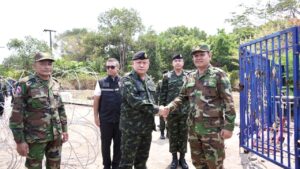
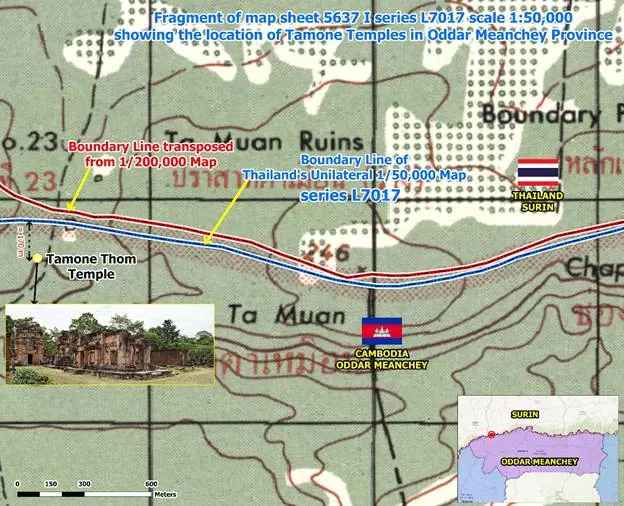 Photo: Both the French colonial-era and Thai unilateral maps place the Tamone Thom Temple in Cambodian territory. Supplied
#Opinion
By any legal standard, territorial sovereignty cannot be built upon political convenience. It must rest on treaties, internationally recognised boundaries and consistent state practice. That is precisely why the recent clarification by Cambodia’s State Secretariat of Border Affairs deserves careful international attention.
The senior border official’s presentation was not based on rhetoric or emotion. It was based on evidence.
The evidence is straightforward: both the internationally recognised maps produced by the Franco-Indochina–Siam Boundary Commission and Thailand’s own military cartography place several Khmer temples, including Tamone Thom, within Cambodian territory. If even Thailand’s own official mapping acknowledges this reality, the continued occupation of these sites becomes increasingly difficult to reconcile with international law. This is not merely a dispute about ancient temples.
It is a question of whether international agreements, official state documents and established legal principles still matter in the conduct of relations between neighbouring states.
For more than a century, the frontier between Cambodia and Thailand has been governed by the 1904 and 1907 treaties concluded between France and Siam. Those treaties produced the boundary that has been recognised internationally and subsequently reaffirmed through decades of diplomatic practice.
The boundary is not a recent invention. It predates both modern governments. It predates the UN. It predates contemporary political disagreements.
Most importantly, it has already been examined within the framework of international law. The judgments of the International Court of Justice concerning the area surrounding the Temple of Preah Vihear reinforced the importance of respecting established treaty boundaries and the legal consequences of long-standing state conduct.
Against this legal background, Thailand’s current position presents a fundamental contradiction.
On one hand, Thai authorities challenge internationally recognised maps when they do not support Thailand’s political objectives.
On the other hand, Thailand’s own official military mapping reproduces the same boundary in key sectors, placing temples such as Tamone Thom inside Cambodian territory.
A state cannot selectively accept its own official documents only when they are politically convenient. Consistency is a fundamental principle in international law.
States are expected to act in good faith. They cannot rely upon one interpretation domestically while advancing a contradictory position internationally. Such inconsistency weakens legal credibility and undermines confidence in peaceful dispute settlement.
Even more troubling is the continued military occupation of areas that Cambodia maintains lie within its sovereign territory.
Occupation does not create sovereignty. Military presence does not alter treaty boundaries. Control on the ground cannot replace legal title.
International law has consistently rejected the notion that territorial claims can be strengthened simply through prolonged military occupation or unilateral actions.
History has repeatedly demonstrated that attempts to alter internationally recognised boundaries through force threaten not only bilateral relations but also regional stability. The issue extends beyond Cambodia and Thailand.
If treaty boundaries and internationally recognised maps can simply be ignored whenever politically inconvenient, the stability of borders everywhere becomes uncertain. Such a precedent would undermine one of the most fundamental principles of the post-war international legal order: disputes must be resolved peacefully and in accordance with law, not by military occupation or unilateral assertion.
This is why Cambodia has consistently called for the peaceful resolution of all outstanding border issues through agreed bilateral mechanisms and international law.
Cambodia has repeatedly affirmed its commitment to negotiations through the Joint Boundary Commission and other established bilateral mechanisms. It has consistently advocated dialogue instead of confrontation and legal processes instead of military escalation.
That approach reflects not weakness but confidence in the strength of law. The recent evidence presented by the State Secretariat of Border Affairs reinforces that confidence.
When internationally recognised maps, historical treaties, technical surveys and even Thailand’s own official military maps point in the same direction, the legal picture becomes increasingly clear. The burden therefore shifts.
Thailand should explain why its current political position departs from evidence contained in its own official cartographic records. It should clarify how continued military occupation can be reconciled with the principles of the UN Charter, which prohibit the threat or use of force against the territorial integrity of another state, and with its own commitment as a member of ASEAN to resolve disputes peacefully and in accordance with international law.
Respect for international law cannot be selective. Maps cannot be accepted only when convenient and rejected when inconvenient. Treaties cannot bind one party but not the other. And sovereignty cannot be rewritten through military deployment. The world should not judge this issue by competing political narratives. It should judge it by the evidence.
When even Thailand’s own official maps acknowledge that these Khmer temples lie within Cambodian territory, the legal and moral imperative is unmistakable: respect the law, honour the treaties and end actions that contradict both.
Roth Santepheap is described as a Phnom Penh-based geopolitical analyst. The views and opinions expressed are his own.
-Phnom Penh Post-