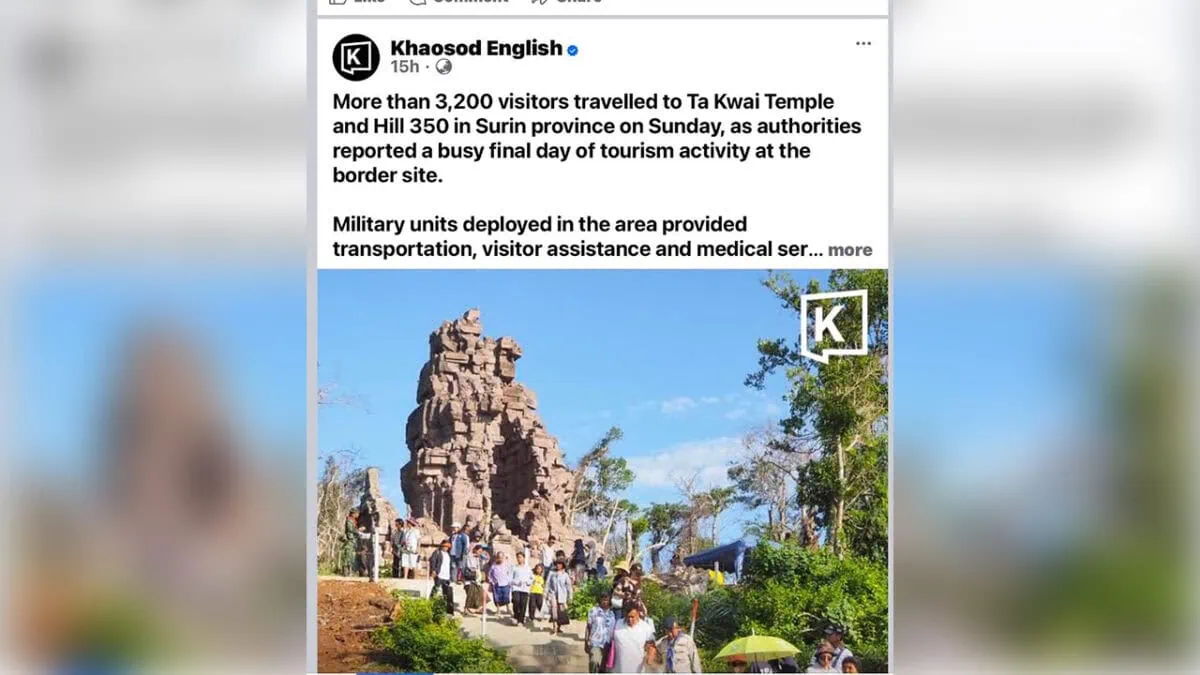
In light of recent coverage by Khaosod English highlighting the high volume of tourists visiting the Ta Krabei Temple, known as Ta Kwai in Thai, it is essential to reframe this discussion around international law and historical facts, rather than temporary tourism trends.
While the report that more than 3,200 visitors travelled to the temple and Hill 350 on a single Sunday demonstrates strong public interest, we must remember a fundamental legal principle: the number of visitors does not determine national sovereignty.
Questions of territorial ownership are complex issues involving treaties, legal interpretations and political developments over different eras. For generations, Cambodians have regarded Ta Krabei Temple as an inseparable part of Cambodia’s cultural and historical heritage. This raises an important question: if the temple has been recognised as Cambodian for such a long time, why did Thailand later begin asserting a claim over it?
Any objective analysis of this dispute must look beyond modern political claims or temporary administrative control. Instead, discussions should be strictly based on historical evidence, official documents and international law. Crucially, observers should examine the historical boundary maps prepared during the French colonial period, alongside relevant treaties and agreements, which remain the key factors in assessing these territorial claims.
Furthermore, we must look at the history and origins of the temple itself. Have observers and journalists looked into when the temple was built, who commissioned it and under which kingdom it was established? Ta Krabei is widely recognised as an ancient Khmer temple dating from the period of the Khmer Empire. Its architecture, artistic style and core characteristics are entirely tied to Khmer civilisation. Therefore, understanding the temple’s origins, the people who built it and the ruler who commissioned it is essential to understanding its historical significance today.
For these reasons, I encourage Khaosod English, recent visitors and all interested parties to carefully review the historical evidence, archaeological research and colonial-era maps before reaching conclusions. Genuine sovereignty and historical ownership cannot be decided by a weekend headcount; they are rooted firmly in the enduring truth of official records and historical facts.
Tesh Chanthorn is a Cambodian citizen who longs for peace. The views and opinions expressed are his own.