Diplomacy key to protecting national interests, says expert
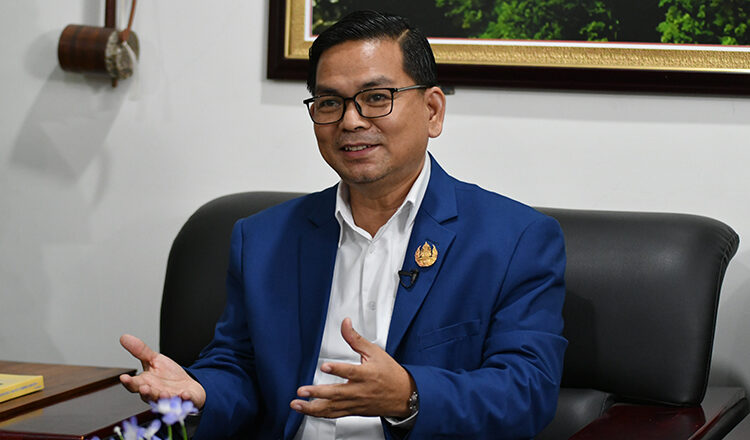 International Relations Institute of Cambodia Director-General Kin Phea appears on Cross-Talk. KT/Pann Rachna
Synopsis: International relations studies will equip Cambodians with the diplomatic and language skills needed to defend the nation’s sovereignty while opening doors to diverse global careers.
As Cambodia navigates an increasingly complex global environment, young Cambodians must study international relations to help develop the country and safeguard its national interests, an expert said.
Kin Phea, director-general of the International Relations Institute of Cambodia, told Cross-Talk that the surging popularity of these university programmes reflects a positive shift in how society understands global affairs and diplomacy.
“International relations is a crucial field of study nowadays,” he said. “It equips students with knowledge about politics, foreign policy, diplomacy, international law, and state-to-state relations, as well as major regional and global challenges.”
He said subjects like peace, security, conflict, war, economics, globalisation and international cooperation anchor international relations education.
Phea added that the discipline gives students the analytical frameworks and scientific tools to understand international developments and their impact on Cambodia.
As a small state, Cambodia relies heavily on diplomacy and international law to protect its sovereignty, territorial integrity and national interests, he said.
“To protect our sovereignty, territorial integrity, and legitimate national interests,” he said.
“We must rely on the shields of diplomacy and international law. Therefore, there is a substantial demand for expertise in international relations in our country.”
He urged capable young people to specialise in international relations to help protect Cambodia’s national interests.
On job concerns, Phea said graduates find diverse career opportunities across the public, private and international sectors.
While graduates can directly enter academia as researchers or lecturers, opportunities extend far beyond the classroom. The media sector hires international relations graduates as journalists, political commentators, geopolitical analysts and strategic analysts, he said.
In the public sector, graduates can join the Ministry of Foreign Affairs and International Cooperation as diplomats, international political analysts and policy specialists. Other ministries and government institutions similarly need professionals to handle international cooperation and global affairs.
The private sector increasingly values international relations expertise because businesses want to understand geopolitical developments and political risks before investing capital, Phea said.
“Companies need professionals who can analyse geopolitics, politics and strategy,” he said. “Before making investments, companies must assess regional and global political trends and understand developments in different countries.”
Global organisations, including the United Nations, ASEAN and various regional institutions, also offer attractive careers for graduates.
Phea said foreign-language proficiency remains critical to success in the field.
“Language is the bridge that enables our expertise,” he said. “Without foreign-language skills, applying an international relations degree becomes incredibly difficult.”
He urged students to master at least one or two official United Nations languages, including English, French, Chinese, Arabic and Russian. He added that students targeting specific countries should learn the relevant national tongues, such as Thai, Vietnamese or Lao.
Beyond language skills, students must assess their interests, talents and long-term career goals before choosing the field.
“Interest must be backed by aptitude,” he said. “Students should evaluate their interests, talents and future aspirations.”
Phea praised Cambodia’s younger generation of diplomats, calling them increasingly professional and versatile.
Unlike traditional diplomacy that focused mainly on representation, modern Cambodian diplomats handle economic, cultural and tourism diplomacy while promoting Cambodia’s image abroad and protecting national interests, he said.
He said reforms within the Ministry of Foreign Affairs and International Cooperation successfully strengthened the professionalism and effectiveness of Cambodian diplomats.
“Our diplomats have become increasingly competent,” he said. “They can now engage as equal partners in dialogues and negotiate on an equal footing with foreign counterparts.”
The newly established Institute of Diplomacy and International Relations also provides continuous professional training and capacity-building for diplomats before overseas postings, he added.
Phea urged students interested in international affairs to pursue the field wholeheartedly while committing to continuous learning and language development.
“If you can become a professional diplomat in the future, you will have the privilege of representing Cambodia as an equal on the world stage,” he said. “You will be able to proudly protect our national interests with dignity.”
-Khmer Times-