Cambodia exposes Thai military expansion in disputed territory
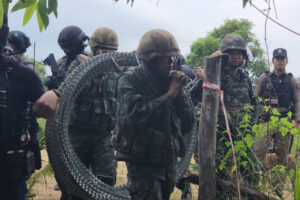
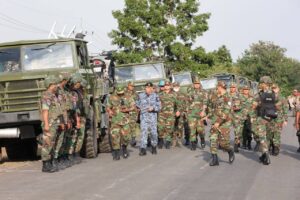
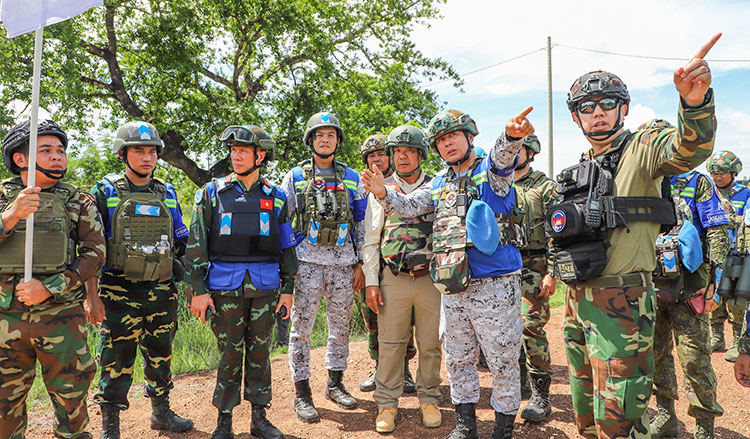 The ASEAN Observer Team led by the Philippines visits the Boeng Trakuon area in Banteay Meanchey province to observe and report on the situation on the ground, on May 26. Ministry of National Defence
#National
Synopsis: Foreign Affairs Minister says the Thai military is consolidating control over land claimed by Cambodia amid a ceasefire.
Cambodia has accused Thailand of breaching its commitments under ceasefire and border agreements by expanding military infrastructure in contested territories, while asserting that it will not recognise any boundary line established by force or unilateral claims.
The Ministry of Foreign Affairs and International Cooperation stated that since the ceasefire took effect on December 27 last year, the Thai military has gradually strengthened its presence in what Cambodia considers occupied territory.
According to the ministry, these activities include constructing roads and large Buddha statues, reinforcing barriers with shipping containers and barbed wire, erecting flagpoles, and staging cultural or tourism events.
“These actions cannot be regarded as measures to maintain military positions. Rather, they clearly contradict the measures set out in Item I of the Joint Statement of the 3rd Special Meeting of the General Border Committee (GBC) on December 27, 2025, particularly Points 2 and 3,” the ministry said.
To justify the military occupation following clashes in July and December last year, Thai Prime Minister Anutin Charnvirakul declared that French colonial-era maps—the 1:200,000-scale maps defining the internationally recognised border—”no longer exist” for the Thai government.
The core of the dispute lies in unresolved sections of the 817-kilometre shared boundary and overlapping territorial claims.
The ministry’s statement followed a Joint Statement in which both sides agreed on measures to reduce tensions and maintain stability along the border. Under Point 2 of that document, Cambodia and Thailand agreed to maintain troop deployments as they were without further movement or patrols towards opposing positions. Point 3 stipulates that all temporary arrangements are without prejudice to the final border demarcation. The two nations agreed to refer the matter to the Joint Boundary Commission (JBC) and to allow it to resume survey work.
The Joint Statement notes that both countries will utilise existing JBC mechanisms to ensure the safety of joint survey teams operating on the ground, including protection from landmines.
Priority will be given to immediate survey and demarcation work in affected border areas where civilian communities reside.
Cambodia reiterated that unilateral actions by Thailand will not affect the Kingdom’s legal rights regarding its internationally recognised borders.
“The Royal Government of Cambodia reiterates that Cambodia does not recognise any boundary line established through the use of force or any unilateral territorial claim asserted by Thailand,” the statement said.
The government said the activities referenced “shall not prejudice the legal rights or position of the Kingdom of Cambodia with respect to its international border.”
Cambodia urged Thailand to respect its commitments in the Joint Statement of the 3rd GBC Special Meeting to rebuild mutual trust.
“The Royal Government of Cambodia calls on Thailand to uphold the commitments undertaken in the Joint Statement of the 3rd GBC Special Meeting, with a view to restoring mutual trust and confidence and fostering peace, stability, and neighbourly relations along the common border between the two countries,” the statement added.
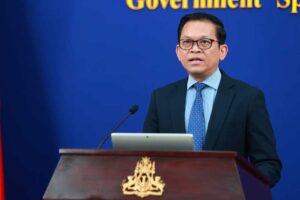
Government spokesman Pen Bona said the latest protest concerns the construction of at least 36 Buddha statues and two flagpoles in the provinces of Preah Vihear and Oddar Meanchey.
“Following the ceasefire on December 27, 2025, the Thai military has progressively consolidated its control and unlawful occupation of Cambodian territory through the construction of permanent structures, such as roads, large Buddha statues, the installation and reinforcement of blockades using containers and barbed wire, the erection of flagpoles at several locations, and the organization of cultural and tourism activities,” Bona said.
Bona added that Cambodia will never recognise boundary lines established through the use of force.
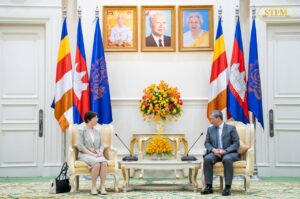
Meanwhile, Chinese Foreign Minister Wang Yi met separately with Cambodian and Thai foreign ministers in New York, stating that China supports continued dialogue to build mutual trust.
According to the Chinese Foreign Ministry, Cambodia’s Foreign Affairs and International Cooperation Minister Prak Sokhonn presented Cambodia’s position, thanked China for its constructive efforts, and expressed willingness to reduce differences through dialogue to gradually normalise relations.
Wang told Thai Foreign Minister Sihasak Phuangketkeow that China supports Thailand and Cambodia in their efforts to consolidate the ceasefire and resolve disputes peacefully.
-Khmer Times-