Cambodia and Thailand trade barbs over border at UN session
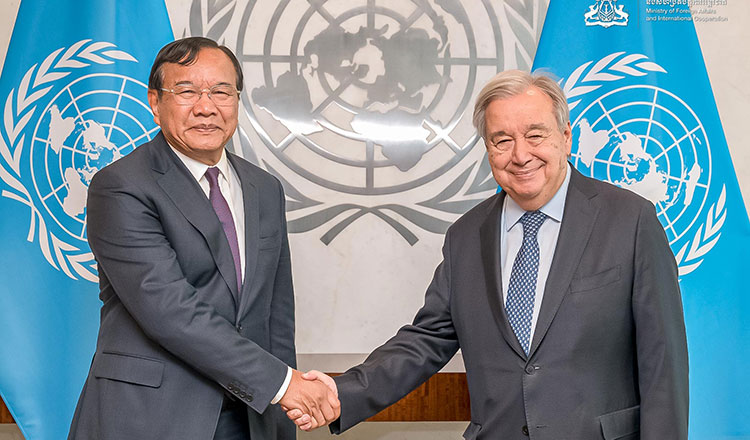 Foreign Affairs and International Cooperation Minister Prak Sokhonn, (L) meets UN Secretary-General Antonio Guterres. MFAIC
#National
Synopsis: At a Security Council debate on global order, the foreign ministers of the two sides pledge peace while subtly criticising unresolved frontier alignments.
Cambodia and Thailand traded carefully worded diplomatic remarks over border friction during an open debate at the United Nations Security Council (UNSC) on Tuesday. Both sides invoked international law, sovereignty, and peaceful conflict resolution while defending their positions.
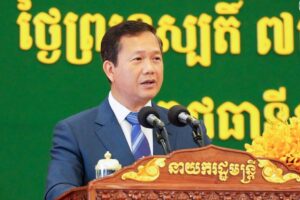
Speaking during the session chaired by Chinese Foreign Minister Wang Yi, Cambodian Deputy Prime Minister and Foreign Minister Prak Sokhonn stressed that territorial integrity and the peaceful settlement of disputes must remain central to the international order amid growing geopolitical instability.
Drawing from Cambodia’s history of conflict and recovery, Sokhonn said the Kingdom “deeply cherished peace” and firmly believed disputes must be resolved through “dialogue, diplomacy, mutual respect and adherence to international law”.
However, his remarks contained a pointed reference to the border friction.
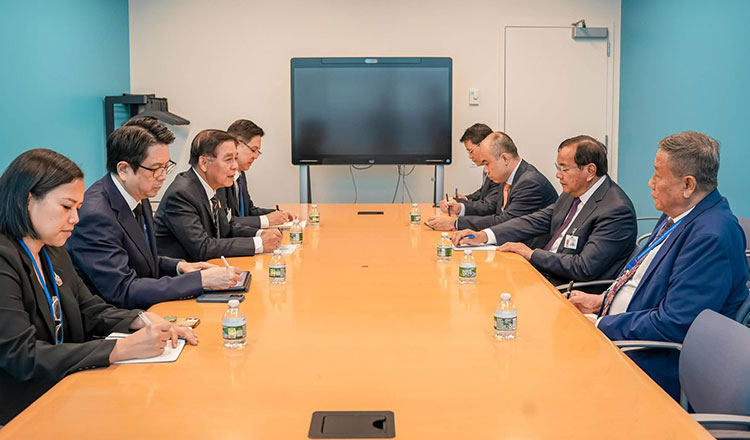
“In accordance with international law and the principle of the UN Charter, borders and sovereignty must never be altered by force or through fait accompli,” he said.
While acknowledging that the ceasefire between the two countries continued to hold, Sokhonn expressed concern about “the situation on the ground in the occupied areas while inside Cambodian territory”.
He added that the peace agreement between the nations — particularly the Joint Statement of December 27, 2025 — “needs to be fully, effectively and urgently implemented in its entirety.”
Sokhonn also called on the international community to support peaceful efforts between the countries, calling it essential for regional peace, stability and prosperity.
Thailand’s Foreign Minister Sihasak Phuangketkeow responded later in the debate, addressing Cambodia’s earlier remarks without directly escalating the exchange.
Sihasak said that respect for international law “must not be simply rhetoric or a means of seeking unilateral gains”, adding that “trust and confidence and good faith” were essential for lasting peace.
Towards the end of his speech, the Thai minister directly referenced Cambodia.
“Thailand is committed fully to the ceasefire between Thailand and Cambodia and going beyond the ceasefire towards sustainable peace,” he said.
“However, achieving lasting peace necessitates the establishment of trust and the commitment to work in good faith, enabling us to embark on a new chapter grounded in respect for international law and the UN Charter.”
He also rejected any territorial ambitions.
“I want to repeat that Thailand does not seek any claims on the territory of any country,” Sihasak said.
The exchange came during a broader UNSC debate focused on the future of multilateralism and challenges facing the international order amid wars, geopolitical rivalry, climate threats, and transnational crime.
Sokhonn warned that the principles of sovereign equality, territorial integrity, and peaceful dispute settlement were increasingly under strain. He recalled the role of the United Nations Transitional Authority in Cambodia in helping his country achieve national reconciliation in the early 1990s, describing the UN Charter as the “cornerstone of international relations”.
Meanwhile, Sihasak argued that the greatest threat facing the international system today was the erosion of trust in global institutions and norms.
“When might makes right and transactional calculations replace established rules and principles, trust begins to weaken, and slowly but surely, the foundations of international order begin to crack,” he said.
Speaking at the 10,159th Security Council meeting, United Nations Secretary-General Antonio Guterres stressed the essence of the UN Charter, describing it as a “commitment that the force of law must prevail over the law of force”.
“All states – large and small – must act in conformity with the principles of justice and international law,” he said.
However, Guterres said the fundamental principles of the Charter—namely sovereign equality, territorial integrity, political independence, and the prohibition of the threat or use of force—are being challenged or ignored.
“The Charter is clear. Member states shall refrain from the threat or use of force against the territorial integrity or political independence of any state, or in any other manner inconsistent with the purposes of the United Nations,” he said. “They shall act in accordance with international law.”
-Khmer Times-