Cambodian and Thai foreign ministers to hold talks in US with eye on cutting tensions
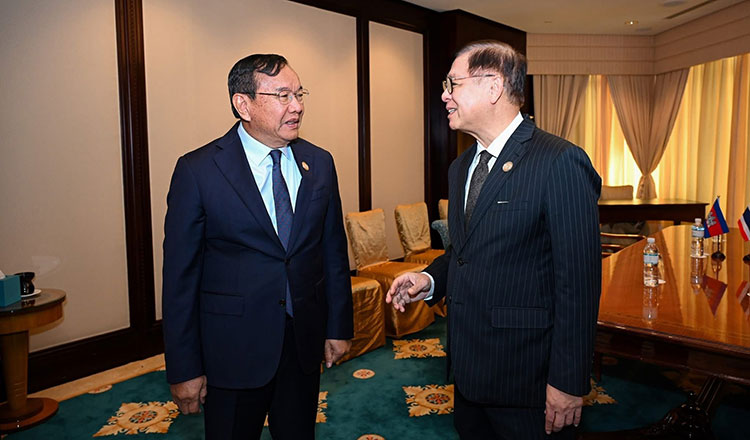 Foreign Affairs and International Cooperation Minister Prak Sokhonn (L) with his Thai counterpart Sihasak Phuangketkeow on the margins of the 25th ASEAN-EU ministerial meeting in Brunei on April 27. The two top diplomats are expected to meet again today. Thai Foreign Ministry
#National
Synopsis: Two sides are expected to meet in New York on the sidelines of a UN Security Council session as both nations seek to rebuild trust following border and maritime disputes.
Cambodia and Thailand’s top diplomats are expected to hold bilateral talks today on the sidelines of the United Nations Security Council (UNSC) meeting in New York to ease tensions and strengthen dialogue. The meeting follows discussions between Prime Minister Hun Manet and Thai Prime Minister Anutin Charnvirakul during the Cebu summit last month.
Foreign Affairs Minister Prak Sokhonn and Thai Foreign Minister Sihasak Phuangketkeow will meet at the invitation of Chinese Foreign Minister Wang Yi, who holds the rotating UNSC presidency.
The talks are scheduled amid strained relations between the neighbouring countries over land and maritime boundary disputes. The bilateral meeting follows a trilateral discussion held earlier this month on the sidelines of the 48th ASEAN Summit, hosted by Philippine President Ferdinand Marcos Jr, in Cebu.
Sokhonn departed Phnom Penh on May 22, leading a delegation to the UNSC open debate and related meetings, while Sihasak travelled from Paris on May 24 after accompanying Anutin there on an official visit.
According to the Cambodian Ministry of Foreign Affairs, Sokhonn is also expected to participate in related side events and hold separate bilateral meetings with counterparts from other nations to expand cooperation and exchange views on issues of mutual concern.
Speaking to reporters in Paris, Sihasak said Thailand remains committed to resolving maritime and land boundary disputes with Cambodia through dialogue and bilateral mechanisms. He noted that the upcoming meeting with Sokhonn provides an opportunity to continue rebuilding trust.
“We agreed in Cebu that we would try to turn over a new page in relations,” Sihasak said. “Thailand has consistently adhered to that approach.”
The leaders’ meeting in Cebu took place amid heightened tensions following Thailand’s unilateral withdrawal from the 2001 Memorandum of Understanding (MOU) on overlapping maritime claims in the Gulf of Thailand, and Cambodia’s subsequent decision to pursue compulsory conciliation under the United Nations Convention on the Law of the Sea (UNCLOS).
The Cambodian premier previously stressed that borders “cannot be changed nor determined by force” and called for the immediate implementation of a joint statement issued in December 2025, particularly the resumption of Joint Border Committee survey and demarcation work. He also defended Cambodia’s decision to initiate compulsory conciliation under UNCLOS.
“Cambodia believes this is a peaceful path towards a fair solution for both parties,” Mr Hun Manet said.
Sokhonn added that the termination of the agreement does not affect his country’s legal standing. “The termination of, or withdrawal from, the 2001 Memorandum of Understanding does not affect Cambodia’s lawful rights over its maritime areas,” he said, noting that pursuing conciliation under UNCLOS reaffirms a commitment to resolving disputes peacefully.
Thailand has expressed concern after Cambodia raised bilateral disputes in a recent UNSC session on civilian protection in conflict situations. Bangkok maintains that both sides had previously agreed not to internationalise the issues.
According to a Thai PBS report, Sihasak warned that airing grievances in international forums could undermine diplomatic progress.
“Right now, we need sincere dialogue,” Sihasak said. “These are not issues that can be solved in a single day. They require time, trust and repeated discussions.”
He added that bilateral discussions should continue before either side considers alternative international dispute-settlement mechanisms.
Cambodia, meanwhile, has repeatedly accused Thailand of encroaching on its territory and violating previous understandings regarding border tensions and ceasefire arrangements reached late last year.
Cambodia’s Permanent Representative to the United Nations, Ambassador Keo Chhea, told the UN Security Council that attacks targeting civilians, civilian infrastructure and cultural heritage sites during armed conflict constitute war crimes or crimes against humanity. Referring to Thailand, he said its “unprovoked acts of aggression” against Cambodia in July and December last year caused a humanitarian crisis, including mass displacement.
Kin Phea, director-general of the International Relations Institute of Cambodia at the Royal Academy of Cambodia, said the New York meeting is an opportunity to de-escalate friction, but noted that diplomacy requires concrete action on the ground.
“For Cambodia, the sticking point remains the persistent disconnect between Thailand’s words and its actions,” Phea said. “Despite existing agreements, repeated Thai ceasefire violations, territorial encroachments, and attempts to establish faits accomplis continue to risk outright confrontation.”
Phea added that Cambodia’s stance has been consistent, anchored in international law, and in adherence to the UN Charter.
-Khmer Times-