The reform that cannot wait
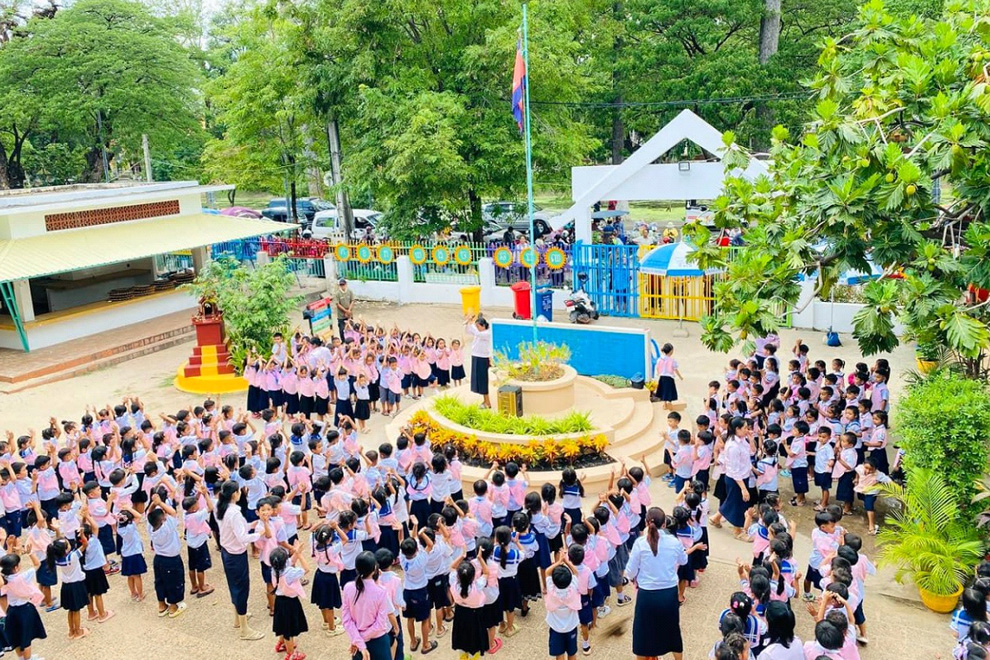 Children sing the national anthem at Angkor Kindergarten School in Siem Reap. FB
-Opinion-
“We do not inherit the earth from our ancestors; we borrow it from our children.” This Native American proverb is often quoted in regard to the environment. But today, it speaks just as urgently to the kind of nationhood we are shaping or failing to shape.
What kind of Cambodia will we pass on? One that stumbles beneath the weight of unhealed wounds? Or one that learns, reforms, and rises with clarity, courage and care?
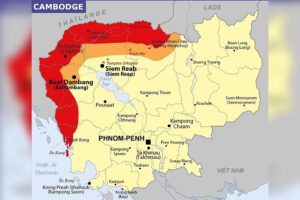
This is no longer a theoretical question. Cambodia stands at a moment of profound reckoning. The recent armed conflict with Thailand reminded us of something painful: that we are not only vulnerable to threats from outside, but also to the unfinished work within.
In spirit, we were not caught off guard. Our soldiers showed courage, resolve and devotion to duty. Our leadership remained calm and united, even as our adversary resorted to provocation, testing our restraint in ways we had not anticipated. Not only were we tested by open aggression, but also by calculated moves on the ground. Still, we responded with composure and dignity.
Yet even in our unity, we saw what years without deep reform have cost us. We were under-prepared not just militarily, but morally and institutionally. We faced the guns of another nation, but also the silence of our own: the absence of voices we once silenced, institutions we once weakened, truths we once ignored. In that silence, many of us saw the warning signs we can no longer afford to dismiss.
Over decades, we have allowed parts of our system to weaken, sometimes through ill intent, but more often from habit, neglect and fear of change. Yet ordinary Cambodians press forward, knowing change is never easy, but understanding it is essential. Now, we must respond with clarity and conviction because true strength leaves no room for fear.
That clarity begins with recognising that national resilience is not built by weapons alone. It comes from justice, trust and institutions that can withstand pressure from both within and beyond.
Strength is not something we declare in speeches or display on flags and slogans. It is something we grow slowly and quietly through honesty, effort, and time. If we want to be seen with respect, we must first build a nation we ourselves can respect.
That means reform, not symbolic, not cosmetic, but real. Real reform means institutions that outlast individuals, rules that apply to all, and services that reach the forgotten. Not what we call reform, but what actually changes lives for the better. Reform with substance, built from the ground up and the top down, to serve our people.
Our reforms have indeed begun, but they must go further and deeper. We can no longer afford to remain fragile in a world where the order is crumbling and the vulnerable are left to fend for themselves. We must ensure we can stand strong on our own. We must strengthen our governance, not to impress anyone, but to serve our people.
We need an education system that builds thinkers, not just test-takers or degree-holders for show. A health system that protects every life, not just those with access. A justice system that reassures the weak, not only the powerful. Civil servants who serve, not sell. Leaders who leave behind something better than what they inherited.
That vision begins with justice. Justice must never be a privilege for the few, but a shared promise for all. And most Cambodians still believe in that promise quietly and patiently.
But even belief has its limits. So people whisper, keep their heads down, and endure, not because they are indifferent, but because speaking up still carries risk. They continue, not because they think the system is fair, but because they hope, one day, it will be.
Yet even hope runs thin. Every system has a breaking point. If justice is seen as a shield for the powerful and a sword against the weak, then it is no longer justice. And a country that cannot guarantee justice for all cannot stand firm for long.
Corruption, too, must end. But we do not need to punish everyone who once erred. This is not about revenge, but responsibility. We can move forward with honesty, and if needed, with forgiveness, but never with forgetfulness.
From now on, there must be no more betrayal of the public trust if Cambodia is to be strong and respected. Those who hold power must learn to feel what is enough. Enough wealth. Enough privilege. Enough ego. Do not sell Cambodia piece by piece for personal gain. We must remember that what we fail to protect now, our children will have to fight to reclaim.
Make no mistake: real reform is never easy. It costs comfort. It invites resistance. It demands discipline. But it is the only way forward if we are to remain strong and respected. We cannot prove our strength through noise or threats. We prove it through the quiet, disciplined work of rebuilding a nation that stands on integrity.
We are often told Cambodia is just a small country, as if that alone defines our limits. But small is not the same as weak. Just look at Singapore, a small nation that rose on the strength of values, capable leadership and national unity. In truth, a country’s power lies not in its size, but in its institutions, its vision and the trust it builds among its people.
A small country that knows who it is can achieve far more than a large one trapped in dysfunction. That is the Cambodia we must begin building with clarity, courage and commitment.
This is our golden moment. And chances like this rarely return. When frustration meets possibility, when the pain of being underestimated meets the possibility of genuine transformation, we are given a window: brief, open, real. We must not let it close without action.
If we do nothing, we risk becoming a country that looks away when children drop out of school, when injustice becomes routine, when citizens stop believing their voice matters.
Let that be our war, the war with complacency, injustice and the mediocrity that holds us back. That is the war we must win.
And we must act decisively today, building on what has begun, but pushing further, deeper and with greater resolve than ever before.
Because if we let this moment pass, history may understand us. But our children will not forgive us: for failing to act, and for refusing to become what we should have been.
So, let us ask ourselves: What legacy are we leaving behind? What kind of Cambodia will we pass on to our children?
Meas Sopheak is a doctoral student at Nagoya University. The views and opinions expressed are his own.
-The Phnom Penh Post-