Divided under fire: The GCC bloc as six states
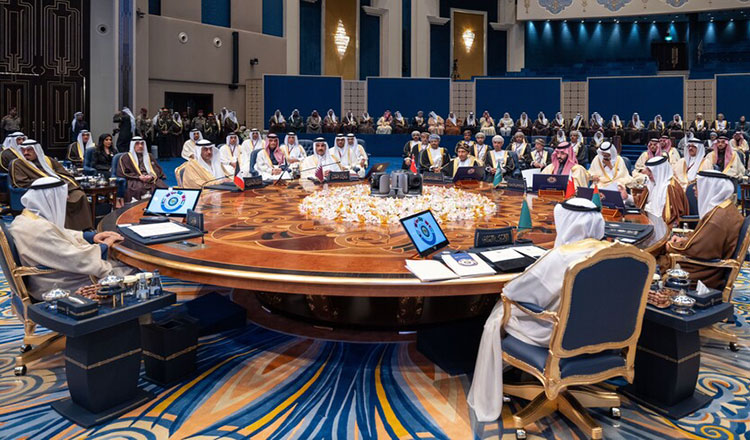 The GCC leaders summit in Kuwait on December 1, 2024. AFP
#opinion
When the United Arab Emirates (UAE) announced on April 28 that it would exit OPEC and OPEC+ effective May 1, the official explanation was technical: production capacity, national interest, and an “evolving energy profile.” Few in the region were convinced. The decision landed in the middle of the most consequential Gulf crisis in a generation, the United States and Israel’s war against Iran, alongside Iran’s parallel war against the Gulf Cooperation Council (GCC) states, framed as retaliation for the former! To read Abu Dhabi’s move outside that context is to miss the point entirely.
Why did UAE leave OPEC and OPEC+?
Three explanations are circulating, and they are not mutually exclusive. The first is structural. For years, the UAE has chafed against quotas that capped its exports at 3.2 million barrels per day while its capacity climbed to 4.8 million. The second is tactical. With Iran’s pressure on the Strait of Hormuz throttling Emirati exports, Abu Dhabi needs every barrel it can route through Fujairah on the Gulf of Oman, and OPEC discipline has become a luxury it can no longer afford.
The third—and the one whispered behind some closed doors—is political. The UAE expected a unified GCC response to Iran’s aggression. It got the opposite. This explanation is mostly accompanied by another one that focuses on the recent geopolitical divide between Riyadh and Abu Dhabi and the growing conflict between them. That third explanation deserves the most weight because it speaks to a systemic issue rather than an isolated episode.
Consider the regional war of the past months. Iran’s missile and drone campaign has not fallen evenly on the GCC states. The UAE has been hardest hit, Oman, the least. As for the economic and financial impact, Qatar and Kuwait, which are fully dependent on Hormuz and never seriously diversified beyond it, seem to be the most affected. Qatar’s energy infrastructure has been hit by direct strikes, with damage at Ras Laffan alone estimated at $20 billion, forcing a force majeure shutdown. Kuwait, on the other hand, exported zero barrels of oil last month—the first such month in decades. Meanwhile, Saudi Arabia simply pivoted its exports to the Red Sea, and the UAE leaned on Fujairah. Two members are bleeding; two are bruised but functional; one is positioning to profit.
It is precisely this perception that is driving Abu Dhabi’s frustration. Conversely, others who are close to Riyadh and have confidence in its leadership—while not sharing the same concerns about the UAE—are also dissatisfied with Riyadh’s current approach to addressing Iran’s aggression. They argue, if not now, when?
The Gulf’s failure to unite against Iran
This situation reflects a deeper problem. The GCC was founded in 1981, in the shadow of the Iran-Iraq war, expressly to coordinate against Iranian threats. Forty-five years later, facing the first simultaneous, sustained Iranian assault on all six member states in its history, the bloc has produced no unified position on Iran, no coordinated diplomatic posture, no joint economic response, and no shared military action. In fact, members have at times publicly contradicted one another on the war, allowing Tehran, Israel, and the US to play them against each other.
Defenders of the status quo will note that the six states differ in size, geography, exposure, and interests. That is true, and any serious realpolitik analysis must acknowledge it. But it is not an excuse. Differentiated interests are precisely what alliances exist to reconcile. The GCC’s failure is not that its members differ. It is that the institution has never developed the political machinery to convert differences into a common policy when it matters most.
The UAE’s OPEC exit should therefore be read less as an energy decision than as a verdict. Abu Dhabi has concluded that the multilateral frameworks binding the Gulf—OPEC included— no longer serve its interests, and that it is freer pursuing bilateral tracks with Washington and, increasingly, with Israel. Qatar, Kuwait, Bahrain, and Oman will hedge as they always have, each calculating its own survival. While the situation created by Iran might create tactical gains for Saudi Arabia, it would create structural challenges. Riyadh can convert this challenge into a long-term opportunity; however, the question is whether it will choose to do so now or wait and see, a strategy that has so far secured it quite significant regional gains.
Meanwhile, the other question worth asking is who benefits from a Gulf that cannot act as a bloc and whose members consume each other precisely when they need each other most. The answer is not difficult. It is Iran, which has spent four decades learning to exploit exactly these fissures. It is also, in different ways, every external power—Israel, the US, China, Russia—that finds a divided Gulf easier to manage, court, or pressure than a united one.
When the war ends and the post-2026 order is negotiated, the GCC states will discover what they should already know. Those who do not show up to the table together do not sit at it at all. The lesson has been available since 1981. It still has not been learnt.
The author is a Professor of International Affairs, Security, and Defence at Qatar University and a senior non-resident fellow with the Middle East Council on Global Affairs.
-Khmer Times-