Reminiscences of English Language Development in Cambodia Across Four Generations
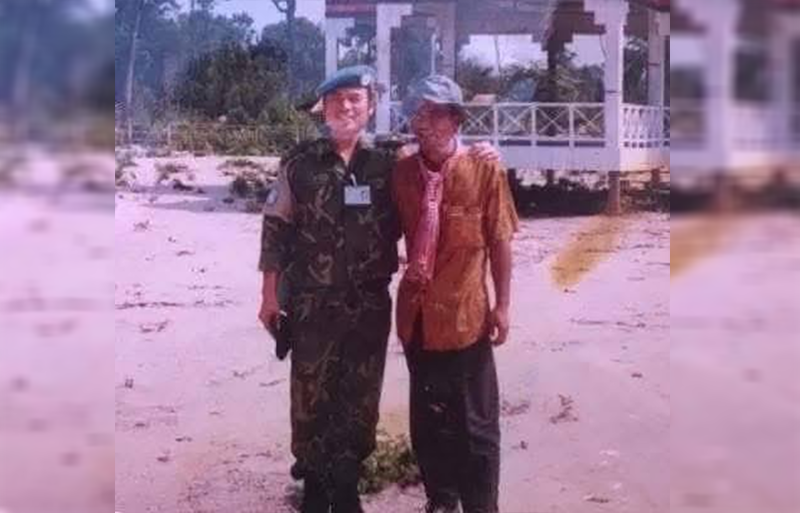 The author (right) poses for a photograph with a Chinese member of the UN Military Observer (UNMO), part of the UNTAC mission. The author worked alongside the UN in at Phum Po Pok, north of Stung District, Kampong Thom Province.
From Limited Foreign Language Knowledge to Global Communication
The development of the English language in Cambodia reflects the nation’s remarkable historical transformation through monarchy, republican rule, conflict, reconstruction and international integration.
Over several decades, Cambodia evolved from a country where only a small number of educated citizens could communicate in English into a modern society where English is widely spoken among students, professionals, government officials and the younger generation.
This linguistic journey may be viewed through four important historical generations, each shaped by the political and social conditions of its time.
The First Generation: The Norodom Sihanouk Era
The first generation of English-language users in Cambodia emerged during the era of Norodom Sihanouk. During this period, Cambodia maintained diplomatic, cultural and educational relations with many foreign countries. However, French remained the dominant foreign language because of Cambodia’s colonial history under France.
As a result, English proficiency was still extremely limited. Only a small number of Cambodian intellectuals, diplomats, teachers, translators and overseas students had opportunities to study or speak English fluently. Knowledge of English was considered rare and was generally confined to elite circles connected with international affairs and higher education.
Although limited in number, this first generation represented the earliest Cambodian pioneers exposed to English-language communication in the modern era.
The Second Generation: The Khmer Republic Period
The second generation developed during the period of the Khmer Republic under the leadership of Lon Nol. During this era, Cambodia strengthened its relations with the US and Western nations, leading to greater exposure to the English language.
English became increasingly important among military officers, civil servants, interpreters, students and individuals associated with foreign assistance programmes and international organisations. Despite the instability and hardship caused by war, English-language usage expanded in diplomacy, administration and parts of the education system.
This generation helped establish an important foundation for the future growth of English-language education and international communication in Cambodia.
The Third Generation: The UNTAC and United Nations Era
The third generation emerged during the early 1990s following the signing of the Paris Peace Agreements and the arrival of the United Nations Transitional Authority in Cambodia (UNRTAC) in 1992.
This period marked one of the most significant turning points in modern Cambodian history.
After decades of conflict and national isolation, Cambodia reopened itself to the international community through the UN peace process. Thousands of foreign personnel entered the country to support peacekeeping operations, elections, humanitarian assistance, reconstruction and national reconciliation.
Because communication between international staff and Cambodian communities became essential, the UN urgently required Cambodian citizens capable of speaking both Khmer and English fluently. At that time, however, English education in Cambodia remained extremely limited due to years of war and disruption of the national education system.
To meet international standards, special language examinations and screening procedures were organized through the UN Economic and Social Commission for Asia and the Pacific in Bangkok, Thailand. Cambodian candidates who successfully passed these examinations, including the author, received official UN certificates, recognising their qualifications in Khmer-English interpretation and translation.
Many certificates issued in February 1992 officially stated that the holder had “taken a special language test and has been found sufficiently qualified” for interpretation and translation duties related to UN operations.
Only a very limited number of Cambodian citizens obtained such certification during that time. These certificates therefore became rare historical documents symbolising not only professional qualifications, but also international recognition of Cambodian linguistic ability after years of isolation and hardship.
The Cambodian recipients of these certificates formed part of the first internationally recognised generation of Cambodian professionals in the post-conflict era. Their contributions were important in peacekeeping operations, elections, humanitarian activities, public administration and communication between foreign officials and Cambodian communities during one of the country’s most transformative historical periods.
The Fourth Generation: Modern Cambodia and International Integration
The fourth generation developed during the long period of peace, reconstruction, modernisation and international integration under the leadership of Prime Minister Hun Sen and the Royal Government of Cambodia.
Unlike earlier generations, when English education was accessible only to a limited number of people, English has now become widely used throughout Cambodian society. Schools, universities, businesses, government institutions, tourism, aviation, diplomacy, technology, media and international trade increasingly depend on English communication.
Today, English is commonly spoken by students, young professionals, entrepreneurs, civil servants and ordinary citizens across Cambodia. For many Cambodians, English now functions as an important second language, reflecting Cambodia’s deeper integration into Association of Southeast Asian Nations, the global economy and the wider international community.
A Reflection of Cambodia’s Transformation
From the small circle of pioneers who first learned English during earlier historical eras to the widespread use of English among modern Cambodian youth, the development of the English language in Cambodia reflects the country’s resilience, transformation and expanding international engagement across four historical generations.
The story of English-language development in Cambodia is therefore more than a history of education or communication. It is also a reflection of Cambodia’s national journey — from isolation to international participation, and from limited opportunity to global connection.
Tesh Chanthorn is a Cambodian citizen who longs for peace. The views and opinions expressed are his own.