
Labour pains and AI gains are not the only option
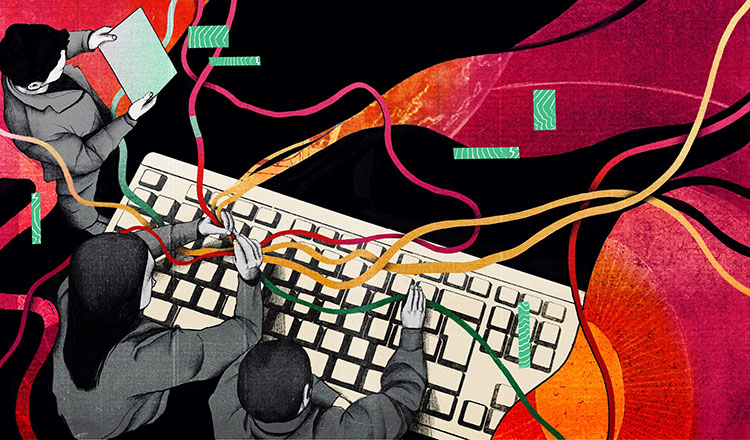 AI entrepreneurs claim artificial intelligence can achieve common prosperity and universal basic income by liberating productivity. Anna Sorokina/Technology Review
#opinion
“You AI guys are traitors to the codebase—you’ve already killed frontend, now you’re coming for backend …” That remark captures the growing unease among knowledge workers in a hyper-competitive work environment.
The GitHub project called “Colleague Skill” has recently gone viral in China. Users can feed a colleague’s chat logs, documents and work patterns into an AI agent that replicates the person’s professional skills—triggering fears of job replacement among workers.
Similar projects—such as Ex Skill, which attempts to recreate former romantic partners, and Zhang Xuefeng Skill, named after the education influencer who died suddenly in March at age 41—have amplified the buzz.
While Ex Skill echoes Black Mirror dystopias, Zhang Xuefeng Skill raises concerns about “cyber immortality”, privacy, and portrait rights of the deceased.
Yet it is Colleague Skill that provokes the deepest anxiety. It turns the abstract FOBO (fear of becoming obsolete) into a concrete threat of layoffs for knowledge workers.
To understand this anxiety, we can look to history.
In October 2025, Japan’s Content Overseas Distribution Association urged OpenAI to stop training its Sora 2 on unauthorised content.
The trigger was a ChatGPT update that allowed users to generate AI images in the artistic style of Hayao Miyazaki and Studio Ghibli. From the perspective of Colleague Skill, ChatGPT’s functionality could be essentially regarded as a form of “Hayao Miyazaki Skill”.
Many artists, musicians, and creators in other fields have been resisting the use of AI and trying to redefine what makes humans irreplaceable.
History has several examples of such transitions. During the Industrial Revolution, inventions such as the spinning jenny displaced textile weavers, who initially defended their artisan spirit against mechanisation.
Over time, most weavers eventually became machine operators. Rewind more than 2,000 years to ancient Greece, when the shift from oral tradition to written words provoked intense philosophical debates.
Philosophers such as Socrates and Plato favoured oral dialogue, viewing speech as a vivid, interactive, and genuine face-to-face exchange.
They argued that writing made people rely on external tools, weakened human memory and produced rigid words that could not respond to questions or avoid misunderstanding and abuse.
Viewed through this lens, the Colleague Skill controversy mirrors the speech-versus-writing clash. Writing represents the vast knowledge of former colleagues, as learnt by large AI models, and speech represents real-life colleagues who can talk and laugh. Even though AI has made one-person companies possible, a successful US entrepreneur said he wants to hire people because working alone is too “lonely”.
History suggests that while regulators may temporarily ban Colleague Skill to prevent mass unemployment and social instability, in the long run we will likely have to accept it as we have accepted writing, textile machines, and AI-generated content, along with their potential benefits.
In a market economy, their development appears to be a rational choice for business operators.
Does that mean we do nothing and allow this trend to spread unchecked?
In his short story, The Wages of Humanity, Liu Cixin, a highly influential Chinese sci-fi writer, presents an extreme thought experiment about capitalism: a single individual legally gains control of 99.99% of a planet’s resources and land, while the rest of humanity struggles to survive in extremely cramped spaces.
Even though many people—mostly AI entrepreneurs—claim that AI can achieve common prosperity and universal basic income (UBI) by liberating productivity, the first group of factory owners over 200 years ago likely made similar promises.
In reality, even without AI, the immense wealth and productivity generated since the Industrial Revolution could theoretically feed and shelter all people on Earth.
Yet today’s reality is that some own fortunes comparable to those of nations, while others still go hungry.
Under the existing socio-economic structure, one possible idea is to establish a new arrangement between data and labour.
Drawing inspiration from academia, where scholars cite one another to mark sources and respect intellectual contributions, AI systems trained on large-scale data should recognise and compensate human inputs.
Instead of banning the use of data, policymakers could explore how to mandate clear data attribution to recognise each contributor’s input both quantitatively and qualitatively. These contributions could then be turned into a recurring payment system based on the logic of intellectual property.
Of course, realising this vision would require a reliable, interconnected social system, strong supervisory and law enforcement agencies, and mutually restrictive mechanisms.
At this pivotal moment of AI-driven transformation, we must imagine and build alternative futures that prioritise public interest and future generations—above plausible efficiency or profit.
The author is Assistant Professor at Academy for Educational Development and Innovation in Education University of Hong Kong.
-Khmer Times-