Govt assesses Pentagonal Strategy implementation
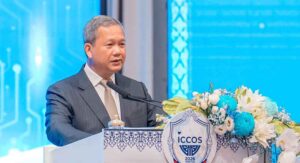
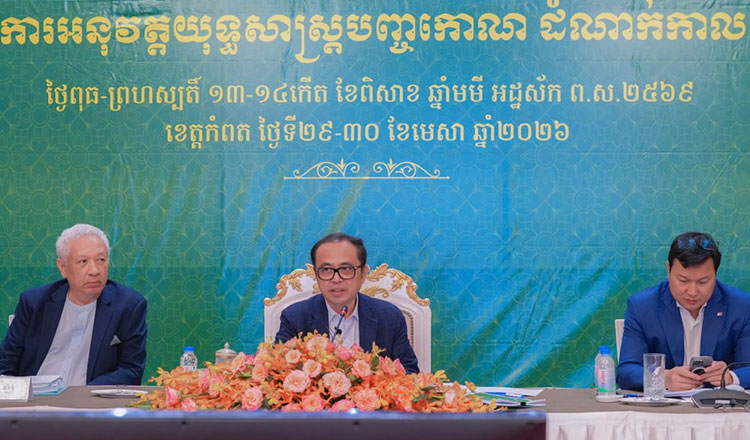 Vongsey Vissoth (centre), Permanent Deputy Prime Minister and Minister in charge of the Office of the Council of Ministers, chairs a meeting to review the progress of the Pentagonal Strategy–Phase One, in Kampot from April 29 to 30. OCM
Synopsis: Vissoth calls for stronger collaboration with development partners, experts, practitioners and stakeholders to improve the draft report for the benefit of the Royal Government and society.
The Office of the Council of Ministers (OCM) convened a two-day meeting to review the draft report on the implementation of the Pentagonal Strategy–Phase One (PS-P1), aiming to reinforce Cambodia’s economic resilience amid the ongoing border and Middle East conflicts driven global energy shocks.
The meeting was chaired by Vongsey Vissoth, Permanent Deputy Prime Minister and Minister in charge of OCM, in the presence of Chhem Kieth Rithy, Senior Minister and Chairman of the Economic, Social and Cultural Council (ECOSOCC) and Dith Tina, Minister of Agriculture, Forestry and Fisheries (MAFF), in Kampot from April 29 to 30.
Key participants included Hing Thoraxy, Permanent Secretary of State of OCM; Hean Sahib, Advisor to the Prime Minister and Secretary of State at the Ministry of Economy and Finance (MEF); and Ky Sereyvath, economist at the Royal Academy of Cambodia (RAC).
Addressing the meeting, Vissoth, also Chairman of the Committee to Monitor, Supervise and Evaluate the Implementation of PS-P1, said that the session was organised to summarise achievements, challenges, and priority directions ahead of the upcoming plenary meeting.
The Permanent Deputy Prime Minister encouraged participants to provide honest and constructive inputs on the overall assessment of PS-P1 implementation, as well as on the draft report for 2025, to ensure it reflects ground realities.
He said the report presents a comprehensive picture of the implementation of the first phase of the Five-Point Strategy, which forms part of the Royal Government’s socio-economic policy agenda.
“It also outlines progress across key sectors, major challenges, remaining gaps and strategic recommendations for the short and medium term, particularly for 2027 and 2028,” he noted.
Vissoth noted that in a rapidly changing and complex global environment, coupled with ongoing uncertainties affecting Cambodia’s economic outlook, a thorough review is required to ensure accuracy.
He continued that data constraints remain a key challenge, with some indicators not yet agreed upon or lacking baselines and targets, making it difficult to fully assess certain sectors.
The Permanent Deputy Prime Minister called for stronger collaboration with development partners, experts, practitioners and stakeholders to improve the draft report for the benefit of the Royal Government and society.
According to an OCM announcement, participants reviewed progress in the implementation of PS-P1, noting significant achievements across social, economic and environmental sectors.
These included security and social justice, poverty reduction, disaster management, public services, education, health, social protection, employment, investment, logistics, business environment, small and medium enterprises (SMEs) and agriculture, the statement added.
They also raised key challenges facing ministries and institutions, including weak inter-agency coordination, limited financial resources, insufficient statistical data and shortages of technically skilled officials.
The meeting noted that the monitoring and evaluation results serve as an essential foundation for the Royal Government, under the leadership of Prime Minister Hun Manet, to track progress and ensure accountability in the implementation of government policies, priority programmes and key measures.
In addition to monitoring and evaluation, Vissoth also highlighted the need to address key challenges affecting economic growth, including the prolonged Cambodia-Thailand border issue and the conflict in Iran, which has significantly disrupted fuel supply and prices.
He stressed the need to further strengthen internal capacity, improve policy responses and enhance implementation of key measures to build a resilient national economy capable of withstanding external pressures and global uncertainties.
Speaking to Khmer Times, economist Duch Darin said that successful PS-P1 implementation shows that political stability and sound public policy deliver concrete outcomes across the economy, driven by sustained reforms and coordinated development efforts across key sectors.
The improvements in public service delivery, agriculture, manufacturing, SMEs, investment and logistics indicate that deep reforms are enhancing the ease of doing business in Cambodia, thereby creating jobs and strengthening investor confidence for inclusive and sustainable economic development, he added.
-Khmer Times-