Angkor is not the past. It is our voice
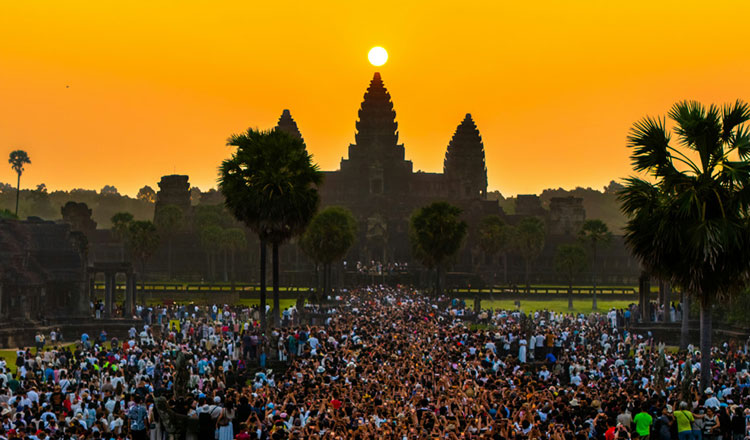 Thousands of tourists gather at the western entrance of Angkor Wat Temple to witness the Angkor Equinox between March 21 and 23. AKP
#opinion
We often speak of Angkor as if it belongs entirely to another time. A golden age. A distant achievement. Something we inherit, admire, and place carefully behind us.
That instinct is understandable, but it is also limiting.
Angkor is not behind us. It never has been.
The more difficult question is not what Angkor was, but what it continues to mean.
Over the years, a great deal of effort has gone into studying Angkor. Its kings have been identified, its temples measured, its inscriptions deciphered. We now know far more about its political structures, its religious life, and its urban organisation than earlier generations ever did. This work has been indispensable. It has given us a clearer sense of scale, of complexity, of achievement.
Yet knowledge, on its own, does not quite settle the matter.
A society may know its past in detail and still feel uncertain about itself. It may preserve monuments with great care, yet hesitate when asked what they truly represent. There is always a gap between what is known and what is understood. That gap is where meaning takes shape.
Angkor, first of all, is memory. It is there in the stone, in the bas-reliefs, in the vastness of the landscape shaped by human intention. But it is also present in quieter ways. In gestures, in rituals, in habits that have persisted without having to be explained. Even in the ordinary, there are traces of continuity.
For this reason, the idea that Angkor was somehow “lost” has never been fully convincing. Political centres shift. Forests reclaim space. But a civilisation rarely disappears in the way such language suggests. It lingers, often in forms that are less visible but no less real.
What has shifted, more profoundly, is the way Angkor is interpreted.
At different moments, especially during the colonial period, Angkor came to be described through frameworks that were not shaped here. We became accustomed to hearing that it had been rediscovered, that its significance had to be revealed from the outside. We also heard that its knowledge came from elsewhere, that its achievements were borrowed rather than produced.
These ideas did not impose themselves all at once. They settled gradually, almost quietly, until they began to feel natural. That is often how narratives take hold. Not through force, but through repetition.
And yet, when one steps back, something feels incomplete.
Angkor did not have to be rediscovered to exist. It remained part of lived reality, part of a civilisational memory that never entirely withdrew. Nor was Khmer civilisation merely receptive. It engaged, certainly, but engagement is not passivity. To take what comes from elsewhere and make it one’s own requires judgment, selection, and transformation. That, too, is a form of intellectual work.
Which brings us to the more delicate question. Who has the authority to interpret Angkor?
This is not only a scholarly issue. It is a cultural one. When interpretation consistently comes from outside, even with the best intentions, something subtle is displaced. A distance appears between a people and its own past.
Reclaiming that space does not mean rejecting scholarship or closing the door to others. It means recognising that interpretation is not neutral. It always carries a point of view. To participate in that process with one’s own voice is not an act of withdrawal. It is an act of presence.
Angkor, in that sense, is not only something to be studied. It is something through which a society comes to understand itself.
Once meaning begins to take shape, something else follows, almost naturally.
A civilisation that is at ease with its past carries itself differently. It does not need to insist. It does not need to exaggerate. There is a quiet confidence that comes from continuity that is understood rather than assumed.
Today, we often speak of “soft power.” The term is convenient, though perhaps too technical for what it tries to capture. At its core, it is simply the ability to be recognised on one’s own terms. To be understood without being translated into someone else’s language.
Angkor offers that possibility. Not because it is monumental, though it is, but because it contains a depth of meaning that can still be articulated. It speaks of a way of organising life, of relating to the world, of imagining order and balance.
But that voice is not automatic. It depends on how it is carried.
If Angkor remains only a memory, it risks becoming something static, preserved but distant. If it is interpreted without confidence, it risks being shaped by frameworks that do not quite fit. Only when memory is taken seriously as meaning does it begin to move outward, to become something that can be shared, even projected.
This is not about returning to the past. It is about recognising that the past has never fully left.
A society that cannot quite articulate where it comes from will often struggle, quietly, with where it is going. Not in dramatic ways, but in subtle ones. There is a hesitation, a sense of discontinuity.
On the other hand, when continuity is understood, even imperfectly, it provides a kind of grounding. It does not dictate the future but gives it context.
Angkor, for Cambodia, remains one of those points of grounding.
Not because it answers every question, but because it reminds us that we are not beginning from nothing.
In the end, the issue is not whether Angkor belongs to history. That is beyond doubt. The more interesting question is whether it is allowed to remain there, confined to a past that is observed but not fully inhabited.
What matters is whether Angkor is taken up as part of an ongoing conversation. Not only about what has been, but about what continues.
We inherited Angkor, certainly. But inheritance, by itself, is passive. What gives it life is interpretation.
And perhaps that is where responsibility begins.
Not simply to preserve what remains but to understand it well enough to speak through it, in our own terms, without hesitation.
Because Angkor, in the end, is not silent. It becomes silent only when we stop speaking for it. Angkor is the soul of the Khmer, past, present, and future.
Chhem Rethy, Distinguished Professor of AI and Humanities, CamTech University.
-Khmer Times-