How Phnom Penh Can Address Female Students’ Growing Demands for Safe and Inclusive Dorms
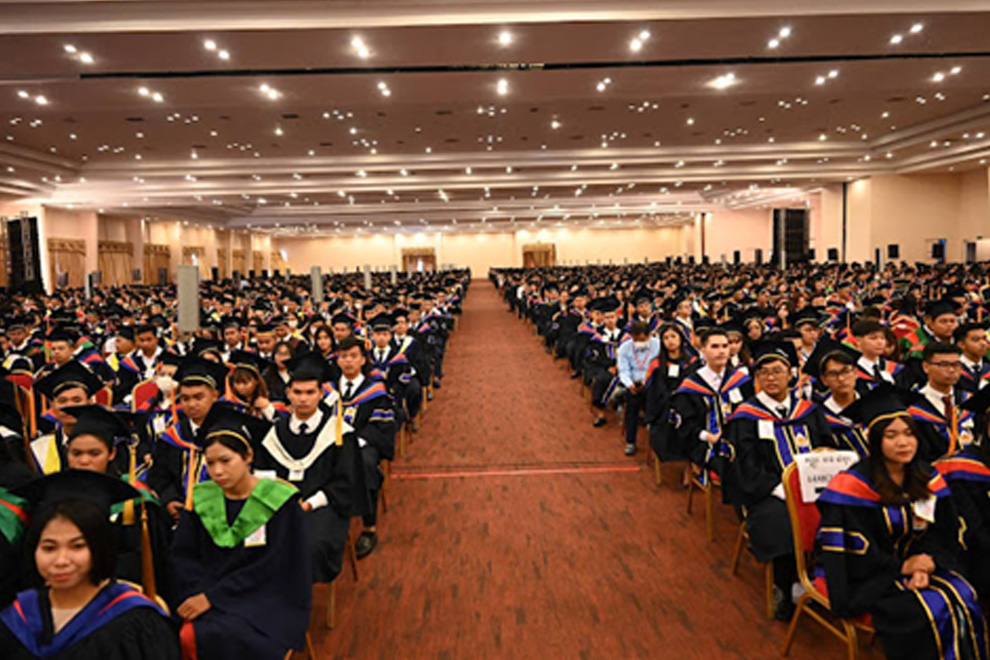 [A university graduation ceremony in recent years. Government Press Unit]
-Opinion-
In addition to serving as a hub for government and economic activities, Phnom Penh also serves as Cambodia’s education centre, with the highest concentration of educational institutions, training centres and professional opportunities. The capital city attracts a large number of students, both female and male, from across the Kingdom, who want access to higher education and better job prospects.
The migration of female students pursuing higher education in Phnom Penh increased significantly in the past five years since the setbacks caused by the Covid-19 pandemic.
Female students often face challenges in finding safe and affordable houses for living during their academic year in Phnom Penh. Existing dormitories in Phnom Penh aren’t sufficient when compared to the number of female students; they accommodate less than 800 every year. There is a serious need for safe, affordable female dormitory options for young female students in Phnom Penh. Many fresh graduate students experience financial strain and social vulnerability, but having a safe and caring dormitory to live in positively affects their academic development and overall well-being, thus reducing barriers for young women in pursuit of their studies in the capital.
Therefore, the government should take proactive measures to support and incentivise the development of female dormitories by investing in and facilitating public-private partnerships, which are necessary to support female students during their academic year.
Inadequate dormitory supply
Do the current female dormitories in Phnom Penh meet the demands of female students from the provinces in Cambodia?
Currently, Phnom Penh has fewer than 5 dormitory facilities specifically for female students, including those developed by the government, development partners (NGOs) and the university.
480 female students have access to the dormitory at the Royal University of Phnom Penh, with three out of seven dormitory buildings available to them, and the others reserved for male students and scholarship students from Laos, China and Vietnam. Annually, there are 120 spaces available for new students out of 300 applications to replace graduating seniors.
This year, a new female students’ dormitory, with a total investment of around $10 million by Somdech Hun Sen, Senate president, is under construction. Located in Sangkat Prek Leao, Khan Chroy Changva, Phnom Penh, the 126-room dormitory will be able to accommodate 500 students. It is expected to be completed within 17 months.
The Harpswell Foundation, a development partner focused on building leadership in young women, houses 70 students in two dormitories, but only accepts 15-20 new students each year.
These facilities accommodate fewer than 800 female students each year, far too few to support the numbers that relocate to Phnom Penh to pursue their higher education.
According to students from RUPP, without a dormitory, students at least spend $30 per month for a room, electricity and water, excluding daily spending. Other than the cost, however, finding safe and affordable housing is another concern for parents. These challenges put financial pressure on students, as the limited availability of dormitories forced them to seek costly alternative accommodation, which is a heavy concern for female students from lower-income families.
Limited awareness and dormitory information
To what extent does limited access to reliable information affect female students’ ability to find safe and affordable housing?
Besides the limited dormitory spaces, many young female students find themselves without reliable information channels or guidance on seeking options for lodging in Phnom Penh. Currently, there is no centralised platform or coordinated outreach to inform students and their families about existing dormitory. Because of that, many students rely on people, social networks or informal sources, which often provide incomplete or outdated information.
The gap in information is further exacerbated by the limited effort from public institutions and development organisations to promote or advertise the availability, eligibility criteria and application process for female dormitories.
Proposed Recommendation
In response to the increase in female students migrating to Phnom Penh for education, the government, in collaboration with relevant stakeholders and development partners, should invest in the construction of additional female student dormitories.
To implement the recommended action, the following must be considered:
Government Support and Facilitation.
Relevant governments, such as the Ministry of Women’s Affairs, the Ministry of Education, Youth and Sport, the Ministry of Land Management, Urban Planning and Construction, The Ministry of Economy and Finance and other relevant government institutions, hold an important role in creating a foundation for the sustainable development of female-only dormitories. Their support can be demonstrated in several key ways, particularly through the provision of tax incentives for NGOs or the private sector (such as private schools or real estate developers) that are willing to invest in or develop female-only dormitories in Phnom Penh.
Tax relief measures should be offered to non-government organisations, provide schools and support companies investing in the construction or operation of these dormitories. This might include eliminating import tax on materials needed for construction, a reduction in land leasing fees or deductions on corporate income tax for a stipulated timeframe. The offer of such incentives will encourage the development partners to come into what has usually been the domain of public services, thereby increasing the supply of dormitories.
Consider integrating dormitory construction into urban education and infrastructure development plans; it is important. The development of female dormitories should be firmly integrated into urban planning, where educationally induced migration is on the rise. Once dormitory construction is locked into the city development plans and integrated with education infrastructure (by taking into consideration the location near universities or public land or spaces that are left empty), the government can ensure future alignment with national objectives for access to education and housing policy.
Public-Private Partnership (PPP) Framework:
Another essential framework to mobilise the combined strengths of the government, civil society and private investors is Public-Private Partnership (PPP). This approach should begin with multi-stakeholder collaboration. It involves establishing formal frameworks that allow relevant ministries, local authorities and development partners to jointly finance, build and manage dormitory facilities.
These partnerships can help bridge funding gaps while maintaining quality and oversight. Additionally, incentive-based Co-Investment Schemes should be introduced. The government can offer matching grants or land space (return to the government in any specific period for land), while development partnerships and educational institutions may contribute to design principles or social services for residents. These partnerships ensure affordable rent, safety and a student-centred environment.
Awareness and Information Campaign:
In addition to that, a coordinated information campaign should be launched to ensure that students, especially those from rural areas, have access to accurate, comprehensive information about available accommodation options.
To facilitate this, relevant stakeholders should develop a centralised outline platform and maintain a user-friendly online portal that acts as a “Dormitory Directory” for female students. This platform should provide maps of dormitory locations in Phnom Penh and a clear view of the dormitory, including room availability and dorm space and safety or security ratings. It should also explain information on annual fees, the application process and dormitory rules. The platform must offer filters based on proximity to schools, accessibility features, or sponsor types (government/NGO/educational institution) and should allow application submission or inquiry directly through the platform. In addition to that, it should feature feedback and reviews from current or past residents.
To further enhance outreach, a multi-network outreach should be initiated by the government, in collaboration with stakeholder engagement, including development partners, school-based announcements, commune council and youth organisations. It could also disseminate information about available dormitories.
A government-managed data system should be established to supply and demand gaps in each urban zone, the number and type of dormitories available, occupancy rates and waitlist volumes, as well as student feedback mechanisms. This data could be used to improve management practices, address security and plan future dormitory locations.
Investment in female dormitories is a strategic and impactful solution to address the multifarious challenges that female students encounter while migrating for further education in Phnom Penh. Safe, affordable, accessible, and equitable housing would cause a significant long-term impact on empowering women inclusively in education and enhance academic performance since the students are able to focus more on their education. This initiative directly reduces their vulnerabilities to exploitation, to being taken advantage of or harassed, and to living in unsafe conditions. Further still, it fosters social equity, addressing gender gaps by ensuring that young women, regardless of their socio-economic standing, can equitably seek and pursue higher education in Phnom Penh. Last but not least, investing in female dormitories benefits not only the individual students but, more importantly, it contributes to a more inclusive, educated society.
Saly Mikavaty is a junior research fellow with Future Forum Cambodia. The views and opinions expressed are her own.
-The Phnom Penh Post-