From Commitment to Contradiction: Thailand Must Stop Delaying the JBC
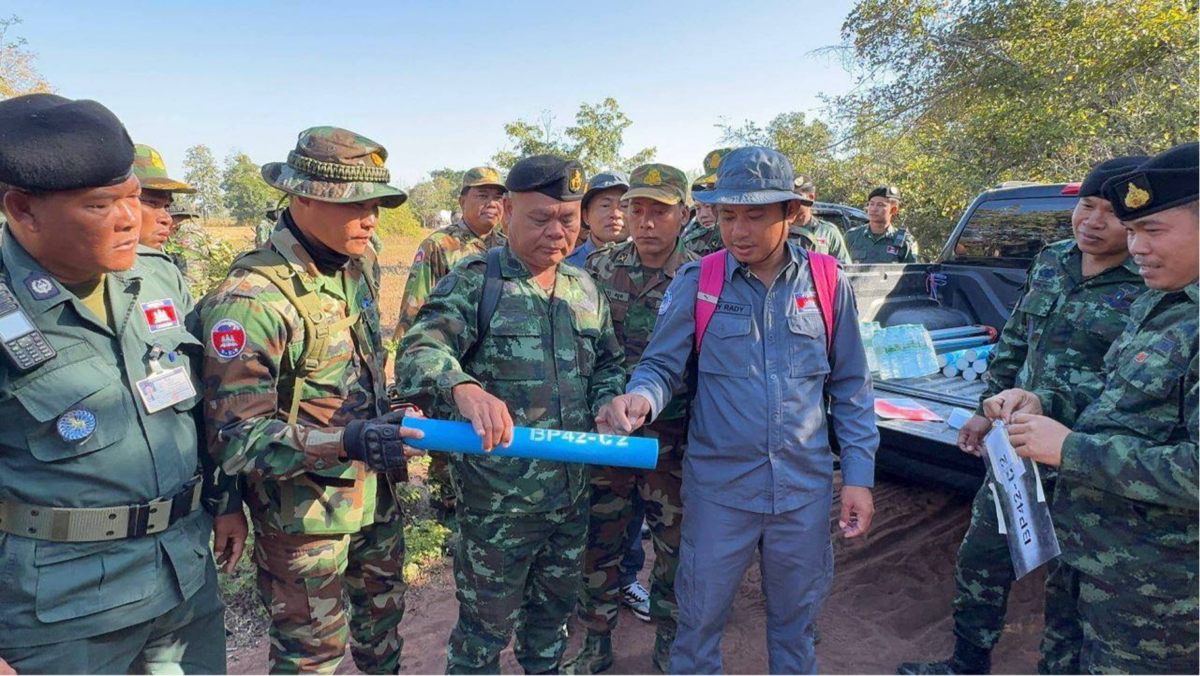 A joint Cambodian-Thai land survey team working together before the December clashes. Supplied
#opinion
In diplomacy, inconsistency is not a minor flaw — it is a liability. When a state makes formal commitments, especially before the UN Security Council, those words become obligations, not options.
Thailand has made not one, but two clear commitments to resolve its boundary issues with Cambodia through established bilateral mechanisms.
First, in the Joint Statement of 27 December 2025, both Cambodia and Thailand explicitly agreed — under Point 3 — to advance boundary resolution through existing mechanisms, including the Joint Boundary Commission (JBC). This was a mutual reaffirmation of trust: that both sides would rely on dialogue, technical processes and cooperation to move forward.
Second, in an official January 16 letter to the Security Council, Thailand went even further. It declared that it “remains firmly committed” to boundary survey and demarcation and that all matters “must be addressed” under the framework of the 2000 agreement via the JBC. It also pledged to resume JBC activities “at the earliest practical opportunity” following its general election on February 8.
Taken together, these are not vague diplomatic gestures. They are explicit, sequential commitments — bilateral and international — made within weeks of each other. And yet, today, Thailand is not acting on them.
Instead, statements from senior officials, including Sihasak Puangketkeow, suggest that Thailand is still “not ready” to convene the JBC, citing the need to finalise internal procedures after the formation of the new cabinet. This is where the contradiction becomes untenable.
Thailand cannot, on one hand, assure the international community that it will resume JBC activities at the “earliest practical opportunity”, while on the other hand indefinitely postponing that very process under the pretext of internal readiness. If “earliest practical opportunity” does not mean now — after elections have concluded and a Cabinet has been formed — then the phrase risks becoming meaningless.
Diplomatic language is not meant to obscure intent. It is meant to signal it.
The Memorandum of Understanding on the Survey and Demarcation of Land Boundary 2000 (MOU2000) provides a clear, agreed roadmap. The JBC is not a new proposal; it is a standing mechanism precisely designed to handle disputes like the current one. By reaffirming it in both the Joint Statement and the UNSC letter, Thailand acknowledged that this is the legitimate and preferred path forward.
So what, exactly, is the delay?
Internal administrative procedures cannot override international commitments. Governments are expected to maintain continuity in their external obligations, regardless of domestic political transitions. Otherwise, every election would become a convenient reset button for avoiding responsibility.
Even more concerning is the growing gap between Thailand’s procedural commitments and its political messaging. Efforts to shift attention toward unrelated issues — such as transnational scams — do not advance boundary demarcation. They complicate it. They risk turning a technical process into a politicised standoff.
Boundary issues are resolved through maps, surveys and negotiation — not narratives.
Cambodia has consistently signalled its readiness to proceed through the JBC. The framework is intact. The commitments are on record. The only missing element is Thailand’s willingness to act in accordance with its own word.
This is no longer a question of interpretation. It is a question of credibility.
If Thailand is serious about peace, it must demonstrate it not through statements, but through participation. That means convening the JBC without further delay, engaging constructively, and honouring both the December Joint Statement and the January commitment made before the Security Council.
Anything less risks sending a troubling message: that Thailand’s commitments are situational, its timelines flexible, and its assurances conditional.
In a region that depends on stability, predictability and mutual respect, that is a risk no responsible state should take. The path forward has already been agreed. Thailand should follow it.
Roth Santepheap is a geopolitical analyst based in Phnom Penh. The views and opinions expressed are his own.
-Phnom Penh Post-
———————