How France helped preserve Cambodia’s territorial integrity amid centuries of threat
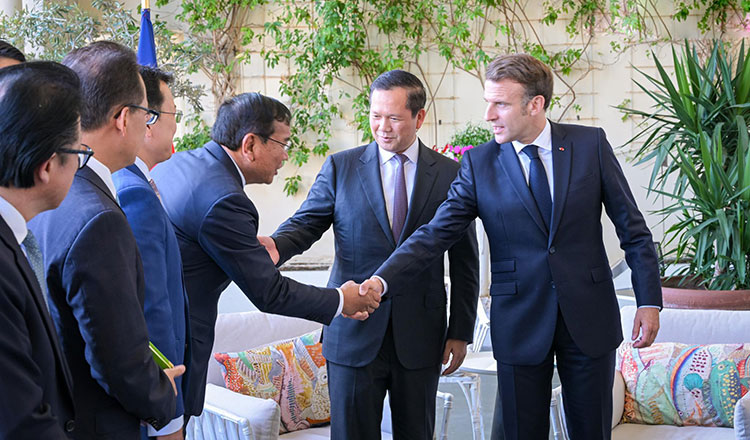 Prime Minister Hun Manet (2-R) introduces his cabinet members to French President Emmanuel Macron (R) in Nice, France. AKP
#opinion
As Cambodia again faced aggression along its border with Thailand in 2025, resulting in the tragic loss of Cambodian soldiers and heightened instability, it is worth reflecting on our nation’s turbulent history. Understanding the past is essential to not only grasp why these disputes persist but also to appreciate the pivotal role one nation played in safeguarding our survival as a sovereign entity.
For centuries, Cambodia found itself squeezed between two powerful neighbours. In 1795, Siamese forces seized the key western provinces of Battambang, Banteay Meanchey, Siem Reap, and Preah Vihear. Throughout the 19th century, Cambodia risked being partitioned between Vietnam in the east and Siam (Thailand) in the west. Both powers encroached on Khmer territory, vied for control of the Mekong River, and sought to deny Cambodia true independence.
It was in this moment of existential vulnerability that France stepped in. In 1863, King Norodom placed Cambodia under French protection. For nearly a century, until our independence in 1953, the French protectorate status served as a crucial shield. France helped prevent the complete dismemberment of Cambodian territory at a time when our kingdom was too weakened to defend itself alone. Cambodians today remain deeply grateful for this intervention, which preserved the core of our homeland and allowed our cultural heritage—including the magnificent temples of Angkor—to endure.
The French role went further. Between 1904 and 1907, France successfully negotiated with Siam for the return of Battambang, Banteay Meanchey, Siem Reap, and Preah Vihear provinces to Cambodian administration. French surveyors then began the formal demarcation of borders, a process that greatly displeased Siam but laid the foundation for modern territorial boundaries based on historical maps and legal principles.
This protection proved vital during the chaos of World War II. In 1940–1941, with Japanese backing, Siam once again invaded and retook western Khmer provinces. After Japan’s defeat in 1945, France demanded and secured the return of those territories—a stroke of fortune for Cambodia that reinforced our territorial claims.
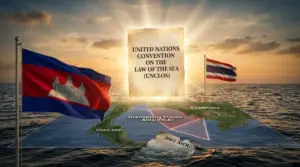
Cambodia finally achieved full independence on November 9, 1953. Yet challenges persisted. In 1954, Thai forces occupied Preah Vihear Temple. Cambodia brought the case to the International Court of Justice (ICJ) in 1959. In 1962, the ICJ ruled that the temple belongs to Cambodia, though the precise demarcation of surrounding areas remained incomplete—an ambiguity that continues to fuel tension today.
Subsequent events, including the temple’s designation as a UNESCO World Heritage Site in 2008, the ICJ’s clarifying ruling in 2013, and the clashes in 2025 involving gunfire and loss of life, all trace back to unresolved border segments, particularly the roughly 4.6 square kilometres around Preah Vihear and areas such as Ta Moan-Ta Krabei.
The recurring territorial disputes are often exacerbated by Thai domestic politics, where border nationalism becomes a tool for political rivals seeking advantage. Cambodia, for its part, has consistently advocated for peaceful resolution through respect for international law.
As we navigate these difficulties, Cambodia expresses profound gratitude to France. Without the French protectorate status, it is highly likely that large portions of our western territory— including Siem Reap and the Angkor region—would have been permanently lost. France’s diplomatic efforts and commitment to mapping and defending the borders gave the young Kingdom of Cambodia a fighting chance to emerge as an independent nation with its cultural heart intact.
Today, the path forward remains clear:
Respect international law: Fully demarcate borders with clear pillars in accordance with ICJ rulings and historical treaties;
Strengthen national unity: Cambodians must stand together, transcending political differences, to defend our sovereignty;
Build resilience: Enhance both economic strength and military capabilities so that no neighbor dares to encroach;
Forge international partnerships: Deepen alliances with friendly nations and multilateral institutions that uphold the rules-based order.
Our message is simple: If Cambodia is strong and united, others will respect our sovereignty. We must not allow ourselves to become political pawns in any neighbour’s internal games.
As we remember the sacrifices of the past and mourn recent losses, let us also honour the historical friendship with France—a nation whose protection in our hour of need helped ensure that Cambodia still stands today as a proud, sovereign kingdom with its ancient heritage preserved.
May wisdom, restraint, and adherence to international law guide all parties towards a lasting peaceful resolution. Cambodia seeks only what is rightfully ours and stands ready to develop neighbourly relations once borders are clearly and fairly settled.
The author is a policy analyst at Royal Academy of Cambodia. The views expressed are his own.
-Khmer Times-
—————-