The Architecture of Encroachment: Reassessing the Legal Response to Developments at Preah Vihear
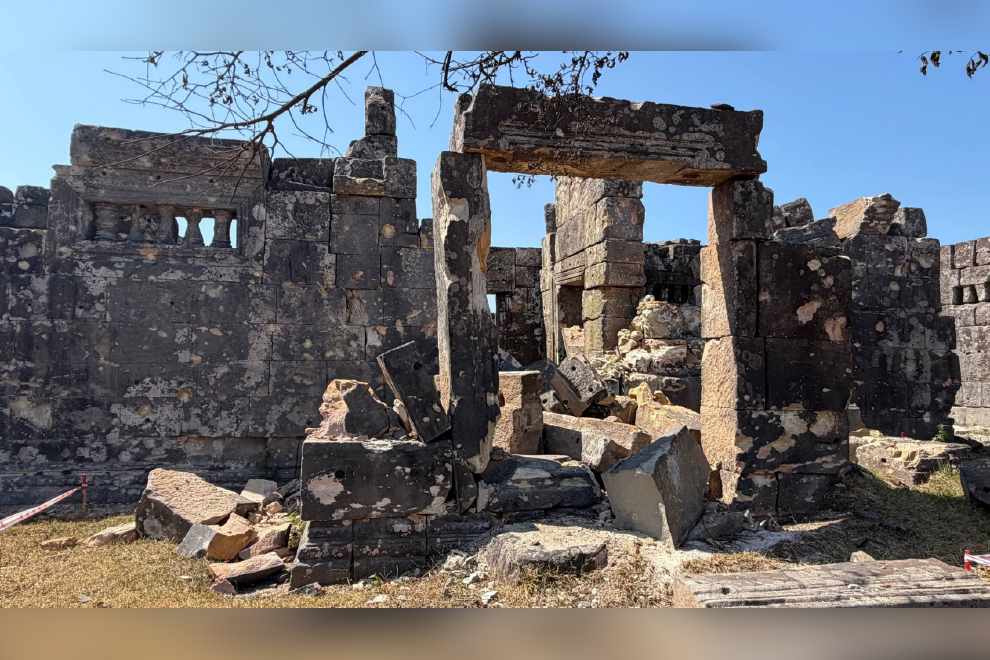 Damage to the Preah Vihear Temple that occurred during the December 2025 fighting. FB
Translating Judicial Title into Territorial Effect
I. Introduction: From Judicial Settlement to Operational Uncertainty
The diplomatic protest issued by Cambodia on March 13, concerning activities near the Preah Vihear promontory reflects a development of legal significance rather than mere bilateral friction. It raises a fundamental question in international adjudication: how far a judicial determination of sovereignty extends in practice when its spatial scope remains partially indeterminate.
The International Court of Justice (ICJ), in its 1962 Judgment, determined that sovereignty over the Temple of Preah Vihear lies with Cambodia. In its 2013 Judgment on Interpretation, the court clarified that this sovereignty extends to the promontory on which the temple is situated. These determinations are final and binding under international law.
However, the court did not undertake a comprehensive boundary delimitation. As a result, the precise spatial application of the terms “vicinity” and “promontory” remains open to interpretation in certain peripheral areas.
II. Recent Developments: Facts on the Ground and Legal Characterisation
Reported construction activities in early 2026 — including road development, guard posts and installations in areas adjacent to the promontory — introduce a new layer of complexity. From a legal perspective, such acts are not determinative of title. However, they are relevant insofar as they may affect the factual context within which legal rights are exercised.
International jurisprudence has long recognised that, in territorial disputes, effectivités — the display of state authority — may acquire evidentiary significance, particularly where legal title is contested or unclear. While the Preah Vihear case is not one of competing original title, the absence of precise delimitation creates a space in which factual developments may influence interpretation.
Accordingly, the current situation may be characterised not as a challenge to sovereignty per se, but as a divergence in the understanding of its spatial extent.
III. The Limits of Bilateral Mechanisms
The recurrence of tensions in early 2026, including incidents near the An Ses area, suggests that existing bilateral mechanisms have not fully resolved the underlying interpretive differences. In legal terms, the persistence of such differences may be sufficient to establish the existence of a dispute concerning the meaning and scope of a prior judgment.
Where a dispute of this nature arises, recourse to judicial clarification becomes not only available but, arguably, appropriate.
IV. Article 60: Interpretation as Continuation, Not Re-litigation
Article 60 of the ICJ Statute provides that, in the event of dispute as to the meaning or scope of a judgment, the Court shall construe it upon request of any party. This mechanism is distinct from contentious jurisdiction over new disputes; it operates within the court’s continuing authority over its own decisions.
For admissibility, the requesting state must demonstrate:
– The existence of a dispute regarding interpretation, and
– That the request does not seek to revise or reopen the original judgment
In the present context, a carefully framed request could invite the court to clarify whether specific areas affected by recent developments fall within the “vicinity” or “promontory” recognised in its 2013 Judgment.
Such an approach would not alter the court’s prior determination of sovereignty, but would seek to translate judicial language into operational clarity.
V. Provisional Measures: Preserving the Subject-Matter of the Dispute
Given the ongoing nature of physical developments, a request for interpretation may be complemented by an application for provisional measures under Article 41 of the Statute.
The court has consistently held that such measures may be indicated where:
– There is a risk of irreparable prejudice to rights, and
– There is urgency
In this instance, continued construction or alteration of the terrain could potentially affect the subject-matter of the dispute before the court has clarified its scope. Provisional measures would therefore serve to preserve the respective rights of the parties pending interpretation.
It bears emphasis that such measures do not prejudge the merits. Rather, they maintain the conditions necessary for the effective exercise of judicial function.
VI. Legal and Practical Considerations
Any recourse to the court necessarily involves both legal and practical considerations. The court may adopt a narrow approach to interpretation, limiting its clarification to what is strictly necessary. Questions of compliance also remain contingent on broader political dynamics.
Nonetheless, the alternative — continued reliance on diplomatic protest in the face of evolving factual circumstances — may allow interpretive uncertainty to persist. Over time, such uncertainty can complicate the implementation of otherwise settled legal determinations.
VII. Conclusion: Clarification as Consolidation
The present situation does not call for the reopening of the Preah Vihear case, but for its completion in functional terms.
A request for interpretation under Article 60, accompanied where appropriate by provisional measures under Article 41, would provide a structured legal avenue to clarify the spatial scope of the Court’s prior rulings and to preserve the integrity of the situation pending that clarification.
In this sense, judicial recourse is not an escalation, but a form of consolidation — ensuring that a binding determination of sovereignty is capable of effective application on the ground.
Where the meaning of a judgment remains uncertain at its margins, clarification is not merely desirable; it is integral to the stability of the legal order it was intended to establish.
Panhavuth Long is founder and attorney-at-law at Pan & Associates Law Firm. The views and opinions expressed are his own.
-Phnom Penh Post-