A turbulent, fragmented world
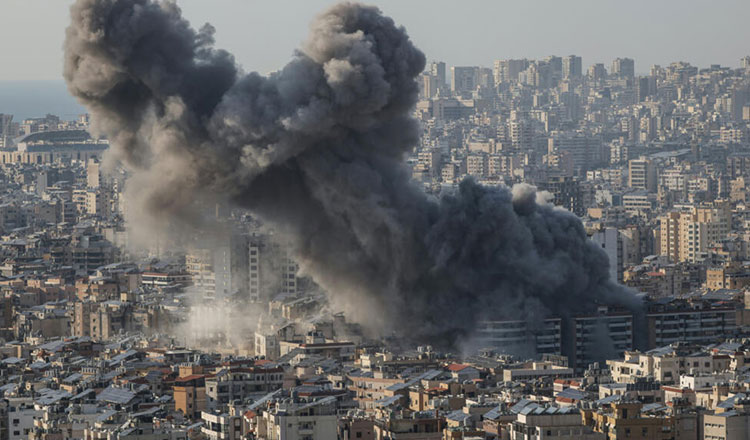 Smoke rises from an Israeli strike in the southern suburbs of Beirut as war breaks out in the Middle East on March 10. AFP
#opinion
For decades, policymakers debated when a “new world order” might arrive. The answer is, it is already here.
The world is entering a new phase—one defined by distributed power, contested legitimacy, competition, confrontation, and fragmentation.
Major power rivalry has returned, wars are reshaping regional security landscapes, and economic globalisation is being reconfigured by geopolitical competition.
For Southeast Asian countries, navigating this global power shift is a matter of survival.
End of Western monopoly
The most important structural change in international politics is the gradual redistribution of power away from the West towards a more diverse group of actors.
For nearly three decades after the Cold War, the United States enjoyed unmatched global influence. But the rapid rise of China, along with the growing economic and political weight of countries across Asia and the Global South, has altered the geopolitical landscape.
Some scholars describe this transformation as the emergence of a “multiplex world order”—a system in which authority is shared among multiple power centres and modernities.
In such an environment, global governance becomes more decentralised.
Asia sits at the centre of this transformation. The region accounts for more than half of global economic growth and hosts several of the world’s most important strategic flashpoints—from the South China Sea to the Taiwan Strait.
This means Asia will not simply adapt to the new world order. It will shape it.
The rules-based order under pressure
At the same time, the legitimacy of the rules-based international order is increasingly contested.
For decades, Western governments promoted the idea that global stability depended on adherence to shared rules and institutions. But critics argue that these rules have often been applied selectively, especially when major powers pursue their own strategic interests.
Military interventions, economic sanctions, and technological restrictions have raised questions about whether the global system truly operates according to universal principles—or whether it reflects the preferences of the most powerful states.
The result is not necessarily the disappearance of international rules but their renegotiation.
A world of strategic fragmentation
Another defining feature of the emerging order is the rise of strategic fragmentation.
Geopolitical competition increasingly takes indirect forms. Instead of direct military confrontation between major powers, rivalry unfolds through sanctions, cyber operations, technological competition, and proxy conflicts.
Recent tensions in the Middle East illustrate how regional conflicts can reverberate globally, affecting energy markets, shipping routes, and diplomatic alignments.
These dynamics reveal a world in which geopolitical pressure is exerted not only through military force but also through economic and technological leverage.
This shift reflects a broader transformation in globalisation itself.
For much of the past three decades, globalisation was driven primarily by efficiency and economic integration. Today, it is increasingly shaped by national security concerns and geopolitical consideration.
Supply chains are being reorganised, critical technologies are becoming strategic assets, and governments are pursuing industrial policies aimed at reducing dependence on geopolitical rivals.
The emerging system is therefore not a retreat from globalisation—but a geopolitically structured globalisation.
China’s rise and reshaping of global governance
China’s growing influence is one of the central forces driving this global power transformation.
Over the past four decades, China has emerged as a technological, economic, and geopolitical powerhouse through its expanding role in infrastructure development, global trade, international payment system, and international institutions.
Yet China’s rise does not necessarily imply the replacement of the existing international order. In many areas, Beijing appears more interested in reshaping global governance than in dismantling it entirely.
This means the future world order may not be defined by a single dominant power. Instead, it may involve a complex balance between multiple major actors—including the United States, China, and influential regional powers.
Why Southeast Asia matters
For Southeast Asia, the emergence of a more decentralised global order presents both risks and opportunities.
The region sits at the intersection of competing geopolitical interests. It is economically integrated with China, strategically linked to the United States, and increasingly connected to other emerging powers in the Global South.
Rather than choosing sides, many Southeast Asian states have adopted a strategy of strategic hedging—maintaining strong relationships with multiple partners while preserving diplomatic flexibility.
Regional institutions such as ASEAN will therefore become even more important. In a fragmented world, ASEAN’s role as a platform for dialogue and confidence-building may help prevent regional rivalries from escalating into open conflict.
But this will require ASEAN to strengthen its cohesion and strategic relevance.
Managing the transition
Periods of global transition are rarely smooth. History shows that shifts in the balance of power often produce instability before a new equilibrium emerges.
Today’s international system is entering such a transition. Economic competition, technological rivalry, and geopolitical tensions are reshaping global politics.
Yet the future is not predetermined.
The new world order is already taking shape. The question now is whether global leaders—and especially those in Asia—can manage this transition in ways that preserve stability and cooperation.
For Asia, the stakes could not be higher.
The region’s prosperity has been built on open trade, relative peace, and predictable international rules. Ensuring that these foundations endure in a changing world will require statecraft, diplomatic skill, and a renewed commitment to regional cooperation and rules-based international order.
In the emerging global order, Asia is one of the principal architects of the system that comes next.
Chheang Vannarith is Chairman of the National Assembly Advisory Council. The views expressed are his own.
-Khmer Times-
—————-