Reclaiming Cambodia’s soul from scourge of scams and unregulated betting
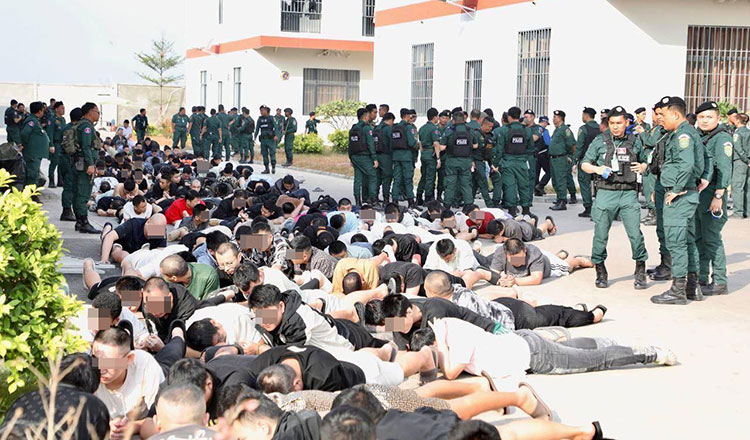 National Police crack down on online scams in Bavet City, Svay Rieng province, arresting more than 2,000 foreigners in January. Anti-Cyber Crime Department
#opinion
In his recent interview with international media, Prime Minister Hun Manet spoke with rare candour and moral clarity. Scam centres, he declared, constitute a “black economy” that is “destroying our honest economy” and tarnishing Cambodia’s name, driving away tourists and legitimate investors alike. For this lucidity, and for his government’s perseverance in confronting what many once treated as an untouchable cash cow, the Prime Minister deserves the nation’s gratitude and the world’s respect. Yet acknowledgement is only the beginning. The moment demands not slogans, but a realistic yet courageous strategy—one that refuses both naive denial and cynical surrender.
The picture before us is stark, yet not without hope. Cambodia has, tragically, become a global hub for cyber-scam empires built on human trafficking, torture and forced labour. Recent reports confirm the arrival of victims from Latin America alongside those from Africa, South Asia and beyond—young men and women lured by false job promises, only to find themselves imprisoned behind barbed wire, beaten for failing scam quotas, and sometimes killed when they try to escape. Lives are not merely disrupted; they are shattered. Families across continents mourn sons and daughters who may never return. The abandoned high-rises of Sihanoukville and Koh Kong, once symbols of reckless boom, now stand as monuments to moral failure—and yet construction crews are already moving back in. After Khmer New Year, the towers may roar back to life unless we act with wisdom and resolve.
We must face three hard truths and build three pillars of genuine reform.
First, the entertainment and betting industry is here to stay. Cambodia’s tropical paradise and strategic location guarantee it. French colonial planners understood this when they built the Bokor Palace Hotel and its casino on the cool heights of Bokor Mountain in the 1920s and 1930s. The grand old building still whispers of an earlier, more elegant era of leisure. Empty casinos will not remain empty for long; human nature and geography ensure demand. The question is not whether gambling and entertainment will exist, but what identity we choose to give them: the lawless shadows of Gotham City, where crime and fear rule the night, or the tightly regulated, tax-paying elegance of Macau? Let us choose Macau—or better, a distinctly Cambodian model of responsible enjoyment that honours our Buddhist heritage of moderation and our Christian call to human dignity.
Second, we must wage a smarter offensive against the metastasised cancer of online scamming that has already spread from Cambodia to Sri Lanka, Armenia, Georgia and beyond. Dispersing the problem across borders may dilute the stigma attached to any single nation, but it does not make the evil acceptable. Concrete measures are required. Stronger control demands a more limited footprint. Casinos and large entertainment complexes should be confined to designated border and coastal provinces—Sihanoukville, Koh Kong, and a handful of others—where geography and logistics allow effective oversight. Scattering them nationwide only invites evasion and corruption.
We must deepen international cooperation with Chinese, Indonesian and American law enforcement agencies to dismantle transnational syndicates such as those once led by figures like Chen Zhi, whose recent extradition marked an important victory. At the same time, we must reconsider the legal framework itself. History teaches humility: hunting has been illegal in Cambodia since the 1950s, yet poaching remains rampant. Blanket prohibition of online casinos has likewise driven the industry underground, where it generates no tax revenue and breeds deeper corruption. Saint Augustine, writing in the fourth century, warned public officials against the delusion that every vice can be eradicated by decree. Some evils, like prostitution in his day, he argued, are better strictly regulated and taxed than pushed into the shadows where they fester and corrupt everything around them. Let us apply that ancient wisdom: create a transparent, heavily monitored, revenue-generating legal framework for licensed entertainment. The alternative—pushing the entire sector into illegality—enriches criminals, not the Cambodian people.
Third, we cannot heal without a healthy civil society. The scam industry has exposed tens of thousands to danger, torture and death. Investigative journalists who dare to expose these horrors, and NGOs such as A21 and Caritas that rescue victims and fight trafficking, must be praised and protected, not threatened or silenced. Education is equally vital: our schools must teach young Cambodians the seductive dangers of this industry before they fall prey to false promises of easy wealth. Religious institutions—from village pagodas to Catholic churches—have a prophetic role to play. We must speak with one voice: Cambodia can and must be a place where all may enjoy life’s legitimate pleasures, but never at the cost of another’s freedom or dignity.
The road ahead is neither easy nor short. Yet hope is real. The government has already shut down hundreds of scam compounds and deported thousands of suspects. International pressure is mounting, and Cambodian public opinion is awakening. If we combine the Prime Minister’s perseverance with honest realism—limited zones, strict regulation, robust law-enforcement cooperation, and an empowered civil society—we can transform a national shame into a model of courageous reform.
Cambodia’s future need not be defined by the screams behind compound walls or the empty glare of unfinished towers. It can be defined by a people who, having stared into the abyss, chose light.
Let us choose courage. Let us choose realism. Let us choose a Cambodia worthy of our children and the world’s respect.
Father Will Conquer is a Catholic priest serving in Phnom Penh and a longtime observer of Cambodia’s social and economic development.
-Khmer Times-
—————-