World NGO Day 2026: An Inflection Point for Our Sector and a Call to Build What Comes Next
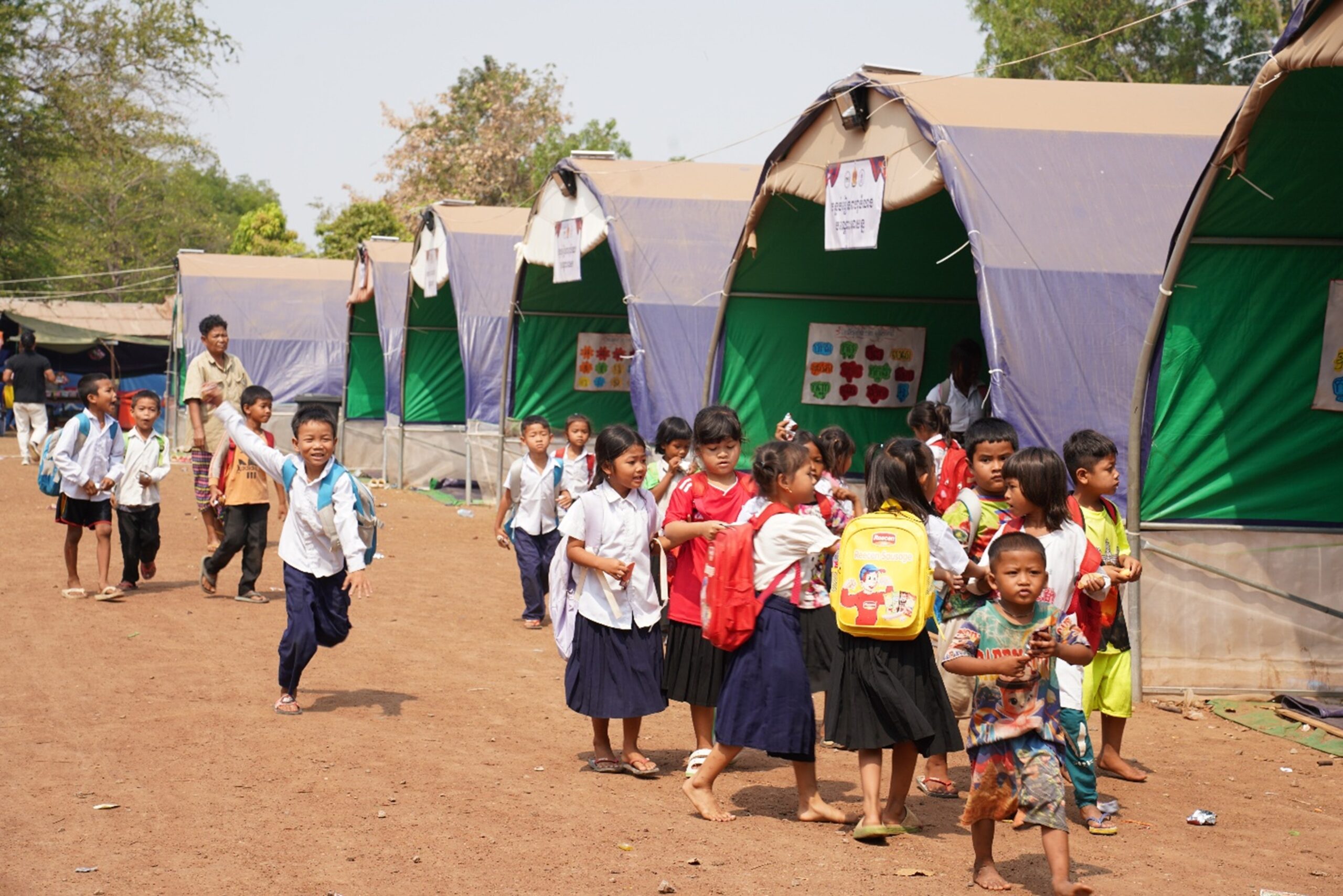 Displaced children from Banteay Meanchey province’s Chouk Chey and Prey Chan villages study at temporary classrooms at the Wat Chan Si shelter. Hong Raksmey
#opinion
World NGO Day has often been a moment for celebration, an opportunity to recognise the role of civil society in responding to crises, advancing development and standing alongside communities in the long work of change. This year feels different. World NGO Day 2026 arrives not as a routine milestone, but as an inflection point.
Across our sector, conversations have shifted. Instead of familiar talking points, leaders are asking harder questions: What is still working? What is no longer fit for purpose? And what must change if NGOs are to remain credible partners for communities and governments in the decade ahead?
The past year has brought contraction in the global development landscape at a pace few anticipated. Funding has tightened. Organisations have restructured. Long‑standing assumptions about how aid is financed, coordinated and delivered are being tested. At the same time, reform discussions across the multilateral system signal something deeper: the architecture of global cooperation is being re‑examined. The era of “business as usual” is ending.
For NGOs, this is not simply a financial or operational challenge. It is a question of relevance. Our legitimacy will not be determined by the number of projects we manage or the speed of our response when the next emergency hits. The clarity of our values will determine it, the rigor of our impact and our ability to help shape systems that can withstand increasingly frequent and complex shocks.
East Asia offers a clear lens on why this shift matters.
The region is economically dynamic and technologically capable, yet increasingly exposed to climate volatility and widening inequality. Severe flooding across Southeast Asia, prolonged drought, extreme winter shocks in Mongolia and rapid urban displacement in major cities point to a common reality: risks are compounding. They rarely arrive one at a time, and they do not fit neatly into traditional categories of “humanitarian” versus “development”.
A flood is no longer an emergency. It is also a climate resilience stress test, a social protection failure and a development setback. A drought is not just an agricultural issue; it can also drive migration, pose a child protection concern and create long-term economic fragility. When risks compound, fragmented approaches leave communities exposed, and institutions perpetually playing catch up.
This is where the traditional aid model is showing its limits. The system has delivered meaningful progress over decades, and that should be acknowledged. But the fragmentation embedded in the old architecture, separating relief from resilience, climate adaptation from development, short‑term response from systems strengthening, has become increasingly misaligned with reality.
The good news is that the system is already in motion. Financing mechanisms are evolving. Coordination models are under review. There is growing recognition that reactive approaches are not only socially costly but also economically inefficient in a world defined by climate disruption and recurring crises. NGOs now face a choice: defend inherited structures, or help build what replaces them.
In East Asia, that choice is immediate and practical. Over the past year, many organisations, including ours, have strengthened efforts to link anticipatory action with long‑term development so predictable climate patterns do not become humanitarian emergencies. We are working to connect social protection systems with emergency response better, helping families avoid sliding into long‑term poverty after a single shock. We are investing in locally led innovation because resilience is most effective when solutions are closest to the communities they serve.
Redesigning systems, however, is not only technical work. It is political and relational. NGOs cannot remain only implementers. We must increasingly act as conveners, bringing governments, civil society, faith actors, regional institutions and the private sector into more coherent collaboration focused on outcomes that reduce risk and protect children. It also requires discipline. Remaining relevant as an NGO in 2026 means prioritising impact over expansion, integration over fragmentation and long‑term resilience over short‑term visibility. Not everything can be scaled. Not every initiative should continue.
World NGO Day 2026 invites a different kind of reflection, not simply on what we have achieved, but on whether our work is strengthening institutions and systems for an increasingly uncertain future. East Asia does not sit at the centre of every global shift, but it clearly reflects the realities reshaping our work. The direction we take now will determine whether civil society remains a trusted and relevant force in the years ahead.
Teresa “Terry” Ferrari is regional leader for World Vision East Asia. The views and opinions expressed are her own.
-Phnom Penh Post-
———————