Fear lingers as people return to UXO-contaminated villages
 Fear lingers as people return to UXO-contaminated villages
#National
Synopsis: Thousands of displaced residents of Banteay Meanchey return home following the December ceasefire between Cambodia and Thailand amid a lurking fear of unexploded remnants of war.
Guns have fallen silent, markets have reopened and thousands of displaced families are returning home. But across the scarred villages of Cambodia’s northwestern border, fear lies under the soil.
In Kok Khang Lech and Yeang Thmey villages in O’Chrov district, those who fled December’s cross-border clashes are slowly rebuilding their lives—under the shadow of unexploded ordnance (UXO), especially cluster munitions.
The Thai army has admitted that during the five-day border conflict in July, it used white phosphorus (WP) shells and cluster munitions—condemned by Cambodia for its long-term effects on civilians.
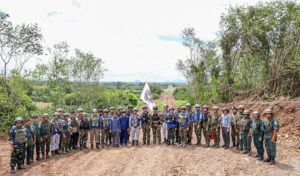
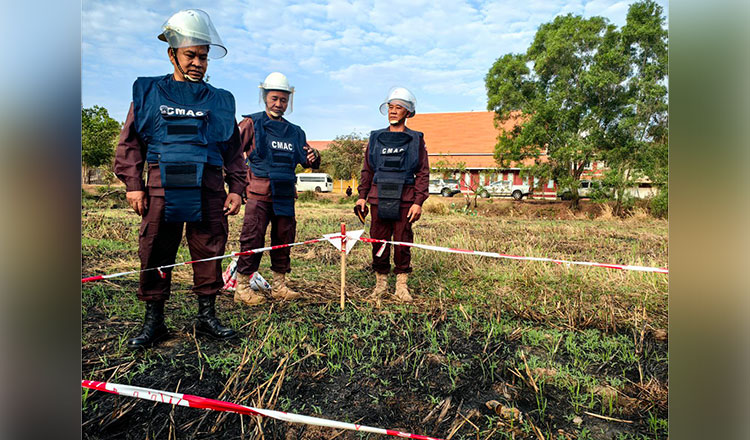
Head of Demining Unit 1 of the Cambodian Mine Action Centre (CMAC) Lieutenant General Neth Ratha, who is based in Banteay Meanchey, said his team has completed a survey of affected areas following what Cambodian authorities describe as Thai military incursions.
Between December 28, 2025 and January 31, 2026, CMAC surveyed more than 2,500 locations across the province. The teams collected 133 surface munitions and identified 138 sites containing buried unexploded devices.
“The total area affected by these munitions amounts to 35,161 hectares,” Lt Gen Ratha told Khmer Times. “Our survey prioritised the most dangerous ordnance, including cluster bombs, drone-dropped explosives and mortar shells.”
Preliminary assessments have identified at least 120 unexploded cluster bomblets scattered across the province so far. Many are believed to be M85-type submunitions designed to disperse over wide areas and detonate on impact—but which often fail to explode, leaving lethal remnants behind.
“These unexploded cluster munitions are extremely dangerous and were found in civilian areas,” he warned. “They pose immediate and long-term risks, particularly to children and farmers.”
He asked residents not to touch any suspicious objects and to report them immediately to local authorities or the nearest CMAC office.
“Do not handle any UXO you encounter. Your safety is our priority,” he said.
Villages Living in Fear
Hem Hek, 67, a resident of Kok Khang Lech village, returned home after staying at Wat Koh Char refugee camp.
“I left my village at 3pm on December. The ceasefire was the next day,” she recalled. “We are worried my three children might play near the cluster munitions. We cannot even check our rice bags without fear.”
Her wooden house was heavily damaged. Unexploded submunitions were visible just metres from the front and sides of her home.
Sim En, 62, who lives with six family members, said they had no choice but to flee when shelling intensified.
“When we evacuated, we had to sell our cow for $250,” he said. “We left everything behind because we were afraid. We just want peace.”
In Yeang Thmey village, similar scenes unfold. Residents describe farmland dotted with metal fragments and unexploded devices.
Duong Srey Pich, 32, said her home was hit on December 26.
“If we had not left, we would have faced extreme danger,” she said. “There were no soldiers here. We live far from the border. Cluster munitions were scattered throughout our home and surrounding areas. We are constantly living in fear.”
CMAC said that from early to late December, at least 121 villages across eight districts in Banteay Meanchey were affected by artillery shells and aerially dropped ordnance.
Displacement on a Massive Scale
According to the Ministry of Interior, more than 640,000 Cambodians were displaced during the fighting. Since the ceasefire, about 550,000—roughly 85 percent—have returned home. However, nearly 97,900 people remain in displacement camps, including over 51,000 women and 31,000 children.
Essential services remain disrupted. Several schools and health centres in Banteay Meanchey and neighbouring provinces have yet to reopen due to security concerns and infrastructure damage.
Nearly 1,000 houses, along with dozens of businesses, vehicles and public facilities, were damaged. Schools, pagodas, bridges and electricity infrastructure were also affected.
Senior Minister Ly Thuch, Vice-President of the Cambodian Mine Action and Victim Assistance Authority (CMAA), has drawn international attention to the use of cluster munitions in civilian areas, raising concerns under the 2008 Convention on Cluster Munitions.
Thailand is not a signatory to the convention. The Royal Thai Army has acknowledged using 155mm projectiles containing M46 submunitions against what it described as specific military targets.
Cambodian authorities, however, argue that civilian areas were hit, resulting in widespread contamination and displacement.
“I Came Empty-Handed”
For many refugees, the pain of displacement goes beyond damaged homes.
Chang Saroeun, 61, from Mean Rith village in Thmar Pouk district of Banteay Meanchey province, said she fled leaving everything behind. “I had to ask a neighbour for a motorbike ride,” she said.
“We didn’t even bring pots or plates.”
She had raised 12 cows for decades. When she returned, they were gone. “Raising cows was the only way I supported myself. Now there is nothing left,” she said quietly.
Meas Tan, 68, also from Mean Rith village, said her house is now surrounded by barbed wire.
“My children tried to go back to get clothes and ID cards. Some could go in, but one of my children couldn’t,” she said. “All our things are still there, but I don’t know how to get them.”
She suffers from high blood pressure, and worries about access to medical care. “I just want to go home and live peacefully,” she said. “I miss my home every night.”
The Long Road to Recovery
For deminers, the work ahead is daunting. Clearing 35,000 hectares of contaminated land in the province, will take time, resources and sustained support.
CMAC teams are conducting emergency clearance operations and risk education campaigns in affected communities. Public awareness sessions are being held in villages and displacement camps to warn residents — especially children — about the dangers of handling unfamiliar metal objects.
Despite the ceasefire, authorities say they remain vigilant. The Ministry of Interior has reiterated that Cambodia will not compromise on sovereignty and has called for border issues to be resolved in accordance with international law.
The ceasefire on December 28, 2025, may have ended open conflict, but for the people of Banteay Meanchey, the remnants of war remain—silent, unseen and waiting beneath the soil.
For villagers in O’Chrov district and beyond, however, politics feels distant. Their immediate concern is survival. Each step into a rice field, each child’s game in a courtyard, carries an unspoken question: Is it safe?
As Hem Hek stood outside her damaged home, she pointed at the patch of land where deminers had recently removed a cluster bomblet. “We are grateful they came,” she said. “I hope life will turn to normal again soon.”
-Khmer Times-