US lifts weapons sale restrictions on Cambodia, marking new chapter in bilateral ties
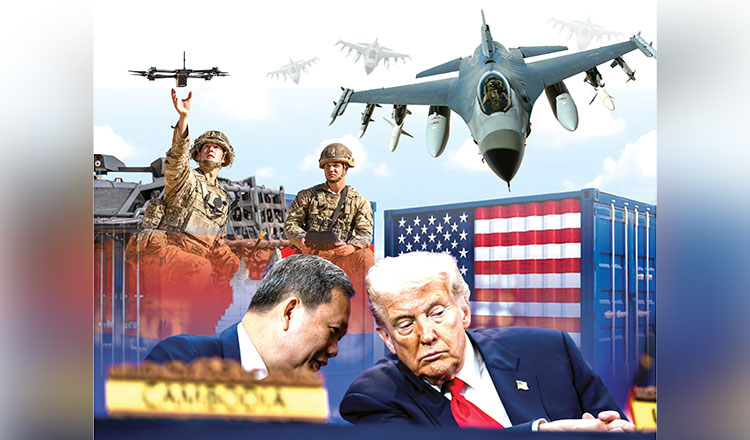 Montage of Prime Minister Hun Manet and US President Donald Trump in Kuala Lumpur on October 26, 2025; (Top right) a US fighter jet; (Top left) American soldiers with a drone at Fort Irwin, California. White House/US Army/Khmer Times
#National
Synopsis: Washington’s removal of Phnom Penh from its arms embargo signals renewed trust, deepening defence cooperation and opening up opportunities for US-Cambodia security, trade and diplomatic engagement.
In a landmark move, the US Department of Commerce officially removed Cambodia from its arms sale blacklist on Tuesday, signalling a significant thaw in military relations.
The change came after the Bureau of Industry and Security (BIS) updated the Federal Register to remove Cambodia from “Country Group D:5”, a classification that had previously limited arms exports to the Kingdom.
The decision follows an assessment by the US Secretary of State, who noted Cambodia’s active pursuit of regional peace and security, continued defence cooperation with the United States, and efforts to combat cross-border crime. The measure aligns with the White House’s prior action in October, when it lifted the ban on arms sales to Cambodia.
“On November 7, 2025, the Department of State published a final rule, ‘International Traffic in Arms Regulations: Changes to Section 126.1’, that removed Cambodia as an arms embargoed destination under the International Traffic in Arms Regulations (ITAR), pursuant to a determination made by the Secretary of State,” the BIS statement said.
“Consistent with this change, Cambodia was effectively removed from Country Group D:5. Specifically, the Note to Country Group D:5 in supplement no. 1 to part 740 states that if there are any discrepancies between the list of countries in Country Group D:5 and the countries identified by the State Department as subject to a US arms embargo, the State Department’s list shall be controlling.”
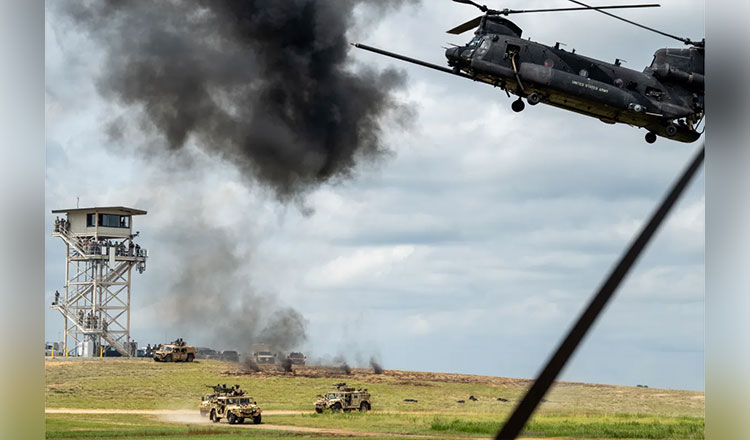
Under the new rule, the “X” designation next to Cambodia in Group D:5 has been removed, effectively ending the majority of US arms-related restrictions from February 3. Experts estimate that the update could raise the number of licence applications for shipments to Cambodia by roughly 100 per year, streamlining previously complex export procedures.
However, for national security reasons, Cambodia remains in “Country Group D:1”, which requires licensing controls for certain military and defence-related technologies under Export Administration Regulations (EAR) Sections 744.21 and 744.22.
The latest move bodes well for trust and cooperation between the two countries on military matters. The removal of the arms embargo opens the way for Cambodia to purchase advanced American technologies.
American Chamber of Commerce in Cambodia President Casey Barnett welcomed the development, calling it a major turning point in US-Cambodia relations.
“This move is a significant symbol of US trust in Cambodia and reflects cooperation between the two countries on military matters. The removal of the arms embargo opens the way for Cambodia to purchase advanced American technologies,” he wrote on Facebook on Wednesday.
Barnett said he was in Singapore to meet US aviation and defence companies to encourage them to sell their products to Cambodia to boost its security and economy.
The US market remains a strong and reliable foundation for Cambodian economic growth and a source of steady income for the Cambodian people even amid the 2025 Thai invasion of Cambodia, he said.
“In 2025, Cambodian exports to the US surged by 28% to $12.7 billion. Notable increases included footwear exports, which rose 52% to $869 million, and tyre exports, which climbed 45% to $1.1 billion. Cambodia also expanded shipments of vehicle parts and rolled steel products, reflecting diversification in its manufacturing sector,” he wrote.
However, electrical equipment exports declined, primarily due to the discontinuation of solar panel shipments following US penalties for transhipment from China, Barnett noted.
“Seasonally, Cambodian exports to the US typically drop in the fourth quarter, as American retailers stockpile garments in the third quarter to prepare for back-to-school and holiday sales,” he added.
“For over 26 years, the US has been a dependable source of revenue for Cambodia. Currently, the US awaits ratification of the October 2025 reciprocal trade agreement by the Cambodian National Assembly.”
The United States has a taken central role in guaranteeing the ceasefire between Cambodia and Thailand following months of border tensions, with senior American officials leading behind-the-scenes diplomacy, facilitating peace negotiations, and committing millions of dollars to post-conflict stabilisation.
The diplomatic push culminated on October 26, when Prime Minister Hun Manet and his Thai counterpart Anutin Charnvirakul signed a joint declaration for peace, witnessed by US President Donald Trump and Malaysian Prime Minister Anwar Ibrahim on the sidelines of an ASEAN summit in Kuala Lumpur.
The new challenges emerged soon after, with fighting resuming in December. Despite this setback, US officials remained engaged behind the scenes to restore calm. The renewed ceasefire was eventually secured following an ASEAN foreign ministers’ meeting convened by Malaysia on December 22 and subsequent engagement through the Cambodia-Thailand General Border Committee. Peace was re-established on December 27.
President Trump has engaged Cambodian and Thai leaders at least six times in recent months to ensure the ceasefire holds, signalling Washington’s sustained political involvement in the process.
The US is also giving financial commitments, $45 million to be specific, to reinforce stability along the border and address humanitarian consequences of the conflict.
Dean of the Faculty of Social Sciences and International Relations at Paññāsāstra University of Cambodia, Kevin Nauen pointed out that while the July 28 preliminary ceasefire, which froze the conflict and gave Malaysia—then ASEAN chair—a chance to set some groundwork for a long-term peace, the Putrajaya ceasefire was a “fragile” one.
“It required the US to continue to apply pressure as the guarantor for peace, in the form of holding out these economic carrot-and-stick options,” he noted. “And the rhetorical pressure on the two parties was backed up with the suspension of bilateral trade talks in December. So it was that continual application of the carrot-and-stick approach which allowed this to unfold over time.”
Experts, meanwhile, point out that the new context presents a golden opportunity for enhancing US-Cambodia bilateral ties.
Youk Chhang, Director of the Documentation Centre of Cambodia, said the removal of Cambodia from the US arms export blacklist is a welcome news in the steadily increasing engagement between Cambodia and the U.S.
“Let’s hope that the two countries continue to build trust and mutual cooperation,” he stated.
Pou Sothirak, a retired academic and Distinguished Senior Advisor at the Cambodia Centre for Regional Studies (CCRS), stressed that Cambodia and the US have now entered a new context that offers an opportunity to move beyond the old narrative of alignment and dependency towards one based on transparency to respect and share strategic interests.
Sothirak said both sides have much to gain from a pragmatic, trust-centred approach rooted in tangible outcomes.
“Cambodia’s geography gives it strategic importance regionally. It sits at the heart of the mainland Southeast Asia border with Thailand, Laos, Vietnam, and the Gulf of Thailand. It is both a continental and maritime crossroads, making it essential to regional trade, energy flow, and security,” he said.
“For the United States, greater engagement with Cambodia fits well with the US-led Indo-Pacific strategy, which aims at fostering a free, open, connected, prosperous, secure, and resilient region through diplomacy, strengthening cooperation, deepening economic ties, and building partner capabilities to promote democracy, democratic governance, international law, and shared security.”
-Khmer Times-
——————