Cambodia should do more to strengthen ‘Heart-to-Heart Relations’ with Japan
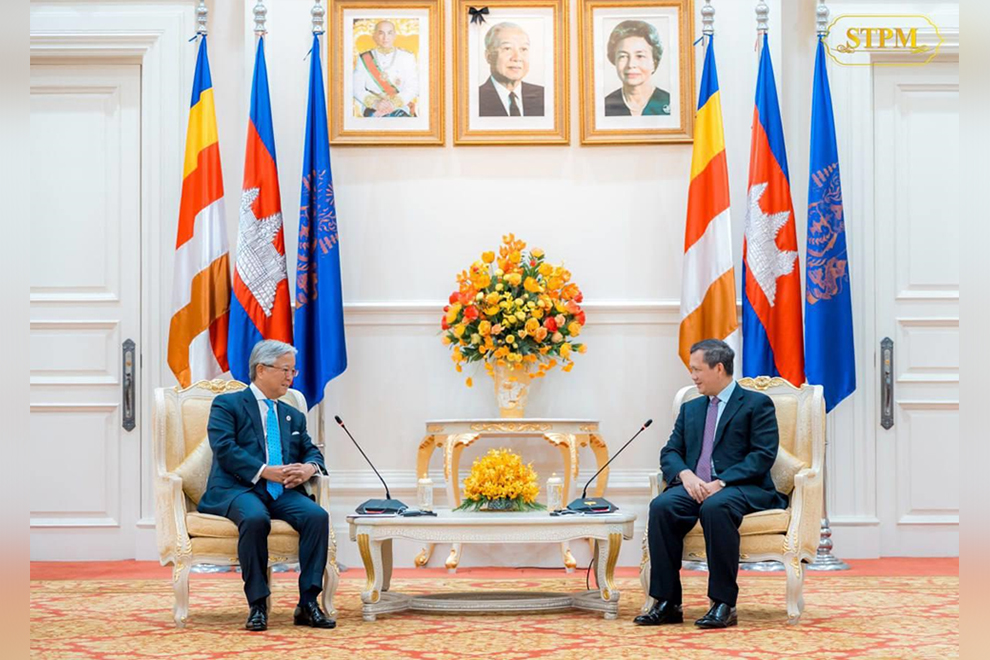 Prime Minister Hun Manet receives a courtesy call from Japanese Ambassador to Cambodia Ueno Atsushi on December 7, 2023 at the Peace Palace.
#Opinion
Cambodia and Japan formally established diplomatic relations in 1953, the very year Cambodia regained full independence from France. Over the past seven decades, the bilateral relationship has evolved into one of the most warm, sincere, and mutually respectful partnerships in Asia.
Both nations proudly describe their ties as “Heart-to-Heart Relations”, a phrase that reflects genuine friendship, deep gratitude, and unwavering support during the most difficult moments of each country’s history.
Immediately after World War II, many Asian countries demanded war reparations from Japan. Cambodia, despite having suffered Japanese military occupation during the war, chose a radically different path. In November 1954, under the leadership of the then King Norodom Sihanouk, the Cambodian government officially and unconditionally renounced all claims to war reparations from Japan.
This extraordinary act of magnanimity deeply touched the Japanese government and people at a time when Japan itself was struggling to rebuild from the ashes of defeat.
Japanese leaders have repeatedly described Cambodia’s waiver as one of the most moving gestures they received in the post-war period. It laid an unbreakable foundation of trust and goodwill that continues to define the relationship today.
In response, Japan launched long-term economic cooperation programmes with Cambodia – often referred to informally as “quasi-reparations.”
Starting with grants, technical assistance, and training programmes in the 1950s and 1960s, Japan gradually became one of Cambodia’s largest and most reliable development partners.
For more than 70 years, Japanese Official Development Assistance (ODA) has consistently ranked among the top sources of support for Cambodia’s infrastructure, education, health, agriculture, rural development and, crucially, landmine clearance – one of the most successful demining partnerships in the world.
Cambodia’s modern history has been marked by unimaginable tragedy: decades of war, foreign invasion, civil conflict and, above all, the genocidal Khmer Rouge regime (1975-1979) that destroyed nearly every aspect of society – killing up to two million people and erasing schools, hospitals, temples, and entire professions.
When Cambodia finally emerged from this abyss in the late 1980s and early 1990s, Japan stood firmly by its side: before the 1991 Paris Peace Agreements, Japanese diplomats and officials worked tirelessly – sometimes until 2am or 3am – alongside Cambodian their counterparts to craft a viable peace framework.
Japan co-chaired, with France, the Tokyo Conference on Cambodia and provided crucial diplomatic and financial backing.
During the 1993 UN-sponsored elections – the first in Cambodia’s modern history – Japan contributed personnel, funding, and technical expertise through UNTAC (United Nations Transitional Authority in Cambodia).
In the post-conflict decades, Japan has remained a steady partner, funding major infrastructure such as National Road No 5, the Neak Loeung Bridge (Tsubasa Bridge), Phnom Penh’s water supply system, the Sihanoukville port expansion and countless rural schools and health centres.
Japanese leaders and ordinary citizens have never treated this assistance as charity, but as an expression of heartfelt gratitude and responsibility towards a friend who once forgave them.
Why Cambodia must now do more
Despite this extraordinary history, Cambodia sometimes takes Japan’s generosity for granted. Every yen that Japan provides comes directly from the taxes and hard work of the Japanese people – people who themselves face aging-society challenges, natural disasters, and economic pressures.
Yet year after year, Japan continues to place Cambodia among its top ODA recipients because of deep emotional bonds and respect. It is therefore incumbent upon Cambodia to reciprocate with greater seriousness, gratitude and strategic thinking.
Treat Japanese assistance with the utmost respect and transparency
Every project must be implemented efficiently, with clear reporting and visible results, so Japanese taxpayers can see the real impact of their contribution.
Deepen cultural and human understanding
Cambodian officials and citizens should study Japanese values – punctuality, precision, long-term thinking, respect for rules and aversion to corruption – so that cooperation becomes even smoother and more productive.
Send only the most qualified and committed participants to Japan-funded training programmes.
It is very important to send only the most qualified or committed officials to participate in capacity building training in Japan, such as military training or technical training since those are the main programmes to immediately build capacity of Cambodian officials. Japan wants to see if the outcome is sustainable after each training.
Formulate clear, realistic and well-prioritised requests
Instead of vague or overly ambitious wish lists, Cambodia should present concrete, bankable projects aligned with both Cambodia’s Pentagonal Strategy and Japan’s Indo-Pacific vision.
What Cambodia can offer Japan in return
Cambodia is no longer only a recipient. Today, Cambodia has much to give back to its cherished friend: rich natural resources and a young, dynamic workforce ready for Japanese investment.
Strategic location as a gateway to ASEAN and the Mekong region.
Consistent diplomatic support for Japan’s positions in the United Nations and other international fora (Cambodia has repeatedly backed Japan’s bid for a permanent UN Security Council permanent seat).
A society that genuinely admires and respects Japan – Japanese culture, discipline, technology and kindness enjoy almost universal goodwill among Cambodians, far more than many other foreign nations.
If Cambodia proactively strengthens people-to-people ties – more sister-city partnerships, university exchanges, tourism promotion, cultural festivals and youth programmes – the “Heart-to-Heart” relationship can reach an entirely new level in the 21st century. Cambodia should provide visa-free for Japanese tourists to visit Cambodia as well.
All in all, seventy years ago, Cambodia extended forgiveness when Japan needed it most. Japan has repaid that kindness a thousandfold with decades of selfless support during Cambodia’s darkest hours.
Now is the time for Cambodia to move beyond gratitude alone and become a true equal partner – one that respects Japanese values, uses assistance wisely and actively contributes to Japan’s own goals and aspirations. Only then will the beautiful phrase “Heart-to-Heart Relations” continue to ring true for the next seventy years and beyond.
Dr Seun Sam is a policy analyst at the Royal Academy of Cambodia. The views and opinions expressed are his own.