The World’s Court Is Waiting: A Nation that Says ‘Thank Peace’ Must also Choose Justice.
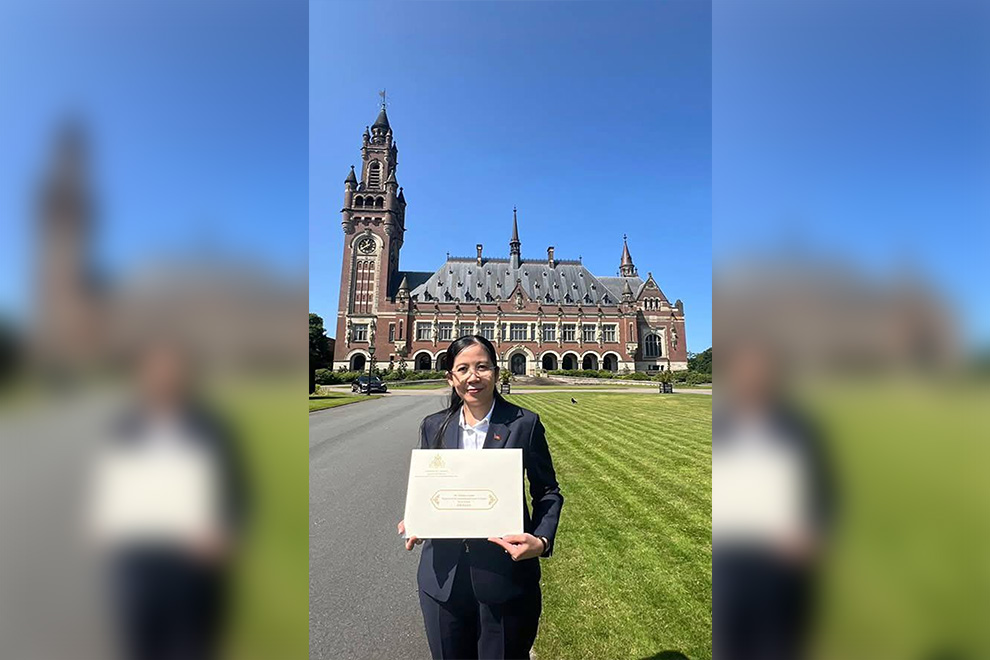 The Cambodian ambassador to the Netherlands submitted a letter to the ICJ in June 2025. FB
#opinion
At the time of this writing, there is no public information indicating that Cambodia has litigated, is currently litigating, or is formally preparing to submit complaints before either the International Court of Justice (ICJ) or the International Criminal Court (ICC). This op-ed is therefore not intended to prejudice, undermine or discount any diplomatic or legal efforts that may be taking place behind the scenes. Cambodia may well be pursuing quiet and responsible avenues consistent with international law.
Rather, this reflection is offered in support of the broader principle that recourse to neutral international adjudication remains among the most credible and peaceful paths for resolving serious interstate disputes and securing long-term regional stability.
In a previous reflection, I emphasised that when serious cross-border allegations arise, no state — whether Thailand or Cambodia — can credibly rely on its own domestic courts alone. I argued that if Thailand believes it has legitimate legal complaints, the principled and internationally respected course is to submit such disputes to the International Court of Justice rather than pursue unilateral litigation at home. The same logic, however, must apply equally to Cambodia.
As a Cambodian lawyer, I maintain that peace in Southeast Asia cannot be sustained through unilateral accusations or domestic litigation alone. International disputes require international forums. Neutral courts — not nationalist rhetoric — remain the only credible path to lasting peace.
But neutrality is not something we demand only from others. It is something we must also accept for ourselves.
If Cambodia truly believes in law over escalation, then Cambodia too must be prepared —where international jurisdiction permits — to place disputes before the International Court of Justice, and to support lawful international accountability mechanisms when the gravest crimes are credibly alleged.
International justice cannot be “your court” when it is convenient and “foreign interference” when it is not. It must be our court, for all parties alike.
Peace Demands More Than Words
The rule of law is strongest when it is mutual.
International law was developed precisely because interstate conflict cannot be settled fairly if each side insists on its own courts. Article 2(3) of the UN Charter obliges all states to resolve disputes peacefully, while Article 33 encourages recourse to negotiation, arbitration and judicial settlement.
For Cambodia, this obligation is not theoretical. It is a responsibility.
When disputes arise involving borders, armed incidents or allegations of cross-border harm, Cambodia should not rely solely on political statements or domestic measures. The principled course is to demonstrate that we are willing to pursue peaceful legal settlement through neutral international processes.
The International Court of Justice exists for this very purpose: to prevent conflict from becoming confrontation, and to ensure that law — not power — determine outcomes.
Where civilians have been harmed, homes damaged and Cambodian communities placed at risk by cross-border incidents, the stakes are far too serious for unilateral claims or politicised retaliation. When there are serious allegations of cross-border violence — including reports of civilian casualties, destruction of cultural or religious sites, and claims of territorial incursions — such matters cannot be resolved through unilateral narratives or domestic proceedings alone.
Precisely because these are grave accusations with profound humanitarian and sovereign implications, they demand impartial investigation and lawful adjudication before neutral international forums, including the International Court of Justice, and where applicable, international criminal accountability mechanisms. Recourse to the ICJ offers the most credible path for establishing responsibility through evidence and law — not rhetoric — and for preventing further escalation through peaceful legal settlement.
“Thank Peace” Must Mean Action
Cambodia has long carried a national principle reflected in its diplomatic posture and public identity: “Cambodia is committed to peace and international friendship”. This is not a ceremonial slogan, but a defining national pledge — born from history, sacrifice, and the painful cost of war.
It is the same spirit expressed in the Cambodian posture of “Thank Peace,” a reminder that peace is not taken for granted, but cherished as a national achievement.
Precisely for that reason, Cambodia must defend peace through law, including by bringing interstate disputes and complaints before the International Court of Justice, where neutral adjudication can prevent escalation and secure lasting legitimacy.
Courts Before Conflict
The ICJ is not a weapon, but a shared forum.
It must also be recognised that the ICJ can only decide disputes when states have accepted its jurisdiction — whether through treaty commitments, special agreements or other forms of consent.
Yet the principle remains: Cambodia should be prepared, in good faith, to submit disputes to neutral adjudication where lawful avenues exist, rather than allowing disagreements to harden into escalation.
If Cambodia calls for neutrality, Cambodia must also accept neutrality.
Cambodia’s recourse to the ICJ or other lawful international mechanisms should not be seen as jeopardising ongoing JBC and GBC efforts. On the contrary, judicial settlement and diplomatic dialogue can — and should — operate in parallel: diplomacy managing immediate stability on the ground, while law provides lasting clarity and legitimacy. Neutral adjudication can reinforce negotiations by anchoring them in impartial principles rather than uncertainty or suspicion, and by demonstrating that Cambodia’s commitment to peace is matched by a commitment to lawful resolution.
Law Protects Sovereignty
Too often, international adjudication is misunderstood as surrender. In truth, engaging international courts is not weakness. It is strength.
The ICJ is the principal judicial organ of the UN, created to resolve disputes between states through evidence, procedure, and impartial judgment.
For Cambodia, supporting recourse to the ICJ means choosing legitimacy over suspicion. It signals that Cambodia is prepared to resolve disagreements through law rather than confrontation.
Peace is not preserved by refusing adjudication. Peace is preserved by embracing it.
Accountability Is Not Politics
Alongside interstate disputes, Southeast Asia must also confront the question of accountability for the gravest international crimes. The International Criminal Court serves a distinct function: it prosecutes individuals — not states — for genocide, crimes against humanity and war crimes.
At the same time, ICC jurisdiction is limited by treaty membership and strict legal thresholds. Cambodia is not currently a State Party to the Rome Statute, and ICC jurisdiction generally arises only through ratification, special declarations or referral mechanisms.
Nevertheless, the broader principle remains vital: accountability for mass atrocities must never be reduced to
politics, and civilians must never be beyond the protection of international law.
Choosing Justice Over Escalation
Southeast Asia cannot afford peace built on denial, politicized threats or unilateral measures.
What the region needs is courage: the courage of all states — including Cambodia — to support neutral adjudication, to accept lawful outcomes and to ensure that civilians are never reduced to instruments of nationalism.
This is not about Cambodia versus Thailand.
It is about whether Cambodia and Thailand alike will choose law over escalation, and courts over confrontation.
If Cambodia truly believes in peaceful settlement, then Cambodia must be prepared to pursue international legal remedies where jurisdiction allows, and to uphold the principle that justice must be impartial, shared, and rooted in law.
Justice must be shared, or it is not justice at all.
Long Panhavuth is founder and attorney-at-law at Pan & Associates Law Firm. The views and opinions expressed are his own.
-Phnom Penh Post-
———————-