Cambodia protests Thai occupation of Thmar Da area
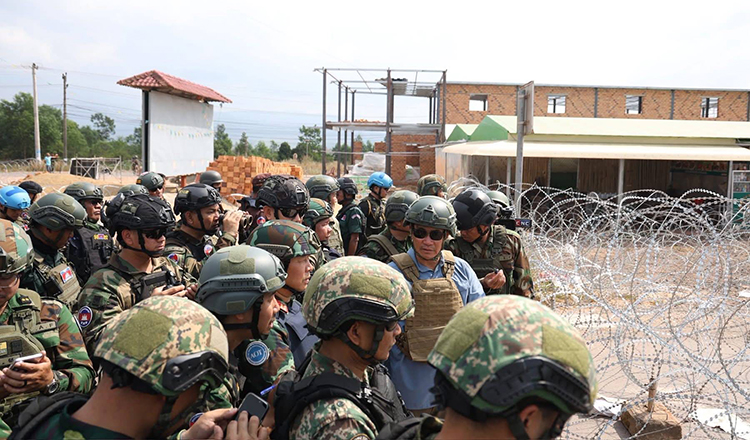 The AOT observes the barbed-wire fence set up by the Thai military in Pursat province, on Friday. Ministry of National Defence
#National
Synopsis: Tensions resurface along Cambodia’s western border after Thai forces reinstall razor-wire barriers around homes and businesses in a section of Pursat province, prompting a strong diplomatic protest from Phnom Penh.
Tensions between Cambodia and Thailand have resurfaced as the Thai military reinstalls razor-wire barriers around occupied homes and shops owned by Chinese businessmen on Cambodia’s side of the western border in the Thmar Da area of Pursat province.
Cambodia has lodged a strong protest against the Thai armed forces’ actions, saying they have altered security conditions near civilian areas and undermined efforts to de-escalate the territorial row between the two countries, the Ministry of Foreign Affairs and International Cooperation said in a statement.
The ministry said the actions have disrupted the safe and dignified return of civilians to their homes land and risk creating new complications to the efforts to restore normalcy along the border.
In particular, the ministry cited the laying of barbed wire by Thai forces near the Thmar Da International Point of Entry in Pursat province on Friday, describing the move as raising serious concerns over Cambodia’s sovereignty and territorial integrity.
The Foreign Ministry said the action was inconsistent with de-escalation measures outlined in Item I of the Joint Statement from the 3rd Special Meeting of the General Border Committee (GBC) held on December 27. The joint statement, it said, was intended as a comprehensive framework to reduce tensions, protect civilians and restore normal civilian life, rather than to entrench military presence.
“The actions undertaken by the Thai armed forces directly undermine de-escalation efforts and hinder the safe and dignified return of civilians to their homes and properties,” the ministry said.
Cambodia called on Thailand to fully and in good faith implement all provisions of the Joint Statement and existing bilateral agreements to restore peace and stability at the shared border.
The ministry reaffirmed Cambodia’s commitment to resolving border and boundary issues with Thailand through peaceful means, in accordance with international law and existing bilateral agreements, while maintaining that borders must not be altered by force.
Thai naval forces have reinstalled razor wire barricades around houses and shops owned by Chinese businessmen in the Thmar Da area of Pursat province, an area that Cambodian authorities say has been illegally re-occupied by Thai troops after the Chinese business owners removed previous barriers in front of their properties.
On January 15 and 16, the Ministry of National Defence facilitated a visit by the ASEAN Observer Team (AOT), which conducted on-site inspections in the Thmar Da area.
Cambodian officials described the new barricades as a provocative act that blatantly violates Point 4 of the December 27 Kuala Lumpur Joint Statement, which states that “both parties agree to allow civilians living in the affected border areas to return as soon as possible, without hindrance and in safety and dignity, to their homes and normal livelihoods in the areas within their own territory”.
Pursat Provincial Governor Khoy Rida said the situation in Thmar Da should not be viewed as a border dispute but as an act of encroachment and occupation of Cambodian territory by Thai armed forces in four locations, causing serious harm to civilians and public infrastructure.
He identified the four locations as Chor 1, Victory Bridge—also known as the Me Toek Bridge—Phluk Damrei, and Chey Chumneas, or Gate 56, an area designated as a special economic zone.
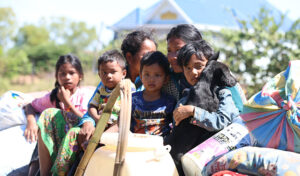
He said the encroachment has directly affected more than 80 families, including 39 households that have lost their home. Other families have been unable to return to their residences because their homes are surrounded by or located next to razor wire fences installed by Thai forces.
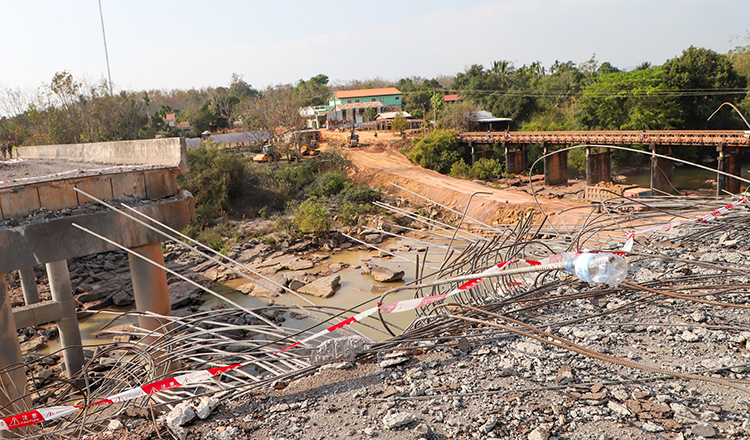
Damage has been reported to administrative buildings at frontline posts, hospital and health centre facilities, commercial buildings and various public infrastructure, particularly the Met Toek Bridge.
“The Thai military has surrounded the homes of 39 Cambodian families,” Rida said. “We have explained clearly to the AOT team that Cambodia is not threatening or invading anyone. In reality, Thailand is the one encroaching on our territory and threatening us, yet they claim we are the aggressor.”
He said the AOT team came to understand the situation following the visit, stressing that the incident was not a temporary clash but a continued occupation.
Thai naval forces have also installed warning signs prohibiting Cambodian civilians from entering their own homes, declaring the area to be under Thai military control, according to local authorities.
Rida acknowledged that about 900 families in Thmar Da were relocated to safer areas, with most later able to return home. However, 84 families remain displaced because their homes are surrounded by or located next to Thai military razor wire fences.
Thai soldiers on Cambodian soil have reportedly destroyed the homes of Cambodian civilians.
Video clips reportedly filmed by the Thai soldiers themselves reportedly show looting of villagers’ property in occupied villages, including vehicles, motorbikes, bicycles, household items and even pets.
In Pursat, Banteay Meanchey, Preah Vihear and Oddar Meanchey, Thai soldiers reportedly cut locks to enter Cambodian homes and seize civilian property—acts that violate Cambodia’s sovereignty, international law and basic human decency.
These were not battle zones, but private residences protected under the Geneva Conventions.
Such repeated incidents across multiple provinces point to a systemic failure, not isolated misconduct. When foreign troops break doors and confiscate property, invasion is defined by actions, not rhetoric. Cambodian civilians deserve protection, not predation.
Cambodian leaders, ministries, institutions and citizens have united in a collective effort to defend national sovereignty and territorial integrity.
The Cambodian leadership said the government and citizenry have mobilised their full physical, intellectual and moral strength to safeguard the country’s sovereignty, while also addressing the hardships faced by civilians affected by the incursion.
Cambodia has reaffirmed its firm commitment to achieving its primary objective of ending the suffering of its people, preventing further destruction and continuing along the path towards peace through just and lasting solutions.
At the same time, the government stressed that Cambodia will not make any concessions that compromise its sovereignty or national dignity.
On territorial integrity, Prime Minister Hun Manet made it clear that the border between Cambodia and Thailand remains defined by existing treaties and conventions.
The Cambodian Human Rights Committee (CHRC) has issued an urgent appeal to the United Nations, calling for immediate international action over the ongoing abuses by Thai armed forces against Cambodian civilians despite a ceasefire.
A formal letter was sent by Ambassador Dara In, Cambodia’s Permanent Representative to the United Nations in Geneva, to Volker Turk, United Nations High Commissioner for Human Rights, urging sustained attention to what Cambodia says are serious and continuing violations committed by Thai forces inside Cambodian territory under illegal occupation.
Ambassador Dara wrote that Thai military forces have continued to operate in Cambodian territory amid a ceasefire and joint declaration for peace.
“These actions have resulted in the burning and destruction of civilian homes; the dismantling of community, religious and cultural structures; and the appropriation, pillage and confiscation of civilian property indispensable to survival and livelihoods,” Ambassador Dara wrote.
The letter stated that in several areas, Thai forces erected barbed wire and placed shipping containers to block access to villages, “effectively sealing off civilian communities, preventing civilians from returning to their homes and entrenching prolonged displacement”.
“International humanitarian law requires not only the protection of civilians and civilian objects during hostilities but also the restoration of normal civilian life following their suspension or cessation,” the letter said, adding that actions that prevent civilian return or perpetuate displacement are incompatible with these obligations.
-Khmer Times-