Sovereignty by Barbed Wire: Thailand’s DIY International Law
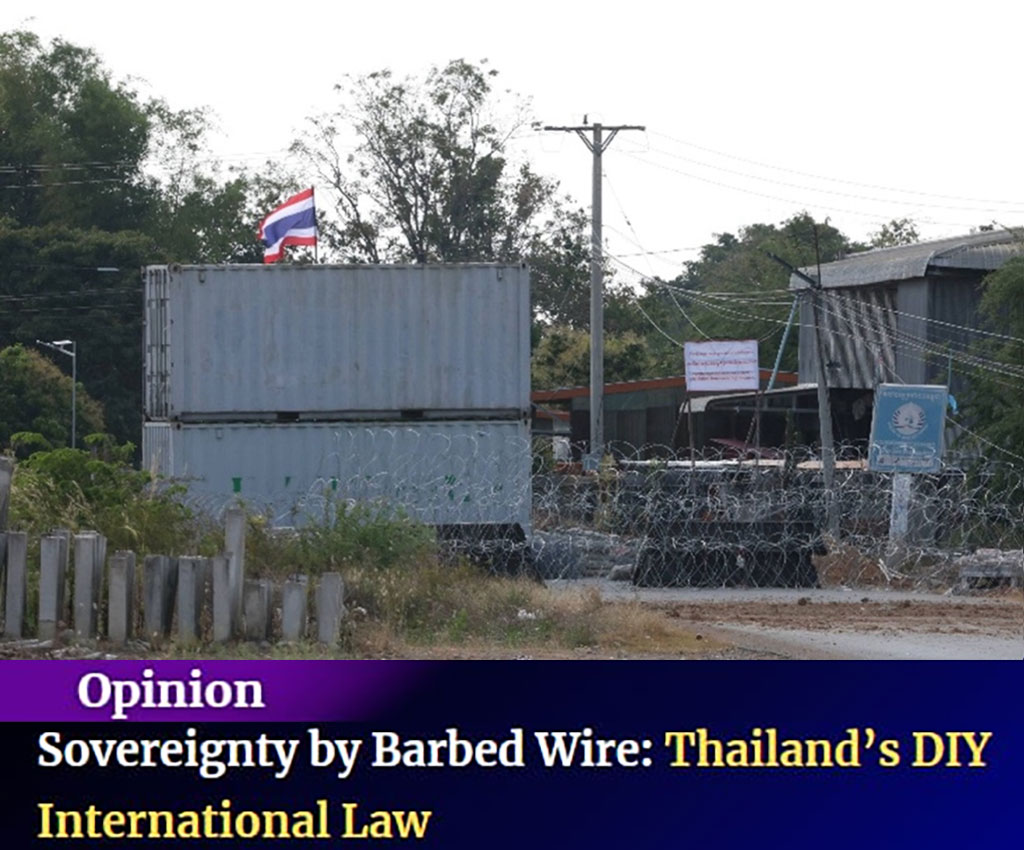 Barbed wire and containers erected by Thai forces to seal off Cambodian villagers from their homes. Supplied
#opinion
Thailand appears to have advanced a novel, if legally untenable, theory of sovereignty: that territory may be acquired not through law, consent or treaty, but through do-it-yourself improvisation with barbed wire on the ground.
Where treaties once fixed borders between states, coils of barbed wire now appear to suffice. Where maps agreed more than a century ago once settled the boundary between Cambodia and Thailand, shipping containers, fences and surveillance cameras are pressed into service. It is sovereignty by assembly — simple in concept, expedient in execution and viable only if international law is set aside entirely.
The Thai armed forces today exercise military control over Cambodian territory, including civilian villages situated well inside Cambodia and far beyond Thailand’s unilaterally claimed border line, in areas delimited by boundary treaties that have governed relations between the two states for more than a century.
Rather than contesting those boundaries through recognised legal or diplomatic mechanisms, Thailand has chosen a hands-on alternative: build first, justify later. Barbed wire has replaced legal argument; surveillance has displaced consent. Borders, it would seem, no longer require agreement — only tools, troops and persistence.
This approach has been neither accidental nor concealed. Thailand’s Defence Minister has openly articulated “five measures” to “control” land Thailand claims to have “taken back”: prolonged troop deployment, permanent and electronic fencing, continuous surveillance, the settlement of veterans and the conversion of the area into tourist destinations.
These are not temporary security precautions. They resemble a project plan — designed to entrench control, embed civilian and administrative presence, and normalise territorial acquisition through force. When international law prohibits the acquisition of territory by force, Thailand’s response appears to be do-it-yourself perseverance.
The humanitarian consequences are stark and well documented. Cambodian villages such as Prey Chan, Chouk Chey and the Boeung Trakuon area have seen homes burned or destroyed, civilian property pillaged, religious and community structures dismantled, and livelihoods erased.
Barbed wire and shipping containers now block access to villages, preventing civilians from returning home and transforming displacement into a durable condition. This is not incidental harm; it is the predictable outcome of coercive territorial control exercised in civilian areas, assembled piece by piece on the ground.
International humanitarian law, however, does not accommodate such improvisation. Pillage is prohibited. The destruction of civilian property absent imperative military necessity is prohibited. Preventing civilians from returning to their homes once hostilities have ceased is prohibited.
Article 53 of the Fourth Geneva Convention does not admit exceptions for fencing strategies, surveillance regimes, veteran settlement schemes or tourism development plans. None of these measures — however neatly installed — can legalise conduct that international law has long placed beyond justification.
At a more fundamental level, Thailand’s conduct engages one of the clearest rules of the international legal order: the jus cogens prohibition on the acquisition of territory by the use of force.
Enshrined in Article 2(4) of the Charter of the UN and affirmed consistently by international jurisprudence, this prohibition permits no derogation. It does not bend to claims of security, administration or stabilisation. Territorial control obtained and maintained through force is legally null, incapable of conferring sovereignty, lawful title or rights — regardless of how carefully it is assembled or how long it remains in place.
Thailand insists that the situation is “under control”. In a narrow sense, it is: controlled by soldiers, wire and cameras operating inside another State’s territory, across a boundary fixed by instruments Thailand itself once accepted. But control is not sovereignty, and repetition does not manufacture legality. If barbed wire could rewrite borders, the prohibition on territorial conquest would be meaningless.
In the end, Thailand’s barbed-wire diplomacy reveals more than it conceals. It exposes a belief that force, once assembled, fenced and administered, becomes right. International law offers a simpler and less forgiving answer: what is taken by force remains unlawful, no matter how tightly it is wrapped in wire.
Dara In is the permanent representative of the Kingdom of Cambodia to the UN and other International Organisations in Geneva. The views and opinions expressed are his own.
-The Phnom Penh Post-