The Philippines, as 2026 ASEAN chair, must pay close attention to the Cambodia–Thailand conflict to protect ASEAN values, prevent deeper fragmentation
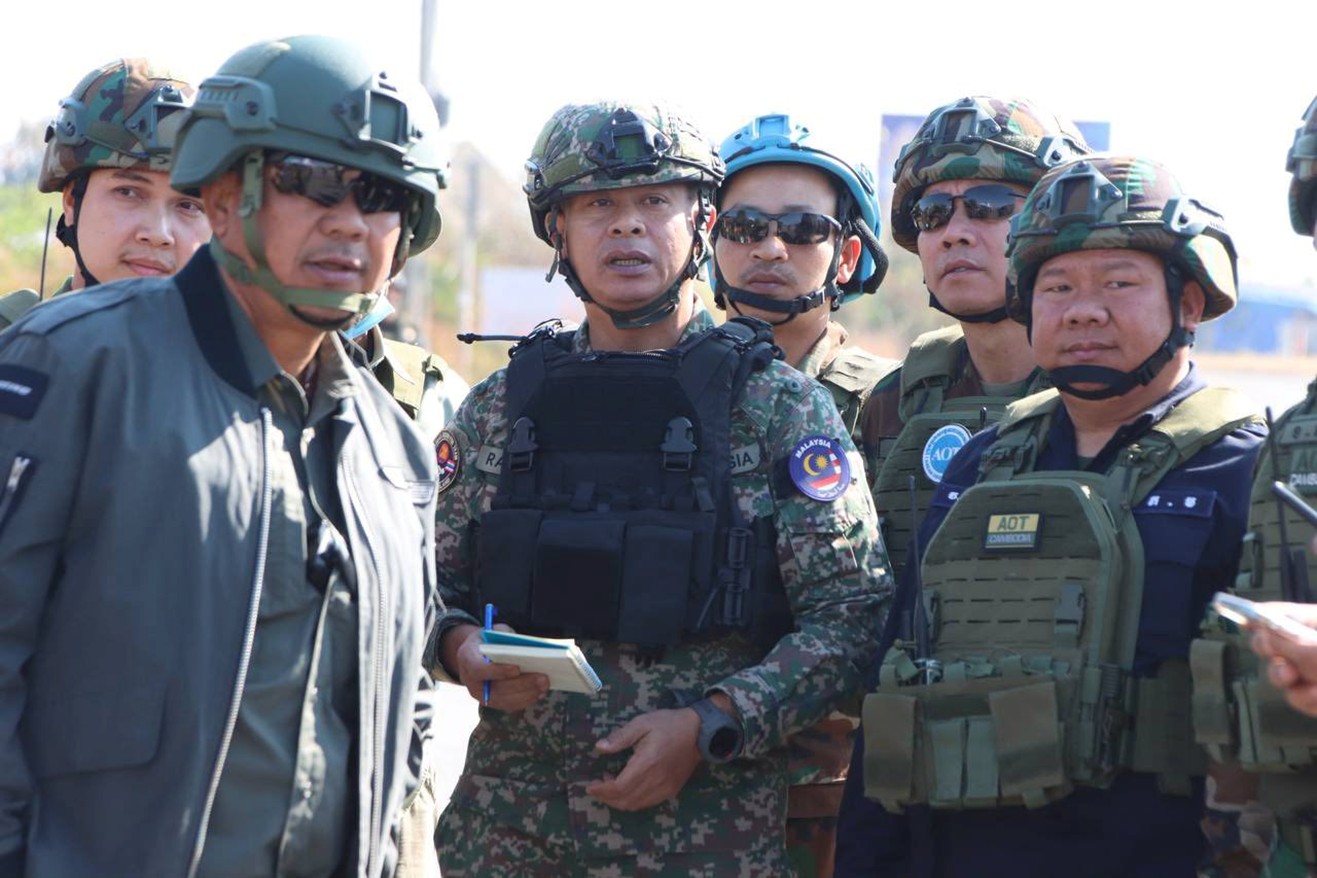 Banteay Meanchey authorities accompany the ASEAN Observer Team to visit the areas destroyed during the recent clashes. AKP
#opinion
The Cambodia–Thailand border dispute in 2025 serves as a sobering lesson for the entire ASEAN region. It unfolded at a time when ASEAN has increasingly been criticized for fragmentation, declining unity and an inability to respond collectively to evolving geopolitical and regional challenges. Too often, member states appear to prioritise narrow national interests over the shared regional spirit, weakening ASEAN centrality year by year.
In this context, ASEAN risks becoming little more than a forum for airing grievances rather than a mechanism for producing meaningful solutions. While ASEAN principles emphasise consultation and consensus, they are also constrained by the long-standing doctrine of non-interference in the internal affairs of member states. These structural limitations have once again been exposed by the Cambodia–Thailand conflict.
In 2025, Malaysia, as ASEAN chair, attempted to fill this gap by acting as a mediator. Kuala Lumpur hosted several key meetings between Cambodia and Thailand, eventually bringing both parties to the negotiating table and brokering a peace agreement in late October 2025, with the US serving as a co-witness. However, this progress proved fragile, as hostilities flared up again in early December and continued until the end of the year.
On January 1, 2026, the Philippines officially assumed the ASEAN chairmanship under the theme “Navigating Our Future, Together”.
Manila’s new mandate immediately raises questions about its capacity to manage escalating political tensions within ASEAN, particularly at a time when the region faces multiple and overlapping crises. Among these is the unresolved Cambodia–Thailand conflict, alongside the Philippines’ own pressing territorial and sovereignty challenges in the South China Sea.
From a broader perspective, the Cambodia–Thailand border dispute and the South China Sea issue are not isolated diplomatic problems. Rather, they are direct tests of ASEAN unity and of the credibility of the bloc’s long-standing motto: “One Vision, One Identity, One Community”.
Cambodia’s appeal to international legal mechanisms such as the UN Security Council or a potential return to the International Court of Justice (ICJ), mirrors the Philippines’ own reliance on international law to defend its maritime rights in the West Philippine Sea. By supporting Cambodia’s legal approach, the Philippines would simultaneously strengthen the rules-based order that underpins its own national interests and demonstrate that the ASEAN Community is more than rhetoric, not just a slogan.
Cambodia views the December 2025 Military clashes Not Merely as a Border Dispute But as an Act of Invasion
The armed conflict between Cambodia and Thailand in December 2025 as the second major clash since July reached its peak over 21 days, from December 7 to 27, 2025. The fighting displaced more than half a million Cambodians and resulted in at least 32 Cambodian deaths. Thailand, meanwhile, reported that 21 soldiers were killed and more than 150,000 Thai civilians were forced to flee their homes.
The Cambodian government accused the Thai military of violating Cambodian airspace by deploying F-16 fighter jets to drop bombs deep inside Cambodian territory, far from the disputed border areas. These strikes reportedly destroyed infrastructure, including schools, hospitals, civilian homes, and other non-military sites. Phnom Penh therefore characterised the operation as an invasion, rather than a limited border confrontation.
Kin Phea, director of the International Relations Institute of Cambodia (IRIC) at the Royal Academy of Cambodia and an official under the Office of the Council of Ministers, described Thailand’s actions as a “real invasion” that had reached a “critical level”.
Warning of broader regional consequences, he argued that if such actions were allowed to proceed without consequences, they could undermine the entire regional order.
“If ASEAN continues to allow Thailand to carry on with this invasion,” he cautioned, “ASEAN will become divided, weak and lose its bargaining power with other major powers.”
ASEAN must become proactive and reshape public perceptions that it carries no political weight
Since hostilities first erupted in late May 2025, when a Cambodian soldier was killed in a brief exchange of gunfire along the disputed border, relations between Phnom Penh and Bangkok have steadily deteriorated. The inability to activate effective bilateral mechanisms led to diplomatic tensions, border closures and a week-long armed conflict in July. Observers have increasingly blamed ASEAN for failing to facilitate peaceful dialogue between its two members.
Bryanna Entwistle of the Asia Society Policy Institute noted in an editorial that consultation and non-interference has become a major obstacle in resolving border disputes such as the Cambodia–Thailand case. These principles, once seen as ASEAN’s strength, now risk becoming liabilities in a region shaped by intensifying geopolitical competition.
During the December 2025 clashes, public frustration was especially visible on Cambodian social media, where many citizens criticised international organisations, particularly ASEAN, for their perceived silence and inaction. Cambodian analysts speaking to local media argued that most ASEAN members appeared reluctant to act decisively, prioritising their own national interests instead. Although Malaysia remained the most active mediator as ASEAN chair in 2025, the bloc as a whole continued to appear ineffective.
Thong Meng David, an advisor to Cambodia’s Ministry of National Defence, warned that ASEAN’s credibility was at stake.
“If ASEAN cannot resolve this,” he said, “the international community may view it as an ineffective organization, weak in conflict resolution. Other ASEAN members may lose faith in ASEAN mechanisms and begin seeking intervention from external powers, bypassing ASEAN entirely.”
Such a trajectory would set a dangerous precedent that one in which larger states feel emboldened to use force against smaller neighbours. It is precisely for this reason that the Philippines, as ASEAN Chair in 2026, should take a more assertive role.
As Cambodian government spokesperson Penh Bona observed, “The whole world accepts the ‘unchangeable’ borders left by colonialism. If we start tampering with those lines, there will be no peace — not just between us and Thailand, but potentially for Vietnam or Laos as well.”
Despite three ceasefires brokered in 2025, the absence of a clear, evidence-based determination of responsibility has left each truce fragile. According to Enrico Gloria, assistant professor of political science at the University of the Philippines, the conflict is likely to persist due to “long-standing historical grievances and colonial-era border arrangements that have never been fully resolved”.
Chheang Vannarith, chairman of the Advisory Council of Cambodia’s National Assembly, echoed this concern, warning that the conflict may evolve into a prolonged struggle with periodic flare-ups.
What the Philippines should do, in the eyes of Cambodian experts
For a sustainable resolution, the Philippines and ASEAN as a whole must shift from passive observation to proactive mediation in order to restore ASEAN’s credibility.
First, the Philippines should lead efforts to dismantle what Cambodian analysts describe as a “culture of impunity”.
As Vannarith argues, “ASEAN must eliminate the idea that states can violate norms without facing consequences. This culture of impunity weakens the entire region.”
Second, Manila should provide a neutral and credible platform for factual information-sharing to counter misinformation. Border disputes, Cambodian experts note, are often politicised for domestic electoral gain.
“The border issue is frequently used to maintain power and mobilize voters,” Vannarith explained, adding that issues such as online scams are sometimes exploited to confuse international opinion. While acknowledging Cambodia’s own shortcomings, he stressed that misinformation must not be allowed to dominate regional narratives.
Third, as a long-standing US ally since 1951 and a state with deep experience in international arbitration, the Philippines should advocate firmly for a return to international legal standards.
As Penh Bona noted, bilateral mechanisms remain useful, but only if they are grounded in treaties, conventions, and international law. “Ultimately,” he said, “we need an international mechanism to decide.”
In sum, Philippine engagement is not merely an option; it is a regional necessity.
By championing Cambodia’s reliance on international law, Manila reinforces the rules-based order that it will itself depend on to safeguard its interests in the West Philippine Sea. As ASEAN Chair in 2026, the Philippines has an opportunity to prove that ASEAN is a functional community and to uphold its core values: a region of peace where the sovereignty of every member, regardless of size, is respected.
Chandara Samban is a junior researcher based in Cambodia with strong interests in foreign affairs, security issues and ASEAN Affairs. He is also a Cambodian correspondent for The ASEAN Frontier (TAF) and RT International Contributor based in Phnom Penh. The views and opinions expressed are his own.
-The Phnom Penh Post-