ASEAN leaders’ silence on Cambodia-Thailand conflict chilling
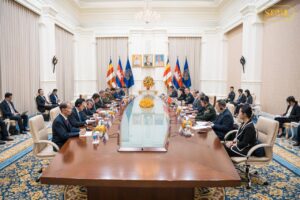
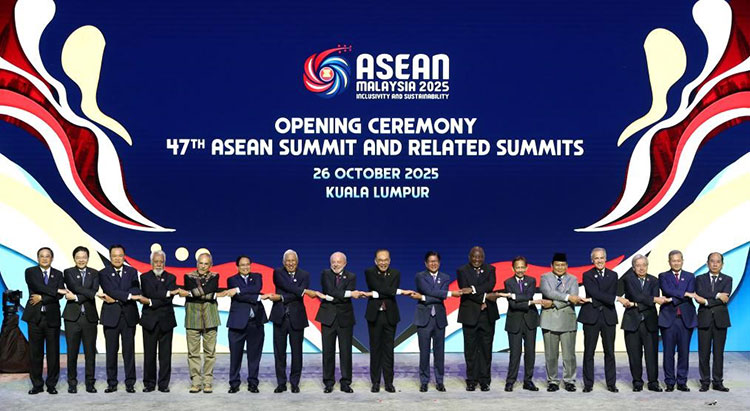 Southeast Asian leaders at the opening ceremony of the 47th ASEAN Summit and Related Summits, in Kuala Lumpur, on October 26. Xinhua
#opinion
It is a struggle to reconcile Cambodia’s efforts to promote peace in the region and the strange silence of ASEAN leaders in the face of the loss of regional peace.
Under Cambodia’s ASEAN chairmanship in 2022, I vividly recall how Mr Hun Sen travelled to Naypyidaw in January 2022, braving criticism from some ASEAN member states, even risking his own safety and that of his entourage, when Myanmar was on the brink of civil war, and a curfew had been imposed.
His intentions were to try to prevent peace from breaking and ensure that the Myanmar people would not face the same tragedy as Cambodia did from the 1970s to the end of the 1990s.
Before that, Mr Hun Sen and the other ASEAN leaders had attended the ASEAN Special Summit in Jakarta in April 2021, when the whole region was struggling to contain COVID-19. While abiding by a strict health and security protocol, every ASEAN leader risked their own health to try to uphold peace in Myanmar in flying to Jakarta when travel was restricted and quarantine was enforced.
In May, even after leaving his government post, Mr Hun Sen, now Senate President, travelled to Indonesia to promote peace and share Cambodia’s experience in peacebuilding at the ASEAN Secretariat in Jakarta. He was warmly received by Indonesian President Prabowo Subianto, who rendered him a treatment befitting a head of state.
In his special address, he did not forget ASEAN’s role as mediator in the Cambodian peace process, even before Cambodia’s accession to the Chair. He spoke at length about Thailand’s important role in the Cambodian peace process and the repatriation of refugees. I quote: “At this point, I acknowledge that Cambodia owes a great deal to ASEAN. We must never forget that ASEAN played a significant role in Cambodia’s peacebuilding process, although Cambodia was not a member of ASEAN at that time. Consider how vital was the role of Thailand in hosting Cambodian refugees and facilitating the return of nearly 400,000 displaced individuals? Why was His Excellency Chavalit Yongchaiyudh willing to facilitate negotiations between Cambodian different factions both in Thailand and even in Japan? Why was Indonesia willing to provide a negotiation platform for Cambodia? And why was His Excellency Ali Alatas willing to step in and act as a mediator in a conflict far from his own country and without a direct impact on its national security? These actions reflect a shared sense of regional responsibility – an institutional spirit that transcends national interests and borders. It exemplifies the use of soft power, the power of negotiation without resorting to gunfire, and relying instead on multilateralism with engagement from multiple stakeholders.”
Looking back I find it difficult to understand the completely different attitudes of the ASEAN leaders towards the wars between Cambodia and Thailand. A violent conflict has erupted between two member states, shaking the entire region, severing economic ties, supply chains, and infrastructure, and destroying cultural heritage. Casualties have been incurred on both sides.
Yet, no ASEAN leader has uttered a word about peace. Their silence is chilling, and suddenly, the slogan “ASEAN: One Community, One Destiny” sounds sinister instead of reassuring.
ASEAN leaders should, without taking sides or condemning any particular actor, at least express their concern about the loss of peace and stability in the region, or commend the countries that have reinstated the ceasefire. But no such pronouncements are forthcoming from ASEAN capitals. Even UNESCO, whose mission is to protect the world’s cultural heritage, is unable to issue a neutral statement urging all member states to safeguard cultural heritage without assigning blame or condemnation.
This silence from the ASEAN capitals is deeply troubling to someone like me who firmly believes in ASEAN values and the ASEAN Way. The ASEAN Way possesses virtues that can be fully applied in the conflict between Cambodia and Thailand, particularly with regard to peaceful dialogue.
The silence of ASEAN leaders is contributing to ASEAN losing its centrality in resolving its own region’s problems, as well as its status as an “oasis of peace” in a troubled multipolar world, devoid of strong and responsible superpowers with substantial police power to maintain peace.
This article, however, is not intended to call for a rejection of ASEAN and its values. On the contrary, as a fervent defender of ASEAN, the author urges member states to live up to the aspirations of its founding fathers and the values that have maintained peace, stability, and promoted prosperity in the region for nearly six decades.
The author is an official at Cambodia’s Ministry of Economy and Finance. He previously served as Director-General of the General Department of ASEAN at the Ministry of Foreign Affairs and International Cooperation. The opinions expressed here are his own.
-Khmer Times-