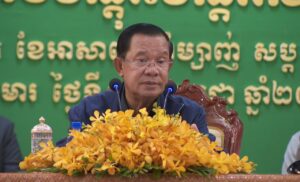
(Video) Selected Comments of Samdech Thipadei Hun Manet, at the “Official Inauguration of Techo International Airport” [Unofficial Translation]
[1]
(1) Four features of the construction of Techo International Airport (TIA)
As reported by Lok Neak Oknha Pung Kheav Se, we are preparing to receive an additional flight in the future after we have just received the Etihad flight. Hopefully, we will have more flights coming in. Regarding this airport, there are some features that culminate the pride of Cambodia […]
Firstly, this is the largest international airport in Cambodia at present. I am speaking at the present time. I reserve because Cambodia does not close the door to expansion (of airport) elsewhere […] this 4F level here and 4E level airport in Siem Reap […] these two together open up the potential of the open-air policy to grow (larger and) more […]
Secondly, this investment project is 100 percent Cambodian. We have 90 percent of investment from OCIC and 10 percent from the Cambodian government, represented by the Secretary of State for Civil Aviation […] it is not like some propaganda that this airport is foreign-owned. It is 100 percent Cambodian […] built by 90 percent Cambodian architects, engineers and builders […] I hope that when we move to the second phase of the airport, we will use 100 percent Cambodians […]
Thirdly, the airport (construction and operation) has helped create jobs. In the report of Lok Neak Oknha Pung Kheav Se also stated that on some days (during the construction time) when it is busiest, we have more than 11,000 workers per day […]
Fourthly, it uses an investment capital of up to 2,300 million dollars. There have been some social media posts that the state borrowed money from China or another country to invest in this airport […] This is a PPP project where the Cambodian private sector uses the capital of private companies entirely, not loans (from abroad) […]
According to the report summarized for me, there is multinational participation, including Canada, England, Singapore, South Korea, China, the Netherlands, and Vietnam, from the design stage to construction and to management […] but the leadership, participation (investment), and management are the responsibility of Cambodia itself […]
(2) The remaining 2,000 hectares will be developed into industrial and residential areas
The construction is not yet complete. There are 2,000 hectares of land area left. It will not be left as farmland. There is a vision (1) to develop it into an industrial area, a residential area, and other job/occupation creation areas. In the next 15 to 20 years, this place will change even more. By now, this place has changed from a lake to farmland, (from a land covered with) war debris, explosives to a (large) airport where […] (2) millions of Cambodians are celebrating. I remember that first week (that TIA was put into operation), there have been visitors coming to see the airport and the traffic was congested. They wanted to come and celebrate the achievements of our nation […] I used to come here before the construction was finished, to meet with the people, and this is the first time I saw the Buddha statue (in the new airport) in person […]
(3) Reveal the truth, avoid misunderstandings, and acknowledge the negative, while strengthen and improve
In the past, on Facebook (and other social media), there were a few opinions that as Cambodia is such a poor country, why do we need to build a big airport? […] What I am saying here is not to have negative thought. It is to refer to how we should respond to such negative perspective. While we are happy to have achieved this remarkable achievement, I think there could be two responses to the negative perspective.
Firstly, if the statement is false, we must show the truth so that there is no misunderstanding […] and (secondly) if it is negative, we must acknowledge it and figure out how we can strengthen and improve it […] This is the view we take to further strengthen this airport […] If they raise a problem with the service, we should not deny it, but first see if there is a problem. If there is a problem, we must solve it and strengthen it […]
(4) Making the airport more modern, responsible and recognized for quality is everyone’s duty
To make this airport more modern, responsible and recognized for quality in the long-term task, and it is whose duty. It is everyone’s duty. Here, we have multiple institutions, including immigration officers, security officers, sanitation workers, security personnel, managers, and company owners. If we want our homes and workplaces to be famous and admired by everyone, then everyone must work hard to fulfill their duties well […] We make this an airport with order, not only with good new construction, but also with cleanliness and order for decades to come, and with improved services, with a high level of quality that everyone wants to travel through […]
[…] Let’s continue to work together to improve services and all kinds of things […] Everyone – the state, civil society organizations, citizens, and the private sector must work together to make us stronger and ensure national unity. Responding to the promotion of what is good, and responding to what is unfair, we must strengthen what is lacking, and work together to do this […] We must continue to set the direction, not only to make the airport better, but also to make Techo International Airport become an airport with a better international ranking in services, comfort, and other things so that we can compete and raise the country’s profile […]
(5) The former Phnom Penh Airport will be a reserve runway, public park, economic and commercial activities and museum
Some people have been saying that the old airport has been sold. I have already stated once on the National Police foundation anniversary that the old (Phnom Penh International) airport will not be sold, and it is still a state property and is under state control. The Secretary of State for Civil Aviation is responsible for maintaining the site. The other day, a budget plan for maintenance was proposed, and it asked for approximately three million (dollars) per year […]
In principle, we are preparing two concepts to make use (of the old airport). Firstly, the existing runway will be kept as a reserve in case planes could not land at the Techo International Airport […] or for VIP plane landing […] and secondly, we plan to prepare it as a public park for the Phnom Penh residents […] We are considering planting some more trees (but) not to block the runway and/or landing path […]
The existing buildings are still state properties, but we can consider some economic and commercial activities to generate income with which to maintain the entire airport facilities, however, not sell it to the private sector. We need to organize it as a museum because this airport has a historical character, since it is the handiwork of the later King Father Preah Borom Rattanak Kaod […]
I may urge our citizens to worry no more and/or not to be confused, or listen to the propaganda regarding the sale of the old airport […] We will keep it to serve the public interest, especially the people of Phnom Penh who need a large place to take their children to relax, organize concerts, other public events, and have a field. So, the area of more than 200 hectares can be used for many things, such as a sports field, a reserve runway […]
[2]
(6) TIA and Siem Reap International Airports on Trial as logistics hubs
About customs procedures […] We want to set up this place as a logistics center […] In the past, a giant international logistics company came to study here. In order for this place to be a logistics center, we need to make our customs services and procedures fast and efficient […] I have studied the models from several countries. We are trying a pilot the project here. Customs procedures in other places already exist, but we cannot change them all at once. We are reforming […] I think we should push this airport to become a logistics hub. Wherever possible. This place has a favorable location and a wide area, and we have a lot of space reserved […] where we can (improve) cargo services, especially customs, because the airport does not only carry passengers, but also cargo […] We should try to promote this place as a logistics hub. If this idea works, it will help a lot both here and in Siem Reap. We can try this place first. Please continue to think about making it easy but not ineffective to clear goods or collect taxes (on goods/cargo) that pass through […] Time is valuable for business people […] With ground handling services at this airport, no matter what the service charge would be, don’t add to the cost burden […]
(7) More people travel happily – a vision and action plan to be taken together
Let the State Secretariat of Civil Aviation, the Ministry of Economy and Finance, and relevant institutions work with various service providers at all airports to ensure that there is no unnecessary burden cost, which will lose competition with nearby airports […] This is the vision and action plan to be taken together to make this airport more people travel. The highest-ranking airport is the airport with the most people traveling through and traveling happily. Let us put it simply […] It is not possible to allow one company to profit but destroy the aviation sector or the airports of the entire country. We must set the goal of protecting our tourism, aviation sector, and new airports to bring more visitors to our country. Some companies may profit, but they are asked to aim for a moderate profit so that we can all survive […] And let’s put a long-term vision in mind, not a short-term, instant, losing competitiveness, which may lead to the downfall of all of us […]
[3]
(8) The Royal Government adopts three approaches at the same time in resolving the border situation
Regarding the border issue, I have not spoken and will not say much […] because the issue is not yet over. I can only inform the citizens of the Royal Government’s thinking […] What approaches does Cambodia (use) to resolve the border issue […]
We have three approaches at the same time. Firstly, where there is a problem, such as the fighting or the incident in Banteay Meanchey or the 18 fighters, we must prevent it from spreading further […] (secondly) find ways to minimize the impact on the people as much as possible and as quickly as possible, and thirdly, find ways to restore the area (and) at the same time find ways to end the conflict completely […]
(Firstly) do not let it spread, meaning that if fighting occurs along the border line of Preah Vihear province, An Ses area, Prasat Ta Moan, Ta Krabey, do not let it spread to other areas and districts throughout the province […] do not let it spread along the border […]
Secondly, wherever the incident occurs, we must try to resolve it by all means possible so that we can try to reduce the risk and loss […] We have implemented this approach in order to achieve a ceasefire on the July 28th and try to prevent it from exploding after the July 28th until today […]
Thirdly, restore the situation (that) is to ensure that this conflict situation ends. This means that we negotiate a ceasefire (by) JBC, GBC, RBC meeting and working together, coordinating together […] Normally, RBC (and/or) GBC meet once a year, but because of this situation, we have to meet more often […] This is part of the approach to ending the conflict that we have been doing in the past to establish and reestablish relations […]
(9) Implement the 3-pronged approach, achieve a ceasefire and plan peace talks under the presidency of President Donald Trump
Borders are a complex issue in ASEAN. Very few among the 10 ASEAN countries that do not have border problems with neighboring countries […] however, the choice to resolve them is through peaceful means i.e., talking (with each other). Some places go to the ICJ, some have bilateral committees, without resorting to guns, anger or (methods) of confrontation. We have the same (means) with Thailand since 2000 […] Cambodia has no intention of violating anyone’s sovereignty or territorial integrity, and we will not allow anyone to violate us. But how to resolve it? It is to resolve it according to the principles that other ASEAN countries (have) done together, which is through a border committee, international law, treaties, conventions (and) that we (have) done for 20 years […]
You may wonder why the government has silent […] since you notice that something occurs in this location hasn’t been resolved, that location hasn’t been resolved. I am asking you to understand the benefits (we aim for). Firstly, the Royal Government may have been silent, but not idle. We do everything we can. As I mentioned earlier, this 3-pronged approach was not achieved by chance, but through active work until we reached a ceasefire, until the JBC and RBC can talk, until we had a plan for peace talks under the presidency of His Excellency Donald Trump. Should we stay idle, all these would not have happened […]
(10) RGC does not abandon people, the frontline soldiers and their families
That the government is silent, perhaps it may have abandoned, no longer cares about the people – so some would argue. It is seen that the people help the soldiers, but the state is silent, leaving the people and the soldiers on their owns. That is not the case. Speaking of the government, from the prime minister to the district governor, the commune chief, to the frontline forces, all levels (have) responsibility. We are with the families of the soldiers, the frontline soldiers and the people. We are trying to find jobs for all the people, whether those who returned from Thailand (even though) some might have not yet found ones (but) we are trying to connect more […] We are trying to (help) the families of the soldiers who were evacuated from the frontline. We are working continuously to help the heroes of the frontline soldiers (who were injured). We continue to help the people who suffered in the Prey Chan and the Jok Jey without giving up […] We do not use violence to expand the conflict area, but we must pay attention to protecting the people […] Ensuring their well-being and food (due to) the bord tension impact on their agricultural land […]
(11) Protect lives of people, territory and property, and find a way to resolve peacefully
Both the Thai and our sides used to be neighbors, like Prey Chan and Nong Chan, people called each other to make offerings […] Most of the people who were angry with each other were from far away. On our side, there were people from Phnom Penh, on the other side, there were people from Bangkok, shouting at each other. The local people who have been neighbors for 30-40 years are not a problem. They just pray for a solution […] The Royal Government wants to end the conflict so that the situation can return to normal. (If) there is a border issue to be resolved, let the state institutions resolve it together, don’t put the burden on the locals […] We must protect what is ours, the lives of our people, our territory and our property, and find a way to resolve it peacefully. We don’t want anyone else’s land, and we won’t give (our) land to anyone else. Let’s resolve it together (according to what has been) left behind for hundreds of years (and there is this) French-Siamese Treaty of 1907, which is 70 years ago, since I was yet born […]
(12) Don’t lose faith, patience, de-escalation and use international intervention
Some of you may have lost faith in patience and international cooperation […] Let’s face it, on July 28, when we signed (this truce) in Malaysia, very few people believed that a ceasefire could be reached that night […] But why did the fighting stop? It was because of international participation and the implementation of this principle. After July 28, how many people could have believed that the ceasefire hold for three months? Very few […] The question is, are these three months not fragile? They are fragile. But whenever a situation is about to explode, we have contacted the IOT, with the ASEAN Chairman, His Excellency Anwar Ibrahim, Prime Minister of Malaysia, to immediately mediate between the military commanders and the military commanders […] Please don’t lose faith, don’t lose patience, and keep trying to de-escalate the situation and use international cooperation to solve the problem. Let us believe in international law and international mechanisms, even if sometimes it doesn’t happen as quickly as we think in every place […]
(13) The great value of the ceasefire is in preventing further loss of life and property
I said we can assess/measure what happened, but we often overlooked the great value of the worst that did not happening […] If there had been no ceasefire on 28 (July) in these three months, how many deaths? How many injuries? How many more destruction? […] would have happened? This is the real value of the ceasefire. We do not see (the benefits of) preventing (the conflict) from escalating. This is the value of preventing the worst from happening […] It is no different from January 7, 1979. In 3 years, 8 months and 20 days, three million people were killed, but the real value after that would within 40 years, we had prevented the Khmer Rouge from killing more people. This is the value of that January 7 […]
(14) Giving up no rights or negotiation through land exchange for ceasefire or peace
(Regarding) the capture of the 18 (soldiers). At that time, some may cry out that the government was silent and wants to hide (the truth). I have met with the families of the soldiers. I have told them. We have not given up on them […] We have not publicized it. Some have gone so far as to say that the government hid information and exchanged the lives of 18 people for a ceasefire. That is not the case. We have not given up on their lives […] We have resolved it until there is a guarantee that they are still alive […] since we have worked with this international organization, their well-being can now be guaranteed under the supervision of the International Committee of the Red Cross […] Hopefully, they will be released soon […] We have not given up rights or negotiating land exchange for a ceasefire or peace […] The issue of border sovereignty negotiations is a bilateral task of the organizations and according to some international legal mechanisms where necessary […] There was no order for the army to withdraw after the ceasefire […]
(15) Ask not where the land was lost or gained … but trust in the sacrifices of the army
I would ask the fellow citizens who asked after the ceasefire, where did the missing go, which commanders died, etc., to stop posing such questions – the conflict is not over. This is a military secret. I ask that you not ask where the missing would be. I ask that you trust only that during the fighting, up to this hour, our army, from the commanders of the battlefield to each and every soldier, has tried to sacrifice their lives, their flesh and blood to defend our land […] In war, there is no winner or loser, neither on the Cambodian side or on the Thai side. The war has left people on both sides in shock, people fleeing, their houses destroyed, some have returned but are still not happy […] What is beneficial is to try together, to agree on a national defense, to find a solution to end the conflict, to restore normalcy, so that we can continue to work peacefully in communication work and border negotiations, etc. […]
(16) If left for too long, the border dispute will turn into a conflict between people and people
This conflict because this conflict affects not only the border. Now it affects the people and the people. We also have Thai people living in Cambodia, working in Cambodia. We have Cambodian people living there. We also have children of cross nationalities. We have Khmer fathers and Thai mothers, and Thai fathers and Khmer mothers. These people are the ones who want to end the dispute the most because if left for too long, it will become a conflict between people and people. It is the duty of political leaders to not let this continue. Some of you may curse, my criticize […] Some of you may think that the government is too quiet, too soft […] It cannot satisfy everyone. But what I want to make clear to all of you is the vision and direction and approach to our resolution and the main goal is to protect lives, property, territory and restore the environment, so that people can live without having to struggle like they do every day […] Let me say this now. (I have been quiet for the last) two months. This is for another two more months. Hopefully, in less than two more months, it will end. Wait until it’s over, things calm down, I will give you the details if you want to know […]
(17) Thank the Cambodian citizens for support to the army and continue working to protect the national interests
May I take this opportunity to thank the Cambodian citizens who have provided support, donated resources, assets, helped provide food, equipment, and encouragement to our heroes on the front lines […] My thanks to His Excellency President Donald Trump for initiating and helping to bring about a ceasefire that will soon be concluded (by) signing a peace agreement in Malaysia, if nothing changes, on October 26. Let me thank the Chinese leadership for actively participating in that agreement […]
Special thanks to His Excellency Anwar Ibrahim, the rotating chairman of ASEAN and the Prime Minister of Malaysia, who has been actively working to initiate a ceasefire since the July 24th, but it was not achieved until the July 28th. We have achieved it […] Let me thank the leaders of all ASEAN countries who have supported and joined the IOT mechanism, and hope that there will be an AOT soon to come and oversee various tasks, leading to recovery and completion, and establishing peace.
Thank you to the major leaders, including His Excellency the French President Emmanuel Macron and many other leaders, His Excellency UN Secretary-General António Guterres and the President of the UNSC, for when the fighting broke out, they immediately convened a meeting […]
I urge that our people are careful and believe only the information that the government has released because the government is responsible. We did not release false information that day just to get away with it because there is evidence on the ground. If we say that this is not our land, we have 3 to 4 years of arguments. When the war is over, you will go and see. If we lie, the people will condemn us […] Let me end my talk about the border issue this much. I hope you can trust and understand that the government is not indifferent to these issues. We have been quiet but not idle, not abandoning the people, not abandoning the nation, and we will continue to work to protect the national interests […]./.