Cambodian and Thai military top brass to meet this month to discuss armistice amid eviction tensions
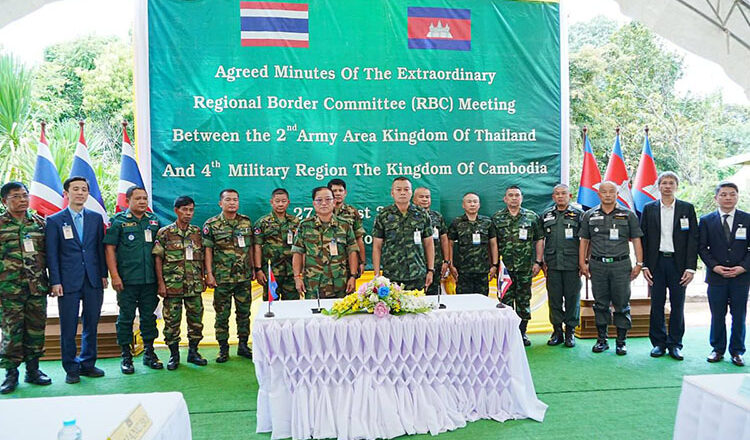 Military commanders of 4th Military Region 4 of Cambodia and the 2nd Army Area of Thailand meet on August 27. Council of Ministers
Synopsis: Cambodia is hosting a series of Regional Border Committee meetings with Thailand this month amid rising tensions along their shared boundary. Cambodia’s Military Regions 3, 4, and 5 and corresponding Thai army commands will meet to discuss a full and effective implementation of the ceasefire, practical cooperation, and a return to normalcy.
Banteay Meanchey – Cambodia will host three Regional Border Committee (RBC) meetings with Thailand’s military regions this month, as both countries seek a full and effective implementation of the ceasefire agreement amid rising tensions along the shared border.
Yesterday, gunfire was reported from the Thai side of the border opposite O’Beichoan commune, O’Chrov district, Banteay Meanchey province, near Border Post No 44, causing concern among local villagers, according to sources.
The incident occurred at 10.43am in O’Beichoan village. The area has long been a flashpoint for border disputes. Cambodia has accused Thai troops of encroaching on its territory in Chouk Chey and Prey Chan villages, where residents have repeatedly reported incidents of intimidation and land intrusions, which Cambodia says contravene international law and bilateral agreements.
Military observers note that recent Thai troop movements and deployments appear to run counter to the ceasefire signed on July 28 with Malaysia, the United States, and China as witnesses.
The cause of the latest gunfire remains unclear. However, explosions and small arms fire have been reported on several occasions in this contested border zone. Cambodian forces, in compliance with the ceasefire agreement, have consistently refrained from retaliation despite what officials describe as Thai provocations.
On September 27, Cambodian authorities reported that Thai forces fired artillery into the An Seh area of Choam Ksan district, Preah Vihear province, though Cambodian troops maintained discipline and did not return fire.
Cambodia has requested that both sides allow the ASEAN Interim Observer Team (IOT) to investigate and forensically examine the evidence at the site of Thailand’s attack.
The incident followed growing tensions. On September 28, Banteay Meanchey Provincial Governor Oum Reatrey lodged a formal protest with his Thai counterpart in Sa Kaeo province, condemning a proclamation by Thai authorities asserting jurisdiction over Cambodian residents in Chouk Chey and Prey Chan villages.
This was after the Sa Kaeo governor issued a formal order for Cambodians residing in Prey Chan and Chouk Chey villages of O’Beichoan commune to evacuate in October, warning that those who remain could face prosecution under Thai immigration and forestry laws.
The eviction deadlines were set for tomorrow in Nong Ya Kaew and October 10 in Nong Chan, with Thai authorities pledging to arrest and prosecute anyone who stayed beyond those dates.
However, as of yesterday, none of the 200 families in the villages, had complied with the order. Residents stated they are determined to defend their homes and land, confident that Cambodian authorities will continue to protect them.
According to Lieutenant General Maly Socheata, spokeswoman for the Ministry of National Defence, the RBC meeting between Cambodia’s Military Region 3 and Thailand’s Chanthaburi-Trat Border Defence Command is scheduled to take place this month.
Cambodia’s Military Region 3 has sent an invitation letter to Thailand’s Chanthaburi-Trat Border Defence Command regarding the convening of the Cambodia-Thailand RBC meeting, which is planned for October 4 to 6, in Koh Kong Province, with Cambodia as the host.
The purpose of this RBC meeting is to promote the continuation of full and effective implementation of the ceasefire agreement between Cambodia and Thailand, to foster practical cooperation, enhance peace and stability, and restore normal relations between the two countries.
In addition, the RBC meeting between Cambodia’s Military Region 4 and Thailand’s Army Region 2 is scheduled from October 7 to 9 in Oddar Meanchey province, with Cambodia as host.
The RBC meeting between Cambodia’s Military Region 5 and Thailand’s Army Region 1 is scheduled to take place from October 10 to 12 in Banteay Meanchey Province, also with Cambodia as host.
In a previous RBC meeting between Commander of the 4th Military Region and Commander of the 2nd Army Area, the two nations had agreed to an 11-point joint statement to “resolve all issues peacefully and avoid clashes,” including the establishment of a coordinating group to enhance communication at all levels.
The two sides agreed to uphold earlier ceasefire decisions, strengthen regular communication at all levels, and resolve issues peacefully to avoid clashes.
Royal Thai Navy Deputy Spokesman Rear Admiral Parach Rattanachaiphan has stated that the Navy has demolished three houses in Laem Klat subdistrict, Trat province, describing them as abandoned structures built by Cambodia that encroached on Thai territory.
The demolition is part of efforts to remove 17 encroachment sites along the border, all of which require Cambodian cooperation. The final site, a large casino building, will necessitate coordination among multiple parties due to its size and complexity.
However, according to the State Secretariat of Border Affairs, there are 17 border locations from Pursat to Koh Kong province, including Veal Veng district in Pursat, Cambodia, opposite Mueang District in Trat Province, Thailand. It said unilateral actions constitute an act of provocation that may lead to an increase of tension along the border, and constitute a violation of the ceasefire.
Cambodia’s Military Region 5 has issued a clarification regarding recent accusations surrounding the demolition of a house at the O’Phlok Domrei site, which had been incorrectly portrayed as an act of ceding Cambodian territory to Thailand.
The statement said Cambodia and Thailand have well-established legal frameworks, institutional mechanisms, and technical procedures to address any border issues. This includes the 1:200,000 scale maps based on the 1904 Convention and the 1907 Treaty, as well as 74 mutually agreed and recognised boundary markers. Both countries have reaffirmed these agreements under the 2000 Memorandum of Understanding (MoU 2000).
Military Region 5 reiterated its firm commitment to defending Cambodia’s sovereignty and territorial integrity without compromise, while also supporting the resolution of border matters through peaceful means in accordance with international law.
Prime Minister Hun Manet has alerted the ASEAN Chair and world leaders to reports that the Thai military plans to seize territory at 17 additional locations across provinces from Pursat to Koh Kong in western and southwestern Cambodia.
In his letters, Mr Hun Manet addressed Malaysian Prime Minister Datuk Seri Anwar Ibrahim, the current ASEAN Chair, as well as leaders including Chinese President Xi Jinping, US President Donald Trump, French President Emmanuel Macron, UN Secretary-General António Guterres, and Annalena Baerbock, President of the 80th Session of the UN General Assembly.
Since August 12, Thai forces have reportedly expanded the conflict zone by erecting barbed wire and barricades, issuing ultimatums, and forcibly evicting Cambodian civilians from long-settled lands in Chouk Chey and Prey Chan villages in Banteay Meanchey province, in northwestern Cambodia, several hundred kilometres from the main conflict zones.
At least 25 families have already been blocked from accessing their homes and fields, while a Thai military spokesperson has reportedly threatened further evictions, potentially affecting hundreds of households. According to credible sources, the Thai military intends to extend its operations to 17 additional locations spanning Pursat to Koh Kong provinces.
On Monday, Cambodia’s Ministry of Interior sharply criticised Thailand over statements related to the recent border tensions made at the United Nations General Assembly.
The ministry accused Thailand’s Foreign Minister of trying to mislead the international community, citing his claim that “we know who the real victims are: Thai soldiers who lost their legs to landmines, children whose schools were destroyed by artillery, and innocent civilians who were attacked by Cambodian rockets.”
In response, Cambodia raised a series of pointed questions challenging Thailand’s narrative.
The ministry asked who initiated the shooting that resulted in the death of a Cambodian soldier in the Mom Bei area, who unilaterally closed the border, and who installed barbed wire and fenced off Ta Moan Thom Temple. It also questioned who launched the attack on Cambodian troops that sparked the five-day battle, and who violated the Franco-Siamese Treaties and the 2000 Memorandum of Understanding.
The statement further criticised Thailand for its reluctance to allow third-party intervention in resolving the dispute, and for violating the ceasefire through multiple provocations, including the arrest of Cambodian troops, expansion of the conflict zone, and deployment of forces onto old minefields.
These actions are based on unilaterally drawn maps, which contradict the mutually agreed maps established under the Commission of Delimitation of the Boundary between Indo-China and Siam (Convention of 1904 and Treaty of 1907), recognised by the International Court of Justice (ICJ), and reaffirmed in the Memorandum of Understanding on the Survey and Demarcation of Land Boundary (MoU 2000) signed on June 14, 2000.
Thailand registered the MoU with the United Nations on May 25, 2011, and it was published in the UN Treaty Series.
Mr Hun Manet said the unilateral actions constitute an attempt by Thailand to demarcate the boundary by force, in direct violation of MoU 2000, the mandate of the Cambodia-Thailand Joint Commission on Demarcation, and commitments recorded in the recent General Border Committee and Regional Border Committee meetings.
-Khmer Times-