
The missing layer 5: In a game without a referee, who checks the numbers?
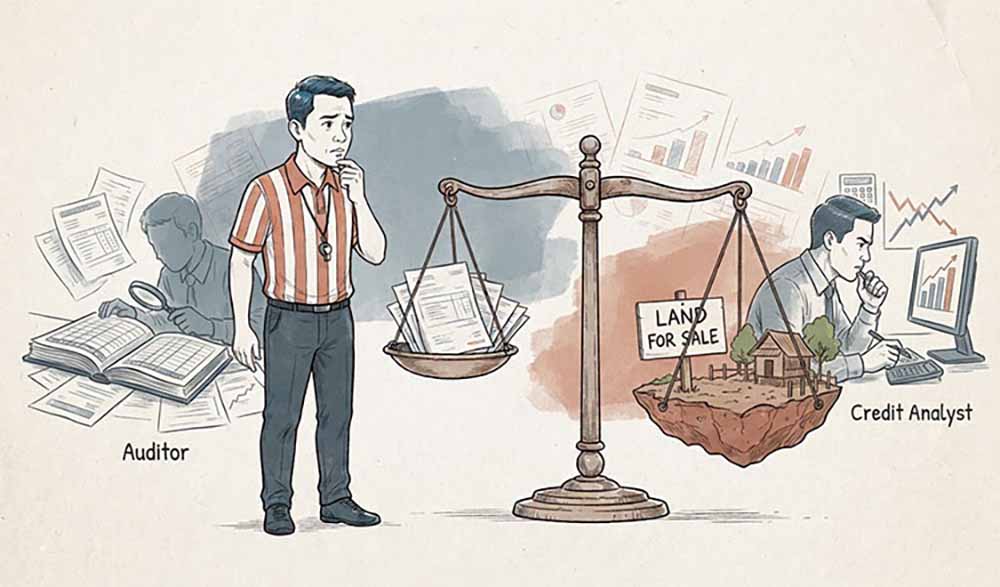 Auditors, valuers and credit analysts stand between the people who produce the numbers and the people who must rely on them. Khmer Times illustration
I once placed two valuation reports for the same plot of land side by side. The location, the size and the valuation date were almost identical. Yet one report put the value noticeably higher than the other. Compared with other reports on similar land nearby, that one stood alone. In statistical terms, it was an outlier.
The reason was not hard to guess. In Cambodia, land is valued mainly by comparing it with nearby transactions. But those transaction prices are often unreliable. The price on paper and the price actually paid can differ, and in many areas, there have been no recent sales at all. When the reference point is blurred, the valuer’s discretion grows. And where discretion is wide, pressure finds its way in. If the client has a number in mind, the valuation tends to lean toward it.
If that is how the number is reached, why do a valuation at all?
Why referees exist
Last week I wrote about companies that cannot prove their own numbers. But no country invests on a company’s word alone. Every market places referees in between: auditors who check financial statements, valuers who put a price on assets, credit analysts who assess loans. They stand between the people who produce the numbers and the people who must rely on them, and they confirm those numbers without taking sides.
The problem is that referees are usually paid by one of the teams. The company being audited chooses and pays its auditor. A valuation is often commissioned by the party seeking the loan. A credit analyst works inside an organisation with disbursement targets. This structure is the same everywhere. What differs is whether anything holds it in check. In a financial system where land is almost the only collateral, a tilted valuation means a tilted loan, and the risk ends up with the whole system.
Rich countries were not always clean
This is not a uniquely Cambodian problem. The accounting history of developed economies is also a history of scandal.
In 2001, Enron in the United States collapsed after hiding debt in off-balance-sheet entities, and its auditor, Arthur Andersen, then one of the world’s five largest accounting firms, disappeared with it. The following year WorldCom went bankrupt after it emerged that it had recorded ordinary expenses as assets to inflate profits. That same year, the US Congress passed the Sarbanes-Oxley Act. It made chief executives personally sign off on and answer for their financial statements, created an independent body to oversee auditors, and restricted auditors from selling consulting services to the companies they audit.
In 2020, Germany’s Wirecard collapsed after it emerged that 1.9 billion euros of cash on its books did not exist, and Germany passed new legislation to overhaul financial supervision and auditing.
In South Korea, after large-scale accounting fraud was uncovered at Daewoo Shipbuilding and Marine Engineering, the external audit law was comprehensively revised, introducing a system in which companies cannot always choose their own auditors.
Fraud happened everywhere. What changed was what came next. Strong laws were passed, and the companies and audit firms involved were pushed out of the market.
Three things must change together
There is no single fix. Three things must move at the same time.
First, individual ethics and expertise. In the end, a person signs the number. That person needs the professional integrity to withstand pressure, and the technical knowledge that gives them grounds to do so.
Second, a system that protects independence. Who appoints the valuer, who pays, and to whom the result is reported all need to be designed deliberately. When valuations of the same asset differ widely between firms, there must be data and standards that can catch the outliers.
Third, strong law and continuous education, working together. Law draws the line that must not be crossed. Education teaches people why the line is there. In Hong Kong, the Hong Kong Monetary Authority and the Securities and Futures Commission manage the qualifications of financial professionals and require regular continuing education. In South Korea, the Korea Financial Investment Association manages licensing exams and registration, and professionals continue their training through its education institute for as long as they hold their licence. A qualification is not something you earn once. It is something you maintain.
Where Cambodia stands
Cambodia has started down this road. For accounting and auditing, the framework already exists. A regulator issues licenses, the professional body requires its members to complete continuing education, and recent rules limit how long the same auditor can audit one company. What is needed now is for these rules to be enforced and for audit quality to be reviewed.
Valuation is a step behind. The industry association has long pushed for training institutions and qualification exams, but regular continuing education to maintain a valuer’s qualification, and clear consequences for misconduct, are not yet in place.
When the referee keeps glancing at one team, no crowd comes to watch, however good the players. Investors are no different. Cambodia has good companies and capable people who can assess them. What is missing is the system that allows those people to judge independently. A number only becomes valuable when someone can confirm it in a way others can trust.
Next week: When you cannot prove, you promise.
Heemin Shin is a founding partner of Plateaux Capital, a private equity house based in New York, with prior roles as CFO of a Cambodian microfinance institution, managing director at Siguler Guff Company & LP, and founder of a fintech company he took to a successful exit. He writes in a personal capacity. Email: david@plateauxnewyork.com
-Khmer Times-