PhD education in Cambodia: Problems and solutions
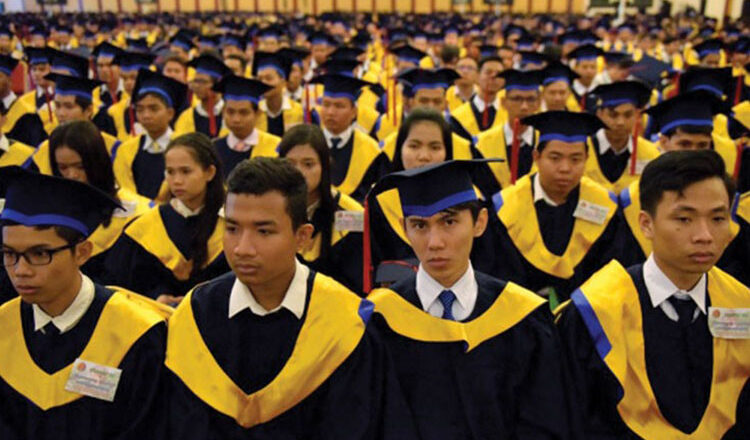 The number of PhD students in Cambodia has steadily increased in recent years, from about 1,000 in 2019–2020 to roughly 1,400 in 2023–2024. AFP
-Opinion-
Cambodia’s PhD education is facing a crisis. While there is an increase in the number of PhD programmes offered by Cambodian higher education institutions, the quality of doctoral education remains limited. Low-quality PhD supervision and the growing prevalence of predatory publishing among Cambodian PhD students and supervisors have further damaged confidence in the system.
In recent years, Cambodia has witnessed a rapid expansion of PhD programmes. According to the 2025 Education Congress report, published by the Ministry of Education, Youth and Sport, there are now 25 such programmes, seven at public higher education institutions and 18 at private ones. This number will increase as more universities seek to offer doctoral programmes to meet the rising demand for PhD degrees.
The Education Congress report shows that the number of PhD students has steadily increased in recent years, from about 1,000 in 2019–2020 to roughly 1,400 in 2023–2024. Despite the rise, the number of PhD enrolments is less than 1% of the total student enrolment in higher education. Specifically, it was reported that of the 316,105 students enrolled in higher education in 2023–2024, 12.5% were pursuing associate’s degrees, 82.2% bachelor’s degrees, 4.7% masters, and around 0.5% doctorates.
The increase in PhD enrolments, however, comes with some interrelated problems. First, the issue concerning low-quality PhDs still persists; second, weak or low-quality PhD supervision remains prevalent; and third, rising predatory publishing among PhD students and advisors.
On the surface, more PhD enrolments is a positive sign. Cambodia will have more PhD graduates who will become intellectuals or highly skilled knowledge workers to drive research and scholarly publication as well contribute to national development. More PhD holders will also help to address a pressing issue in the higher education sector where only around 11% of the teaching personnel hold a PhD degree. This will improve the higher education sector in general and promote research and publication in particular.
Yet beneath this expansion lies a troubling reality. The issue of the inflation of unqualified PhD holders remains unresolved, while newly minted PhDs may not be at the level expected of PhD graduates, thereby further inflating the number of low-quality PhDs.
Altogether, these issues, if not properly addressed, will have long-term negative consequences on Cambodia’s education and research ecosystem and threaten both the credibility of Cambodia’s PhDs and the future of its academic community.
Within this context, three key issues stand at the heart of this crisis: the continuation of the provision of low-quality PhDs, weak PhD supervision, and the rise of predatory publishing.
Fake or low-quality PhDs
The first issue is the inflation of PhD titles without academic substance or value. This is perhaps one of the most damaging trends in Cambodian higher education. Many so-called PhD holders have obtained their degrees from diploma mills abroad or local programmes with little academic rigour. This problem has persisted for years and little action has been taken to address it.
If left unchecked, it will further undermine the value of genuine doctoral training, ruin public trust in Cambodian higher education, and create a culture in which the prestige of the PhD title matters more than the quality of research or scholarship that comes with it. Thus, the inflation of unqualified PhDs needs to be urgently and seriously tackled, especially by the policymakers at the national level. It is critical to put a stop to the problem that has weakened the standing of Cambodian academia and the credibility of doctoral education in the country.
Low-quality PhD supervision
A second issue is weak PhD supervision, linked to a lack of qualified supervisors, particularly in doctoral programmes. This issue is understandable given the limited number of PhD holders in Cambodian higher education and the precarious environment surrounding research and scholarship in Cambodia.
High-quality supervision is certainly the backbone of doctoral education; however, a shortage of academics with PhD degrees, including those with true expertise, strong research and publication output, and sufficient experience in international academic standards, has affected the quality of postgraduation programmes in Cambodia, especially PhD programmes.
Many supervisors may have limited experience in research and publication while some have to cope with heavy teaching loads and administrative responsibilities, resulting in their inability to provide the necessary guidance or mentorship that the students need. The consequences are predictable: poorly trained PhD graduates who will perhaps contribute to perpetuating the low standards of supervision and low-quality teaching when they become lecturers or supervisors.
Rising predatory publishing among PhD students
The third issue is an emerging one. It lies in the growing prevalence of predatory publishing among doctoral students and even their PhD supervisors. As PhD students in Cambodia are required to publish before graduation, there is a growing need to publish quickly and easily to meet the graduation requirements set out by the ministries that supervise higher education institutions in Cambodia.
Without clear quality control on the part of Cambodian universities and the seemingly limited research integrity of some PhD supervisors, many students turn to predatory or low-quality journals that provide quick publication services without proper or rigorous peer review, commonly upheld by credible or international indexed journals, such as those indexed in Scopus or Web of Science databases. The trend of predatory publishing will, over time, risk normalising poor scholarly practices and weakening Cambodian academia and its scholarly contributions to the international academic community.
Solutions to the problems
Cambodian policymakers at the national or institutional levels need to be serious about strengthening doctoral education in Cambodia. There is no time to waste. The country’s PhD education is at a crossroads. It is either improving the quality of PhD education or allowing the phenomenon of “PhD inflation” to continue to damage Cambodian academia and society.
Enforcing accreditation and eliminating fake PhDs
The Ministry of Education, Youth and Sport, particularly the Accreditation Committee of Cambodia, must set and enforce clear standards for doctoral programmes. Although various efforts and mechanisms have been put in place, such as the 2015 Directive on the Management of PhD Training at Higher Education Institution under the supervision of the Ministry of Education, Youth and Sport, a lot more needs to be done.
Read more on Thursday
-Khmer Times-