
Editorial 81 – The Ocean Food Web Begins Small
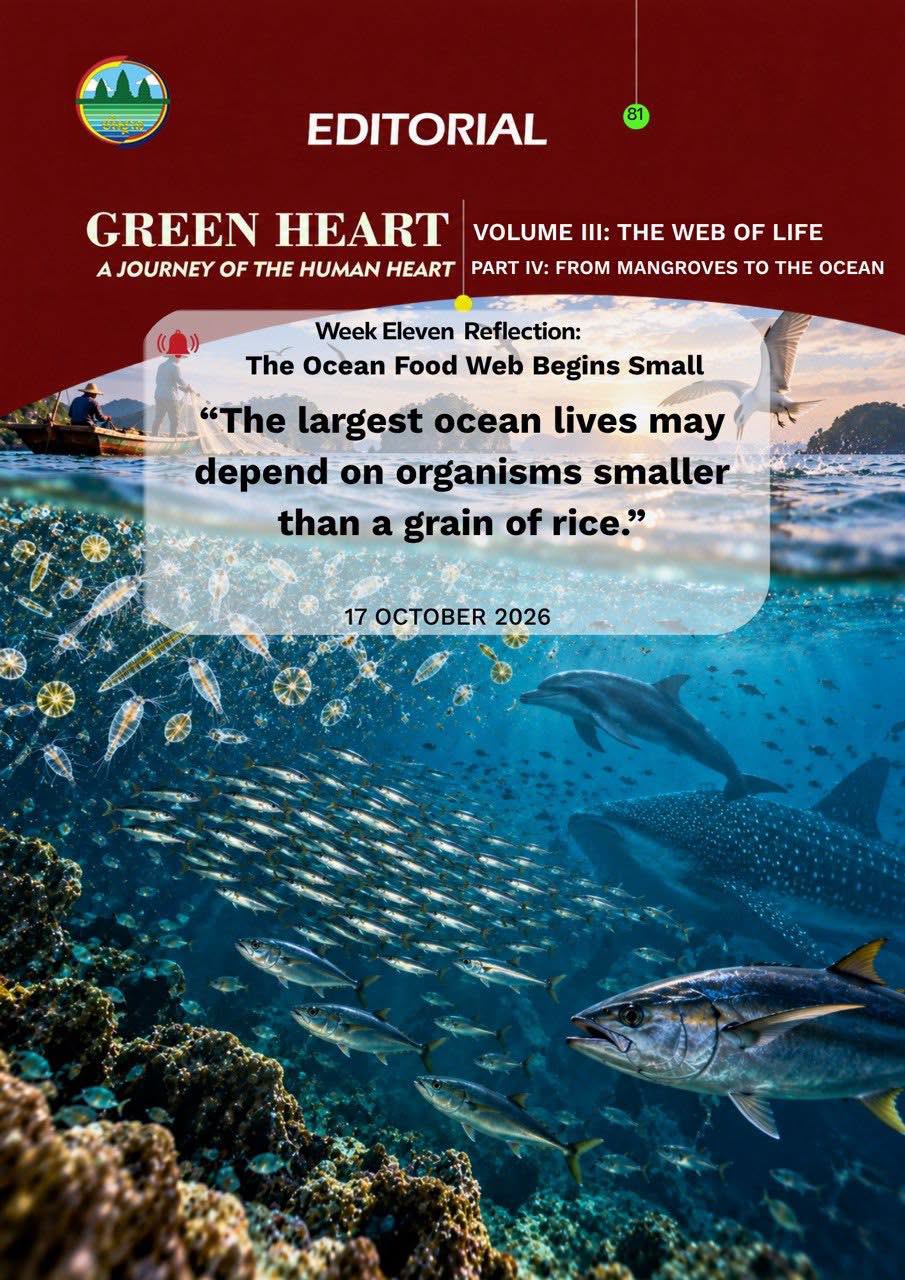 Editorial 81 – The Ocean Food Web Begins Small
Opening Thought
“The largest ocean lives may depend on organisms smaller than a grain of rice.”
Editorial
Whales, tuna, sharks, and sea turtles capture our imagination, but much of the ocean food web begins with plankton—organisms that drift with currents.
Phytoplankton use photosynthesis and form a major primary-producer foundation. Zooplankton include tiny animals and the drifting young stages of larger organisms. Small fish and filter feeders consume plankton; larger animals feed through many connected levels.
Phytoplankton contribute a substantial portion of global photosynthesis and oxygen production. The oxygen we breathe comes from the combined activity of land plants and marine photosynthetic organisms over long periods, not from one forest or one day.
Plankton communities change with light, temperature, nutrients, currents, and seasons. Too few nutrients can limit growth; too many from pollution can contribute to harmful blooms and oxygen loss near coasts.
Some algal blooms produce toxins, though most algae are not harmful. Monitoring and public-health guidance are essential when seafood or water safety may be affected.
Energy moves inefficiently between feeding levels, so large predators depend on vast production below. Changes in plankton timing or distribution can influence fish, seabirds, and marine mammals.
Plastic fragments and other pollutants may enter food webs when organisms consume them. The biological effects vary by material, size, dose, and species, but preventing pollution is safer than allowing the ocean to become an experiment.
Fishing can change the web from above by removing predators or forage species. Climate change can alter it from below by shifting temperature, oxygen, acidity, and plankton. Ecosystem-based management considers these interactions.
Students can explore plankton through safe classroom samples, microscopes, photographs, or scientific videos. Never collect from unsafe water without trained guidance.
The ocean teaches that importance is not measured by body size. A drifting cell may capture a ray of sunlight, feed a tiny grazer, and begin an energy path that eventually supports a whale.
When we protect water quality, climate stability, and food-web integrity, we protect lives both microscopic and magnificent.
Plankton also remind us that monitoring must continue. A change invisible from shore can signal warming, nutrient pollution, or shifting currents. Long-term records help scientists separate ordinary seasonal variation from deeper change.
Community observations can complement instruments when methods are clear. Fishers may notice unusual water color, jellyfish, catch timing, or animal behavior. Reporting patterns gives scientists useful questions to investigate.
Partnership turns local attention into a wider early-warning network.
Buddhist Reflection
The ocean food web softens pride. Great bodies depend on tiny lives, and visible strength rests on invisible foundations. Gratitude should travel through every level.
Today’s Reflection
Why do large marine animals depend on abundant life at the bottom of the food web?
Today’s Action
Draw an ocean food web beginning with phytoplankton and ending with two different large animals.
Today’s Pledge
Today I will respect small ocean lives as the beginning of great possibilities.
When we protect nature, we protect all beings—includi