ICC-Preah Vihear seeks Thailand firing data to support mine clearance
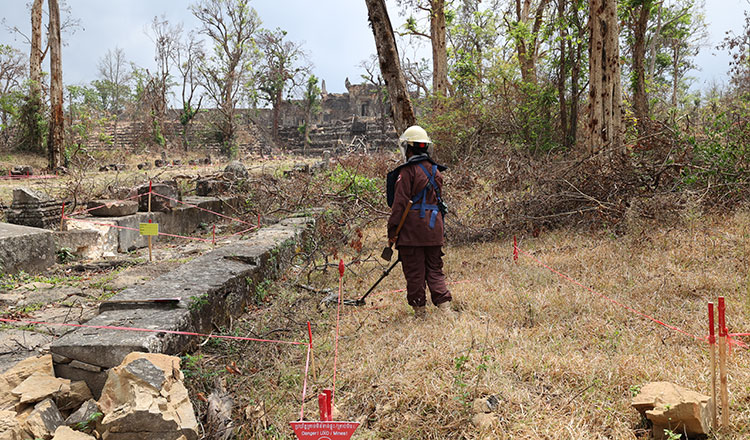 CMAC personnel place warning signs and flags around a hazardous area near the Preah Vihear Temple. KT/Khem Sovannara
Synopsis: Heritage experts and government representatives gather in Siem Reap to assess conflict damage to Preah Vihear Temple and discuss restoration work backed by international partners.
The International Coordinating Committee for the Safeguarding and Enhancement of the Preah Vihear Temple (ICC-Preah Vihear) urged Thailand to provide firing directions and data on aerial bombings and ground fire to support the clearance of landmines and explosive remnants of war around the site.
The request was made during the committee’s 11th Technical Session in Siem Reap province on September 30, chaired by Minister of Culture and Fine Arts Phoeurng Sackona alongside Chinese and Indian co-chairs. Representatives from Belgium, France, Japan, Thailand and the US attended, with about 150 participants joining in person and online.
National Authority for Preah Vihear (NAPV) Director-General Kong Puthikar presented findings from an advisory mission by international experts from the World Heritage Committee and ICOMOS, who assessed conflict damage at the World Heritage Site in March.
The report showed that clashes between July and December 2025 damaged 562 locations at the temple, as well as mountain infrastructure and surrounding communities.
Following recommendations from the UNESCO assessment and the ICC-Preah Vihear’s March session, the NAPV carried out emergency interventions supported by UNESCO, the ALIPH Foundation, the French Ministry of Culture and the Cambodian government.
The Cambodian Mine Action Centre (CMAC) cleared unexploded ordnance from 70 hectares, identifying 625 craters, 977 ordnance items and four drones.
The NAPV catalogued and stored 84,800 broken stone fragments, installed temporary structural supports at 23 locations, set up monitoring equipment at 50 sites, constructed protective roofs over four areas and restored 250 metres of the ancient drainage system.
Experts identified further urgent tasks, including emergency support for 25 additional locations, a shelter for stone fragments and drainage systems to divert water from the temple.
Participants expressed concern over the damage, stressing the need to protect technical teams. Sackona said the site must serve heritage functions and cannot be used for military purposes.
Sackona cited World Heritage Committee Decision 48 COM 7 from July 2026, which expressed concern over conflict damage to cultural sites. She urged the Joint Boundary Commission to resume border demarcation and called for 20,000 displaced Cambodians to be allowed to return home.
To aid mine action, the meeting asked Thailand to supply military firing data as a baseline for clearance. It also advised the NAPV to prioritise areas containing cluster munitions and remnants from recent clashes.
The committee also reviewed progress at the Koh Ker temple site, including the completed restoration of the Prasat Krahom tower and southern gate. Research projects included foundation studies at Prasat Balang Tbong, conservation planning for Prasat Krachap and Prasat Pram, human settlement research by Germany’s Max Planck Institute and excavations by Yale University.
Sackona presented certificates of appreciation to CMAC and documentation certificates to NAPV and APSARA National Authority officials.
Participants commended Cambodian authorities and experts for preventing further deterioration and thanked UNESCO, the ALIPH Foundation, the French Ministry of Culture and the US Embassy for technical and financial support.
The meeting appealed to member states and international institutions to maintain support to preserve the site’s outstanding universal value.
-Khmer Times-