Thai claims Cambodia ‘shut door’ to talks misrepresents facts, say analysts
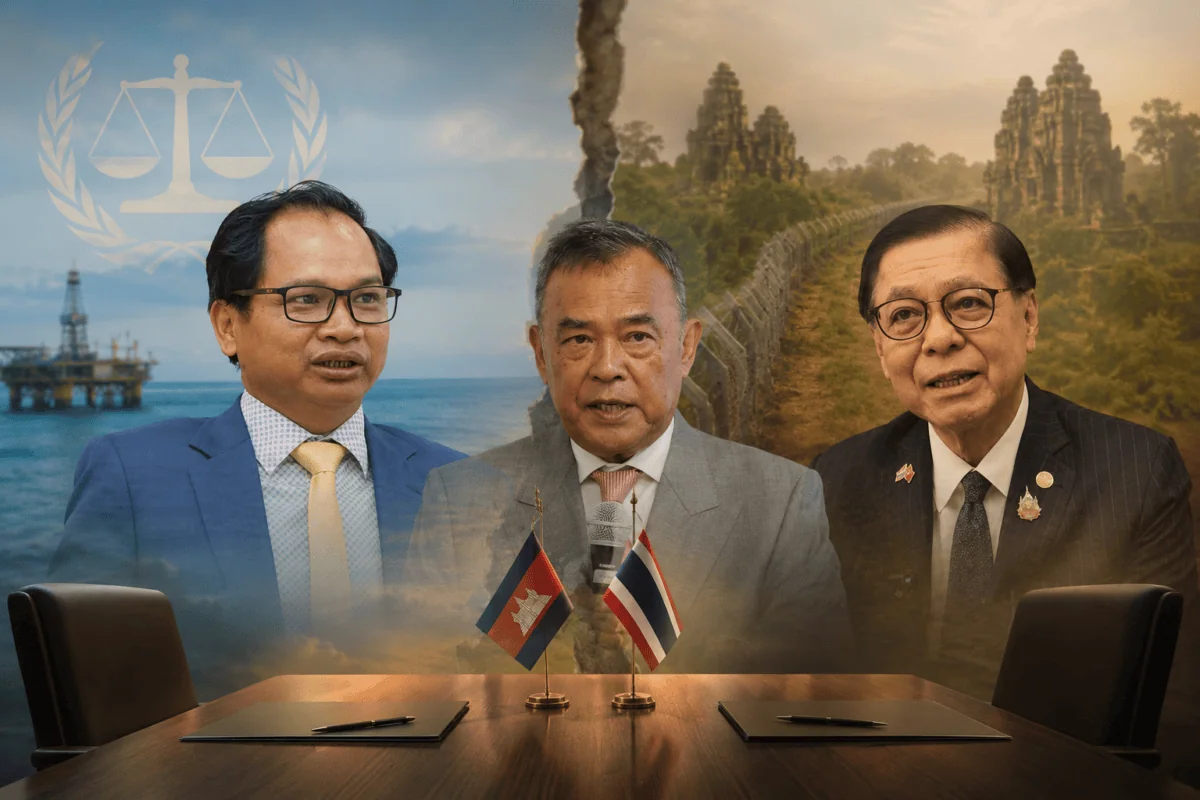 (L-R) Yang Peou, a geopolitical analyst, Pou Sothirak, a senior adviser at the Cambodian Center for Regional Studies (CCRS) and Thai Foreign Minister Sihasak Phuangketkeow. Post AI
Cambodian analysts have rejected Thai Foreign Minister Sihasak Phuangketkeow’s assertion that Cambodia’s decision to initiate compulsory conciliation under the UN Convention on the Law of the Sea (UNCLOS) has effectively “closed the door” to bilateral negotiations, arguing that Phnom Penh has continued to pursue dialogue on land border issues while using a separate legal mechanism to address maritime disputes.
Speaking to Thai media during his recent visit to Beijing, Sihasak said Cambodia’s decision to pursue compulsory conciliation over overlapping maritime claims had undermined trust and made discussions on the land border more difficult.
“At this point, it has effectively closed the door to discussions on the land border. That makes things much more difficult,” he claimed.
The Thai foreign minister argued that compulsory conciliation should only have been pursued after both sides had exhausted bilateral negotiations.
He also said China could encourage Cambodia to honour what he described as a commitment to resolve disputes through bilateral dialogue.
However, Cambodian analysts interviewed by The Post said the Thai minister’s remarks conflated two separate processes and overlooked Cambodia’s repeated efforts to maintain bilateral engagement on land boundary issues.
Pou Sothirak, a senior adviser at the Cambodian Center for Regional Studies (CCRS), said the UNCLOS compulsory conciliation concerns maritime disputes arising from Thailand’s unilateral termination of the 2001 Memorandum of Understanding (MoU) on overlapping maritime claims and should not be confused with ongoing mechanisms for land border negotiations.
“The compulsory conciliation process is separate and independent from the Joint Boundary Commission (JBC) process, although they are linked in spirit because both seek peaceful settlement,” he noted.
He explained that Cambodia resorted to compulsory conciliation only after Thailand unilaterally withdrew from the 2001 MoU without prior official consultation, leaving Phnom Penh with no bilateral mechanism to address the maritime issue.
“That does not mean Cambodia has closed the door to bilateral talks. Cambodia has never had any intention of abandoning dialogue with Thailand,” he said.
Pou stressed that compulsory conciliation itself remains a form of bilateral engagement, with both countries participating directly through conciliators appointed under UNCLOS.
“In fact, Cambodia still wants to talk. The difference is that discussions must now take place within a legal framework under UNCLOS rather than solely through the mechanism established by the 2001 MoU,” he said.
He described Thailand’s latest remarks as a strategic interpretation rather than an accurate reflection of Cambodia’s position.
“My reading is that Thailand sees Cambodia’s use of compulsory conciliation as placing Bangkok at a diplomatic disadvantage and is using it as a reason to delay or hold up land border negotiations. Cambodia has never closed channels of communication,” he said.
Pou noted that the conciliation process was already moving forward after both countries appointed two conciliators each.
The four conciliators are now selecting a fifth member, who will chair the commission before substantive discussions begin.
He highlighted that unlike judgments by the International Court of Justice, recommendations issued through compulsory conciliation are not legally binding, meaning both governments remain free to accept or reject them.
Looking ahead, Pou outlined three possible outcomes.
The most favourable scenario, he said, would see both countries reach a treaty under the UNCLOS process establishing maritime boundaries while also creating a framework for the joint development of overlapping claims.
A second scenario would involve Cambodia and Thailand reaching a new bilateral agreement — similar in spirit to the 2001 MoU but with stronger safeguards against unilateral withdrawal.
The least desirable outcome, he warned, would be a collapse of negotiations that could increase tensions at sea and potentially prompt Cambodia to pursue a binding legal ruling through the International Court of Justice.
“No one benefits from military confrontation. The best outcome is for both countries to continue engaging peacefully and find a mutually acceptable solution,” he said.
Yang Peou, also a prominent geopolitical analyst, also rejected Thailand’s suggestion that Cambodia had abandoned bilateral dialogue, saying Phnom Penh’s diplomatic record demonstrated the opposite.
“Cambodia has never closed the door to bilateral negotiations. The diplomatic record shows Cambodia has repeatedly invited Thailand to meet through the established border mechanisms,” Yang told The Post.
He said Cambodia had consistently sent diplomatic notes requesting meetings through existing mechanisms, including the JBC, the General Border Committee (GBC) and the Regional Border Committee (RBC), while publicly disclosing many of those invitations.
“The claim that Cambodia has shut down bilateral negotiations misrepresents the facts. The available diplomatic correspondence shows Cambodia has continued calling for bilateral meetings, while also pursuing peaceful legal avenues where necessary,” he noted.
Yang added that Cambodia’s decision to initiate compulsory conciliation over maritime issues should not be interpreted as abandoning bilateral diplomacy because the maritime and land boundary issues are governed by different mechanisms.
Cambodian officials have repeatedly maintained that Phnom Penh has continued to seek bilateral engagement on land border issues despite the maritime legal proceedings.
Since tensions escalated, Cambodia has sent multiple diplomatic notes inviting Thailand to convene meetings of the Joint Boundary Commission (JBC), but Thai authorities have either declined or postponed the meetings, citing various reasons.
Cambodian officials argue that these exchanges demonstrate Phnom Penh has consistently sought to keep bilateral channels open while pursuing separate legal mechanisms to resolve maritime disputes.
The dispute stems from Thailand’s unilateral cancellation of the 2001 Cambodia-Thailand Memorandum of Understanding governing negotiations over overlapping maritime claims in the Gulf of Thailand.
In response, Cambodia initiated compulsory conciliation under Annex V of UNCLOS, marking the first such case involving Southeast Asian neighbours.
Despite the legal proceedings, Cambodia has repeatedly stated that it remains committed to bilateral mechanisms for resolving land boundary issues, including meetings of the Joint Boundary Commission, while pursuing peaceful settlement of maritime disputes through international law.
The UNCLOS conciliation process is now entering its next phase, with the appointment of the fifth conciliator expected before the commission begins establishing its rules of procedure and substantive discussions between the two sides.
-Phnom Penh Post-