Thailand’s Two Faces of Neighbourhood Diplomacy: A Question of Double Standards
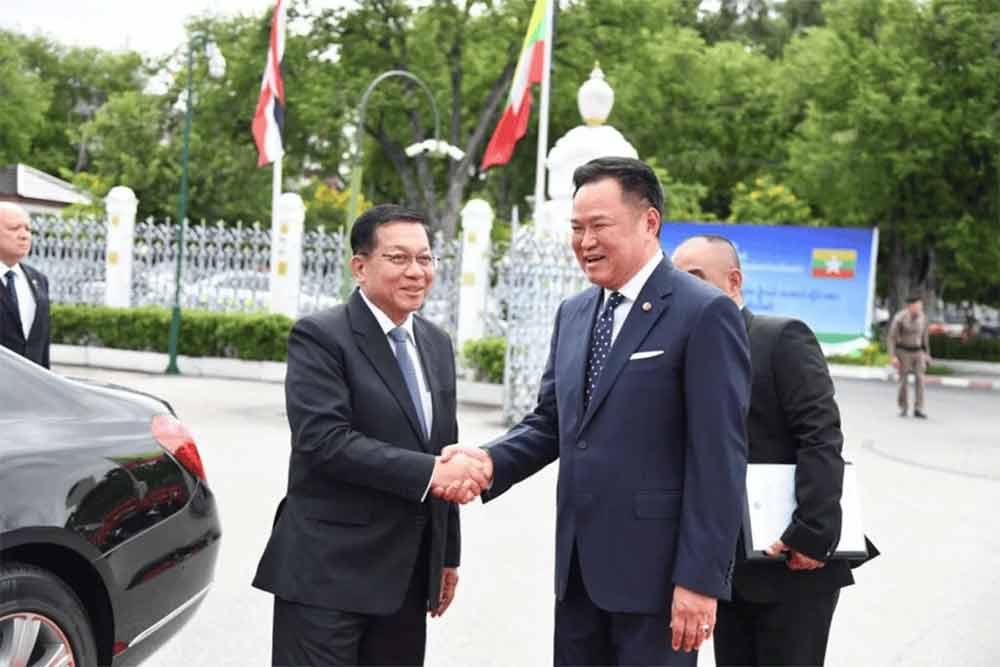 Thai Prime Minister (right) greets Myanmar President Min Aung Hlaing in Bangkok on September 6. Khaosod English
There is a difficult question that Thailand should answer honestly: Does Thailand treat all of its neighbours according to the same diplomatic principles, or does its behaviour change depending on the size, strength and economic importance of the country on the other side of the border?
I raise this question as a Cambodian citizen — not as an enemy of the Thai people, but as someone who has watched the relationship between Cambodia and Thailand for many years.
Thailand frequently presents itself as a major regional power and an important voice in ASEAN. With that position comes a responsibility: a regional power should demonstrate the same respect for sovereignty, territorial integrity and peaceful dispute settlement toward a smaller neighbour that it expects from everyone else.
But Thailand’s behaviour toward its neighbours deserves closer examination.
Malaysia: diplomacy, economic cooperation and accommodation
Look at Thailand’s relationship with Malaysia.
Thailand’s government identified Malaysia as Thailand’s No. 1 trading partner in ASEAN. In July 2026, Prime Minister Anutin Charnvirakul visited Malaysia and emphasised economic cooperation, trade, investment, tourism, border connectivity and security. The two governments set a goal of increasing bilateral trade to $30 billion and described their border as an area of economic opportunity.
Thailand has also emphasised that cooperation with Malaysia is strategically important for the development of Thailand’s southern provinces.
There is nothing wrong with this approach. In fact, dialogue and economic cooperation are exactly what neighbouring countries should pursue.
But it raises a question: Why should the principle of dialogue and accommodation be treated differently when the neighbour is Cambodia?
If economic interdependence and strategic interests encourage Thailand to pursue negotiation and cooperation with Malaysia, why should disputes with Cambodia so easily become matters of confrontation, pressure or nationalist rhetoric?
Myanmar: another test of Thailand’s calculation
Myanmar provides another revealing comparison.
When violence and military operations in Myanmar affected nearby parts of Thailand, including an incident in April 2026 in which a bomb landed on Thai territory in Mae Hong Son province, Thailand’s response included evacuations and strengthened border security rather than a direct military attack on Myanmar.
That is a legitimate choice for a government seeking to prevent escalation. But it demonstrates an important point about international relations: Thailand is capable of restraint when circumstances require restraint.
Therefore, the question is not whether Thailand knows how to exercise restraint. The question is when Thailand chooses to exercise it—and toward whom.
Cambodia should not be treated as the easy target
This is where many Cambodians have legitimate questions.
Cambodia is Thailand’s neighbour. Cambodians are not Thailand’s enemies. Cambodian workers, traders, students, families and businesses have deep connections with Thailand. The two countries share culture, geography, history and an enormous amount of human interaction.
Yet when disagreements arise between Cambodia and Thailand, public rhetoric can become dramatically more confrontational.
This creates the impression — whether intended or not — that the diplomatic threshold for applying pressure to a smaller neighbour may be lower than the threshold for confronting a more economically or strategically important neighbour.
That is the issue Thailand should address.
I am not claiming that every Thai government action has been identical or that every dispute has the same circumstances. They do not.
I am asking a much simpler question: Should the principles of international relations change according to the size and strength of the neighbour?
If the answer is no, then the same standards should be visible everywhere.
Strength should not mean intimidation
A country’s military strength does not give it greater sovereignty than another country. A larger economy does not give one nation greater ownership of international law.
A smaller population does not mean a country’s territorial rights are less important, and being a smaller neighbour does not mean Cambodia should remain silent whenever its interests are challenged.
Cambodia has increasingly emphasised diplomatic and legal mechanisms. On September 15, 2026, Cambodia and Thailand began a UN-backed compulsory conciliation process concerning their maritime boundary dispute, with the opening meeting taking place in Singapore.
That is exactly the type of mechanism ASEAN should encourage: put the evidence on the table, put the law on the table, and let diplomacy work before military power does.
Thailand’s real test is consistency
Thailand cannot simultaneously call for regional peace while appearing to apply different diplomatic temperatures to different neighbours. It cannot ask smaller countries to respect Thailand’s sovereignty while expecting those same countries to accept pressure when Thailand’s own interests are involved.
It cannot celebrate cooperation with one neighbour while allowing disputes with another neighbour to become fuel for nationalism.
The test of a country’s foreign policy is not how loudly it speaks. The test is whether its principles remain the same when dealing with a weaker country.
That is why I believe Thailand should look carefully at its own record.
If Malaysia can be treated as an essential economic and strategic partner, if Myanmar can be dealt with through restraint and security measures despite serious incidents near the Thai border, then Cambodia should also be approached through diplomacy, evidence, international law and mutual respect.
There should not be a “strong-neighbour standard” and a “small-neighbour standard.”
There should be one standard.
An appeal to Thailand
I say this directly to the Thai government and to Thai policymakers: Do not confuse Cambodia’s desire for peace with weakness. Do not confuse Cambodia’s smaller economy with smaller sovereignty.
Do not assume that a Cambodian demand for international law is an act of hostility, and do not allow political rhetoric to turn ordinary Cambodians and Thais against one another.
Thailand is an important ASEAN country. Precisely because of that position, Thailand has an opportunity to demonstrate what responsible regional leadership looks like.
Real strength is not threatening the weaker neighbour. Real strength is having enough confidence to treat the weaker neighbour with the same dignity and respect given to the stronger one.
Cambodia does not need hostility with Thailand. Cambodia does not need a culture war with Thailand.
Cambodia needs a relationship based on equal sovereignty, evidence, international law, mutual respect and peaceful coexistence.
And I believe ordinary Thai people deserve the same thing.
Because at the end of the day, borders are negotiated by governments — but peace is lived by ordinary people.
Tesh Chanthorn is a Cambodian citizen who longs for peace, The news and pinions expressed are his own.
-Phnom Penh Post-