In Xi-Trump summit pomp, pageantry has postponed pressure
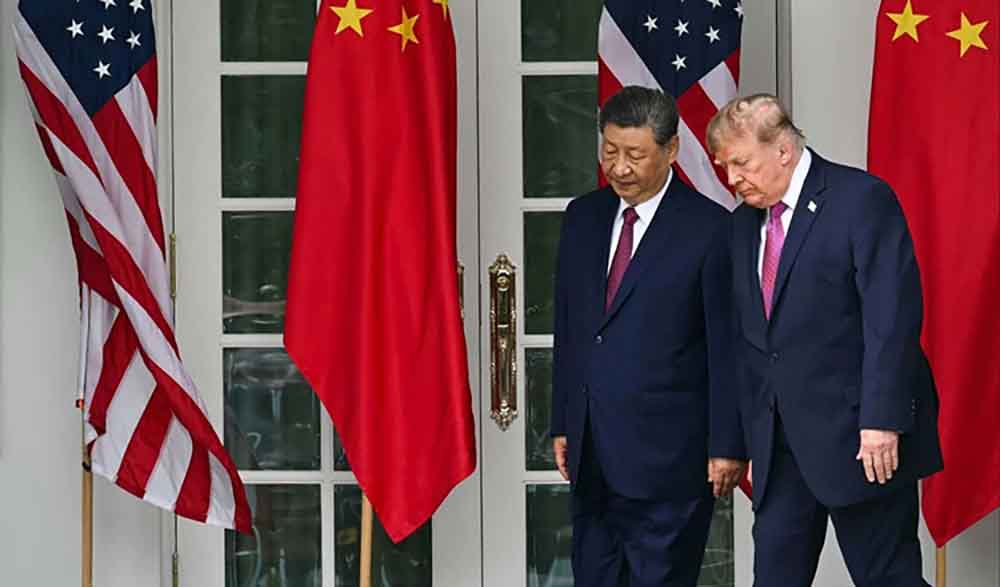 China’s President Xi Jinping (left) and US President Donald Trump arrive for a military review in the Rose Garden of the White House in Washington on Thursday. AFP
#opinion
Chinese President Xi Jinping arrived in Washington, DC, on Thursday with a simple aim: Things are going as well as they can for China, so don’t stir up things and don’t allow Donald Trump to do so. And so it has been: The outcome of the Xi-Trump summit is being judged by the pageant and pomp on display rather than by measurable diplomatic outcomes. The trade truce between the two countries has been extended by two months; there is broad agreement on artificial intelligence (AI), and substantive talks on both issues have been kicked down the road. Taiwan and Iran have not played the spoilers they could have been.
For all their sound and colour, summits rarely yield practical results. But the reception Xi received upon his arrival in Washington, DC, for his first State visit in a decade, was out of the ordinary.
For the first time since 1962, a US president met a visiting counterpart at the airport. On Thursday, there was a gun salute, teams waved flags, bands played the two countries’ national anthems, and as many as two fly-pasts featured cutting-edge US warplanes. At all times, Xi was accompanied by an attentive, even deferential, Donald Trump and US First Lady Melania Trump.
On his last visit in 2015, Xi came as a supplicant, seeking to satisfy US demands on the climate crisis and cybersecurity. This time around, the atmosphere has been speaking for itself.
At the talks on Thursday, Xi said Trump had “maintained communications”, and both leaders had worked together to “steer the giant ship of China-US relations.” This was based on their May agreement in Beijing to pursue a “constructive relationship of strategic stability” whose pillars were cooperation, limits on competition, and effective management of differences. He said this was necessary to avoid the Thucydides trap that could push the two countries into a military collision.
Earlier, welcoming Xi to the country, Trump spoke of the “truly great friendship” that had helped to shape their relationship.
Under the agreement reached in Busan, South Korea, in October 2025, the US lowered its average tariff on Chinese imports to 47% and fentanyl-related levies to 10% and suspended high tech export controls. The Chinese, in return, eased their draconian restrictions on rare earth mineral supply. Beijing also resumed its large-scale purchase of US agricultural goods such as soyabeans.
Now, amid this atmosphere of bonhomie between Beijing and Washington, the Graham Act, recently enacted by the US, and its threat of draconian tariffs on China and India on account of their Russian oil purchases seem to have been set aside for the moment. By extending the truce till January 2027, the two sides seem determined to fashion a more durable trade deal.
Both sides’ primary interest is to keep the relationship steady. Trump wants this at least till the November midterm elections in the US; Xi would like it for a longer period to get his country’s sputtering economy going and to overcome his purge of the top ranks of the Chinese military.
The most talked about item on the presidents’ agenda has been AI. During the talks, Xi spoke of continuing their dialogue and declared “AI must be kept under human control”. Earlier, Trump had tweeted, “Super Intelligence (SI) will be a big topic of discussion, but I want to leave it exactly where it is. That is China’s position also.”
There was little or no reference to Iran in the public remarks. Trump likely asked Xi to talk to the Iranians, but Beijing is clear it would not like to get involved beyond a point. But China also doesn’t want regional tensions to spill over into Yemen and the Red Sea.
The elephant in the room at the White House talks was Taiwan. Xi indicated in his remarks that China’s position was “clear-cut” and hoped that the US would “adhere to the correct position of opposing ‘Taiwan independence.’” He is alluding to the profound diplomatic and operational nuance in the US position that it “does not support” Taiwan’s claim for independence. The US posture on Thursday is not yet known.
For India, the ledger tilts toward loss. The pageantry undercuts the premise that India is the US’s indispensable counterweight to China in Asia, and a president who calls arms supply to Taiwan “a good negotiating chip” with China may see Quad the same way.
The Graham Act’s tariff threat shows the asymmetry: India can be punished for what Beijing is very well spared. The sensible response for New Delhi is to stop waiting for Washington’s favour and to build leverage of its own, through trade deals with others, domestic capacity in critical minerals and electronics, and a border settlement with China that is negotiated on India’s terms rather than after a US-China deal has already set the terms.
In his dealings with China, Trump has been uncommonly accommodating. The grand Washington reception and State dinner will play well not just with the domestic audience, but also with the Global South, where China has considerable influence. Thursday’s summit was the third face-to-face meeting between the two leaders in less than a year, and we are likely to see yet another in November at the Asia Pacific Economic Cooperation (APEC) summit in Shenzhen, China. This will be followed by one at the G-20 summit scheduled in December.
No matter how intractable some of China and the US’s problems are, we should not discount the value of the face-to-face meetings between the two presidents. As Chinese foreign minister Wang Yi noted, “Head of State diplomacy is the cornerstone of China-US relations.”
But while Xi wants the US and China to be “partners, not rivals,” and Trump says “we’ve never gotten along better”, the trust deficit and structural issues between them —Taiwan, technology, trade, critical minerals, AI, and Iran—will not go away. The Washington summit has managed the rivalry; it has not resolved it.
Manoj Joshi is a Distinguished Fellow, Observer Research Foundation, New Delhi.
-Khmer Times-
—————