Ceasefire is not enough: A third way forward for Cambodia and Thailand
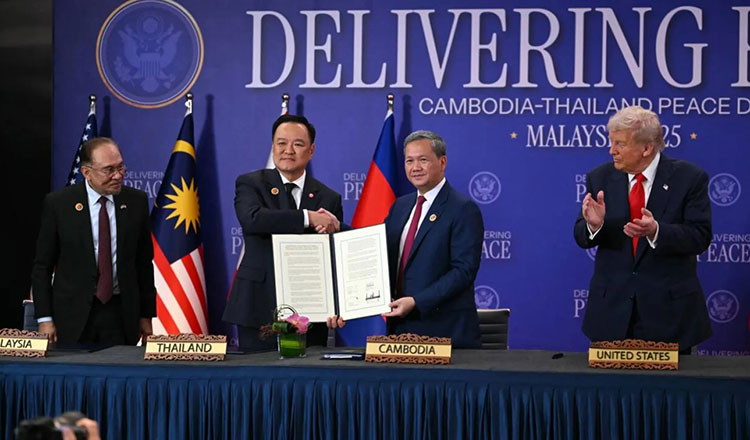 Prime Minister Hun Manet (2-R) and Thai Prime Minister Anutin Charnvirakul (2-L) ink a ceasefire pact, brokered by Malaysian Prime Minister Anwar Ibrahim (L) and US President Donald Trump, in Kuala Lumpur on July 28, 2025. AFP
#Opinion
The Cambodia-Thailand ceasefire has achieved something that must not be taken for granted: the guns are no longer deciding the border. But a ceasefire is not the same thing as a settlement.
For the families living along the frontier, that distinction is not theoretical. Homes remain empty. Communities remain disrupted. Questions about military positions, physical structures, access, administration and the future of disputed areas continue to generate competing claims. Cambodian officials say more than 20,000 displaced civilians still cannot return safely and permanently to their homes. Cambodia continues to press for practical work through the Joint Boundary Commission, including Joint Survey Teams. ASEAN observers remain engaged, and international representatives continue to monitor and assess conditions along the frontier. These efforts matter. Verification matters. Documentation matters. Bilateral diplomacy matters. International law matters. However, the human consequences of an unresolved dispute do not disappear simply because the shooting has stopped.
That raises a difficult question: What should Cambodia and Thailand do when a ceasefire has stopped the violence, but diplomacy has not yet produced agreement on every remaining issue? Perhaps it is time to consider a third way.
Compete instead of fight
Play For It! proposes a simple but unconventional principle: when two countries are determined to resolve a defined dispute peacefully, they could compete rather than fight. This would not be a symbolic exhibition match. It would not be a friendly game designed merely to improve relations. It would be a structured, transparent and internationally witnessed competition in which the two sides agree before the competition on the rules, the sport, the officials, the observers, the stakes and exactly what the result would mean.
The crucial point is that the sporting contest would not determine legal sovereignty on its own. Instead, Cambodia and Thailand could voluntarily agree that the result of a particular competition would determine a narrowly defined practical outcome while preserving each government’s underlying legal and historical position. That distinction is essential.
Neither side would have to declare that the other is legally correct. Neither would have to surrender its historical narrative. Neither would have to abandon the existing bilateral or international mechanisms for resolving the larger boundary question. The competition would simply become another instrument within a broader diplomatic process.
Start small
The proposal does not require Cambodia and Thailand to settle their entire border through sport. That would be unrealistic. A better approach would be to begin with one carefully selected unresolved issue where the practical consequences are clearly defined. Before any competition, the two governments would agree on a temporary framework. Military forces would not advance to improve their position. No new physical facts would be created during the process. Civilians would not be displaced because of the competition. Schools would remain open. Healthcare would continue. Water, markets, roads and other essential services would remain accessible. The parties could also agree on neutral monitoring and verification, potentially involving ASEAN observers or another mutually accepted international mechanism. Then comes the competition.
The sport could be selected by mutual agreement, perhaps reflecting sporting traditions shared by the two countries. The precise choice would matter less than the principle: the contest would have rules, qualified officials, transparent scoring and an independently verifiable result. Most importantly, the governments would have already agreed what that result means.
For example, a competition might determine temporary administrative responsibility for a narrowly defined area, management of an agreed resource, or another practical arrangement for a fixed period. The losing side would retain the protections guaranteed by the agreement, while the underlying legal claims would remain available for resolution through the appropriate diplomatic or legal process. This is competition without escalation.
The goal is not to turn territorial disputes into entertainment. The goal is to find a peaceful mechanism for resolving specific questions that otherwise risk remaining frozen indefinitely.
Why would either side agree?
The obvious objection is that no government would allow a sporting event to determine something as serious as territory. That is precisely why the proposal should not be framed as a replacement for diplomacy or law. It should be framed as a voluntary political agreement between sovereign governments. Governments already agree to arbitration, mediation, referendums, international judgements, commissions and other mechanisms in which they accept in advance that a process will produce an outcome they may not control. Play For It! applies the same principle to a sporting competition. The important element is not the ball, the ring or the playing field. It is the agreement beforehand to accept the result. There is also a political advantage.
Territorial disputes are about more than maps. They involve national pride, historical memory and political identity. Leaders have to answer to citizens, veterans, soldiers and nationalists. A settlement perceived as surrender can be politically difficult even when both sides understand that continued confrontation serves no one. Sport can provide a different political language.
A government could say: “We competed. We followed the rules. We accepted the result.” That is fundamentally different from saying: “We surrendered.” For two proud neighbouring countries with deep cultural and economic connections, preserving dignity may matter as much as the outcome.
ASEAN can help make it credible
This proposal should not be designed outside the regional diplomatic architecture. It should be designed within it. The Joint Boundary Commission should continue its work. The General Border Committee and other existing mechanisms should continue. International law should remain the foundation for permanent boundary questions. ASEAN’s role in monitoring and encouraging de-escalation should continue. But ASEAN could also help make an experimental competition credible. Its involvement could include observation, verification, monitoring compliance with pre-agreed rules and helping both sides maintain confidence in the process.
The same principle could apply to other mutually trusted international observers. The purpose would not be for an outside power to decide who is right. It would ensure both sides know the competition is fair and that the agreement is being respected. That is particularly important in an environment where competing accounts of events can themselves become sources of tension.
Turn a border crisis into an opportunity
There is another important reason to consider the idea. A major Cambodia-Thailand sporting event could become more than a diplomatic experiment. It could generate broadcasting, sponsorship, tourism, hospitality and local commerce. A portion of revenues could potentially be directed into a jointly administered fund for affected border communities, schools, healthcare, infrastructure or other agreed priorities. The symbolism would matter. Instead of the border generating only military expenditure, displacement and uncertainty, it could begin generating investment and cooperation. The two countries would still compete fiercely. But the competition would produce something constructive rather than destruction.
That is the larger vision of Play For It!: transforming adversarial energy into peaceful competition and, eventually, making cooperation more valuable than confrontation.
A lesson from history – but not a blueprint
This idea may resonate in this region for historical reasons. The 1593 Battle of Nong Sarai is remembered for the famous encounter between opposing champions. Its historical circumstances were entirely different from today’s Cambodia-Thailand border dispute, and it should not be presented as a literal blueprint for modern diplomacy. But the broader idea is worth remembering: societies have sometimes sought ways to narrow the scope of confrontation rather than allowing conflict to consume everyone.
Play For It! modernises that principle. The weapons are removed. The rules are written in advance. The participants compete voluntarily. The process is observed. Civilians are protected. And the outcome is binding because the parties agreed beforehand that it would be.
The time for innovation is now
Cambodia and Thailand have plenty of diplomatic mechanisms available. That is not an argument against Play For It!. It is an argument for considering whether another instrument could complement those mechanisms. Both countries continue to say they want peace. The ceasefire has created space for diplomacy. ASEAN observers remain involved. Cambodia continues to seek progress through established bilateral mechanisms, while Thailand likewise maintains that the dispute should be addressed peacefully through bilateral channels. That creates an opportunity.
Innovation in peacemaking should not wait until after another war. It should not wait until after another mass displacement. It should not wait until another generation grows up viewing the neighbouring country primarily as an enemy. The time to experiment with peaceful alternatives is while the guns are silent. Cambodia and Thailand do not have to choose between surrender and war. There is a third way. They can compete.
Play For It! does not ask either country to abandon its history, surrender its legal claims or walk away from international law. It asks a narrower question:
When two countries cannot agree through words, and refuse to settle their disagreement through violence, can they agree to settle a defined part of it through competition?
The answer deserves to be tested.
The people living along the border have already paid too high a price for disagreement. They need to go home. They need their schools open, their farms accessible, their businesses functioning and their children growing up without fear.
A ceasefire can stop the shooting. Diplomacy can settle the claims. And perhaps sports competition can help create the political space between the two, where two proud nations can compete, accept an outcome, preserve their dignity and remain good neighbours.
The best way forward does not have to be through guns. It can be through games.
Nicholas Marian founded Play For It!, a US-based volunteer initiative developing sports-based approaches to territorial and geopolitical disputes. The views expressed are his own
-Khmer Times-