Experts warn UNCLOS conciliation could prove long and difficult
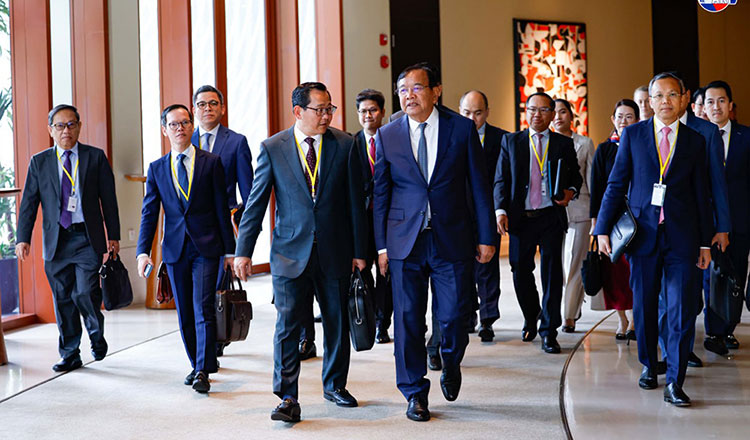 Foreign Affairs and International Cooperation Minister Prak Sokhonn (front row, right) is representing the Cambodian side in the UNCLOS compulsory conciliation meetings with Thailand in Singapore. AKP
Synopsis: Analysts say the process offers Cambodia and Thailand an avenue for peaceful dialogue over their maritime dispute, but substantial differences mean sustained negotiations are required to reach settlement.
The first round of compulsory conciliation under the United Nations Convention on the Law of the Sea (UNCLOS) opened a structured channel for dialogue between Cambodia and Thailand to settle their maritime dispute, though significant differences threaten to stall a final maritime settlement, analysts noted.
The third meeting of the UNCLOS Conciliation Commission concluded in Singapore yesterday, following opening positions presented on Tuesday. President Katrina Cooper chaired the five-member commission, with the Permanent Court of Arbitration serving as the registry.
The process concerns overlapping maritime claims in the Gulf of Thailand following Thailand’s May 5 decision to terminate the 2001 Memorandum of Understanding on the area. Cambodia subsequently invoked the compulsory conciliation mechanism under UNCLOS.
Cambodia seeks a comprehensive maritime boundary treaty while proposing joint development of offshore resources as an alternative arrangement. Thailand maintained that the immediate priority should be delimiting the maritime boundary before discussions on resource-sharing.
The competing approaches mean the conciliation process must address technical questions surrounding maritime delimitation alongside differing views over how negotiations should proceed.
Chheng Kimlong, president of the Asian Vision Institute, described the closed-door meeting as a positive step demonstrating willingness to address differences peacefully.
He cautioned against expecting an immediate settlement.
“I do not expect this first bilateral dispute-resolution mechanism to produce an immediate comprehensive solution, because the process will take time,” he said.
Kimlong said the process could take up to two years as parties work towards frameworks, joint recommendations and potential further mechanisms to facilitate negotiations.
He added that a successful conclusion could create conditions for cooperation in maritime security, environmental protection, fishing, commercial shipping and tourism while rebuilding trust.
The governments continue to differ over the scope of negotiations. Thailand said conciliation is expected to last 12 months and produce a non-binding report containing recommendations.
Policy analyst Seun Sam of the Royal Academy of Cambodia said future stages could become complicated if Thailand fails to provide full cooperation to the commission, which must examine legal documents, treaties and historical materials.
Sam said Cambodia should strengthen communication with the international community and provide the commission with documentation.
“Cambodia must have confidence in this process and provide more relevant documents and cooperation to the five commissioners currently carrying out the work,” he said.
Thailand had argued that the 2001 MOU produced little progress over two decades and that terminating it created a new basis for negotiations. Bangkok maintained that maritime delimitation should precede joint resource development.
Cambodia said Thailand’s termination of the MOU left it with no alternative but to seek the UNCLOS mechanism while proposing either a single boundary agreement or an interim joint-development arrangement.
During his opening statement, Thai Foreign Minister Sihasak Phuangketkeow raised broader bilateral disputes, including allegations concerning a leaked phone conversation, landmines and rocket fire. Thailand said it participates in good faith to seek a settlement protecting its rights.
The Cambodian side urged attention to legal issues under consideration rather than allowing unrelated disputes to dominate proceedings.
Kin Phea, director-general of the International Relations Institute of Cambodia, said UNCLOS conciliation could provide neutrality and transparency if both sides demonstrate commitment.
He said the maritime dispute should remain separate from land-border issues, as the mechanism concerns maritime delimitation rather than land sovereignty.
“Conciliation under the UNCLOS framework concerns maritime issues and the search for a solution to the delimitation of the maritime boundary between Cambodia and Thailand,” he said.
Phea added that using international law provides a legal basis for a lasting settlement, warning that military confrontation could complicate relations. He said the objective should establish a framework providing stability along the boundary while allowing cooperation in marine resource use.
Thailand stated it remains ready to cooperate with the commission, emphasizing that a settlement requires dialogue, trust and political will.
Youk Chhang, director of the Documentation Center of Cambodia, said the UNCLOS mechanism should be viewed as an instrument for securing peace rather than a guarantee against conflict.
“Agreements like laws are not ironclad guarantees of peace, but they are important instruments nonetheless for making peace more probable and secure,” he said.
He added that Cambodia can approach the process with optimism while remaining aware that peace remains fragile.
-Khmer Times-