A decade of conservation work destroyed, no timeline for Preah Vihear restoration
 A decade of conservation work destroyed, no timeline for Preah Vihear restoration
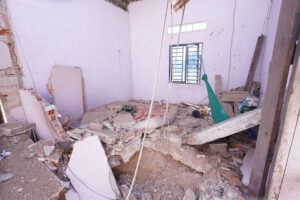
Several parts of Preah Vihear Temple that Cambodia and its international partners spent nearly a decade conserving were destroyed by Thai shelling during last year’s Cambodia-Thailand border conflict, with authorities unable to determine when full restoration work can begin.
Kong Puthikar, director-general of the National Authority for Preah Vihear (NAPV), said some conservation projects which were nearing completion had been destroyed.
The attacks not only reversed previous restoration work, he said, but left some structures in worse condition than before.
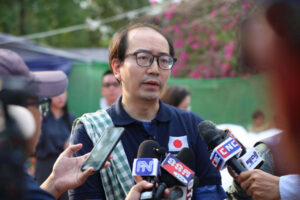
Speaking at a roundtable discussion on landmines and unexploded ordnance in Preah Vihear province on September 9, Puthikar said the July and December clashes had destroyed years of work by Cambodian specialists and international partners.
“After more than 10 years, much of the work was nearly complete, but the recent shelling destroyed almost everything we had worked so hard to achieve,” he said.
“It did not simply return the temple to its previous condition. The damage is now worse than it was before and more severe than that caused by natural factors,” he added.
According to the NAPV, the July clashes caused damage at 142 locations across the temple, while shelling in December affected a further 420 places.
The authority recorded damage at 562 points, leaving around 70,000 stone fragments scattered throughout the complex and affecting architectural structures, gopuras, carvings, stone pillars, walls and tourism infrastructure.
Puthikar noted that many shells scored direct hits on heritage structures, and that some sections were damaged repeatedly during both rounds of fighting.
Technical findings presented by a Cambodian Mine Action Centre (CMAC) official at the same roundtable provided further details about the explosive contamination left in and around the Preah Vihear temple area.
UXOs pose new threat
Ean Sothea, head of CMAC’s Demining Unit 6, said the agency had identified 1,597 landmines and unexploded ordnance items in the Preah Vihear temple area, with 970 unexploded items cleared.
CMAC teams also found eight drones, including four in the temple area, he noted.
Sotha said deminers had identified 520 locations or craters associated with unexploded ordnance on the temple grounds. The items found included hand grenades, ammunition and several other types of explosive ordnance.
CMAC teams were continuing to find heavy aerial bombs, including MK-82 bombs weighing approximately 500 pounds, which Sothea warned have a powerful destructive capacity.
He also reported the discovery of unexploded cluster submunitions, which pose a serious danger to farmers and other civilians. Some were found in locations very close to civilian homes.

Sothea said unexploded ordnance could remain active and detonate if disturbed, making public awareness and professional clearance essential before affected land can be used for farming or residential purposes.
He also referred to items suspected of being chemical munitions. Technical teams were conducting further studies to assess their possible effects on human health and the environment and determine appropriate measures for handling them.
Some explosive ordnance had fallen into ponds, he added, making clearance more difficult because underwater operations require specialised equipment and experienced personnel.
The CMAC official stressed that the images presented during the roundtable were taken at actual clearance sites and were not generated or altered using artificial intelligence.
He appealed to residents not to touch any object suspected of being a landmine or unexploded munition and to immediately report it to local authorities or the nearest CMAC personnel.

No easy steps
Among the conservation projects affected by the recent conflict was the restoration of the northern staircase at Preah Vihear temple, which had received support from the US Ambassadors Fund for Cultural Preservation.
Puthikar said the project began in 2018 and continued until halted by the fighting of July 2025. Authorities had expected to complete the work in approximately two more years, but it has since been suspended and the staircase has sustained further damage.
He noted that even repairing damage caused by natural deterioration requires considerable time, while damage caused by weapons is more complex and difficult to assess.
The conservation site at Gopura V, supported by the Indian government, was also destroyed. The site included an office, conservation and stone-cutting workshops, a crane for lifting stone blocks and a building providing information about the restoration work.
Puthikar said the facilities had been completed in 2025 in preparation for conservation work, but none of the structures could now be reused.
He added that even the steel crane and concrete framework had been destroyed.
In addition to the US and India, China was planning to support the restoration of sections of Gopuras I, II and III. Those projects have also been suspended because of the security situation.
Puthikar said all repair and conservation activities conducted by the NAPV and its international partners had been halted. Specialist teams were now able to undertake only emergency rescue and stabilisation work.
“All we can do at present is emergency rescue work for Preah Vihear temple, not restoration,” he said.
Emergency measures include supporting unstable structures, sealing cracked sections, collecting and protecting stone fragments, preparing scientific documentation and using 3D photography to record damaged and hazardous areas.
The measures are intended to prevent structures from collapsing or deteriorating further until full restoration can begin.
Puthikar explained that reassembling damaged ancient stones is highly complex because a single block, weighing between 100kg and 200kg, may have shattered into 20 or 30 fragments.
Specialists must determine which fragments belong together, identify their original locations and decide which techniques should be used to reassemble them. The work requires extensive research, specialist expertise and technology, and most of all, time.
As technical assessments have not been completed, the authority remains unable to determine the full cost of the damage, the funding required or how long the restoration will take.

Puthikar said UNESCO had sent specialists to inspect the site and mobilised $20,000 for emergency assistance.
The funding is being used for technical studies, reporting, photography and scientific documentation rather than the restoration of the temple.
He said the UNESCO funding was the only international emergency assistance the authority had received to date, while domestic efforts were being supported by the national budget and public donations.
According to Puthikar, the resumption of restoration work will depend on the security situation and progress in resolving the border dispute.
The presence of military forces near the temple has placed pressure on tourism, heritage management and the safety of conservation officials, he said.
Puthikar could not say when full conservation work would resume or how many years would be required to repair the damage.
He said the situation could improve if the border dispute were resolved and both sides returned to working through established mechanisms. However, if military deployments and tensions continued to increase, the resumption of normal conservation activities would remain difficult.
-Phnom Penh Post-