AmCham president draws historical parallels, warns that Thailand repeating past territorial aggression
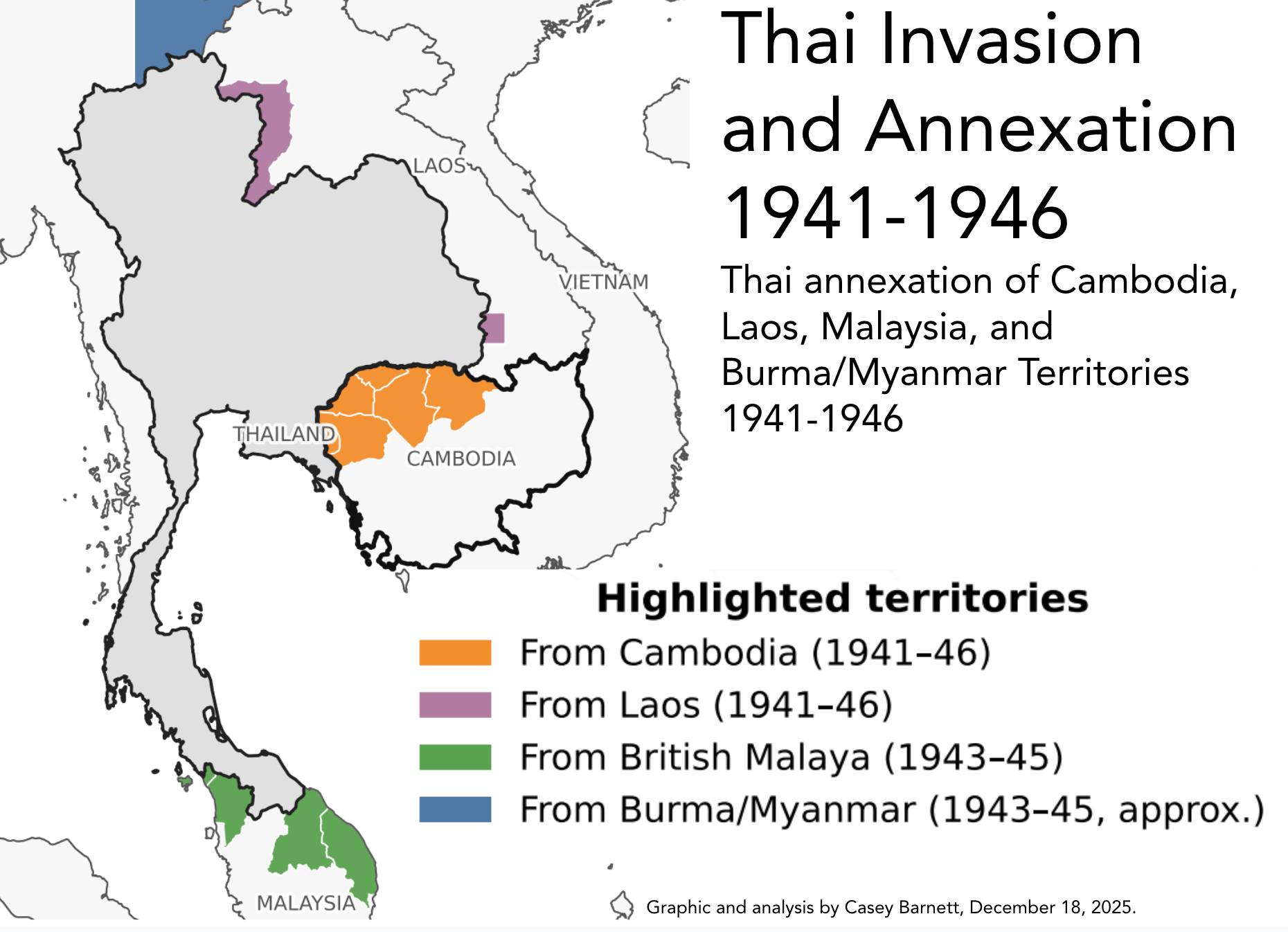 [The Thai invasion and annexation of Cambodia, Laos, Malysia and Burma/Myanmar Territories from 1941-1946. Casey Barnett]
Casey Barnett, president of the American Chamber of Commerce in Cambodia (AmCham), has warned that Thailand is repeating a pattern of territorial aggression against Cambodia, drawing direct parallels between current border tensions and Thailand’s actions during World War II.
In a December 17 social media post, Barnett recalled that Thailand invaded Cambodia in 1941 before later declaring war on the US and UK.
He argued that the justifications used then mirror those being cited today.
“In 1941, Thailand invaded Cambodia,” Barnett wrote, adding that similar accusations of cross-border gunfire were used at the time to legitimise military action.
“In 2025, Thai accusations that Cambodian soldiers fired across the border are again being used to justify an ongoing Thai invasion of Cambodia,” he added.
Barnett said historical records show that Thailand’s claims in 1941 — that French colonial forces in Cambodia had fired into Thai territory — were used as a pretext for an invasion that had been prepared months in advance.
“Then, as now, Thailand’s military action was intended to annex Cambodian territory,” he wrote.
The AmCham president also highlighted Thailand’s wartime alignment with Japan, noting that Bangkok entered into a treaty with Tokyo in June 1940 despite international awareness of Japan’s atrocities in China, including the 1937 Nanjing Massacre.
He said the agreement enabled Japan’s expansion into French Indochina and British Malaya.
After ratifying the treaty, Thailand invaded Cambodia and Laos in January 1941, claiming border provocations.
“In reality, Thailand had been preparing for invasion for months,” Barnett stated, noting that the northern Cambodian provinces were forcibly annexed within weeks.
He further pointed to Thailand’s December 1941 agreement with Japan on mutual military support, under which Japan explicitly backed Thailand’s territorial claims over areas of Cambodia, Laos, Malaya and Burma.
According to Barnett, this cooperation allowed Thailand to serve as a logistics and staging hub for Japan’s military campaigns in Southeast Asia.
Barnett also cited Thailand’s role during the construction of the Burma Railway, which relied heavily on forced labour. Among those subjected to brutal conditions were tens of thousands of Allied prisoners of war, including Australian, American and British soldiers, many of whom did not survive.
Following the Allied victory in World War II, Thailand was forced to return the territories it had annexed from Cambodia and neighbouring countries.
However, Barnett noted that postwar accountability was limited, as the US opposed harsh punitive measures proposed by Britain, arguing they would destabilise the region.
“As a result, Thailand faced limited accountability for its wartime territorial aggression,” he wrote.
Barnett warned that the consequences of this historical leniency are resurfacing today.
“Now, in 2025, with little apparent collective memory of the consequences of its earlier irredentist ambitions, Thailand is once again invading Cambodia,” he said.
His comments come amid growing conflict along the Cambodia–Thailand border, with the situation drawing growing attention from regional observers and the international community.
-The Phnom Penh Post-