Thailand ‘s Changing Narratives and Strategies toward Cambodia
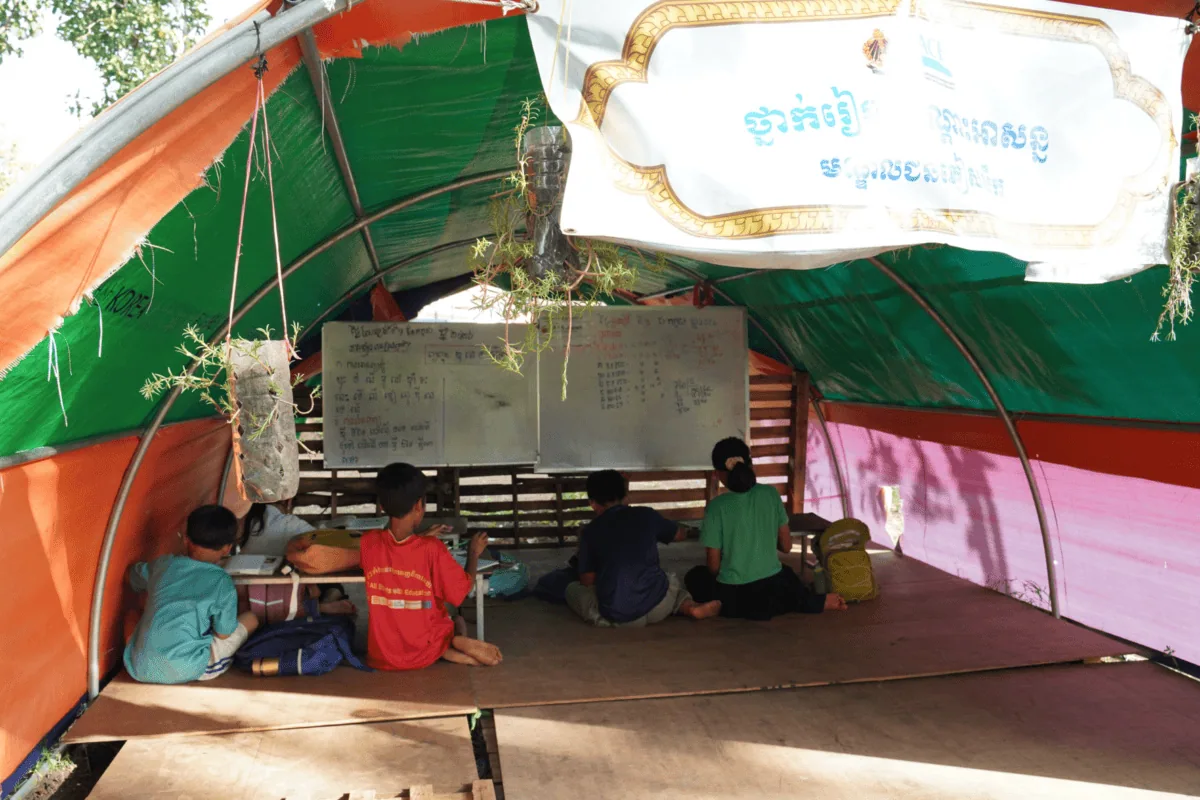 Displaced Cambodian children study in a makeshift classroom in a temporary shelter in Preah Vihear province. Hong Raksmey
#Opinion
The 2025 Thailand–Cambodia border conflict should not be understood only through the military clashes that occurred along the frontier. It should also be examined through the changing political narratives, diplomatic messages, territorial claims and strategic justifications presented by the two sides before, during and after the fighting.
From a Cambodian perspective, Thailand’s approach appeared to evolve from raising security-related concerns to making increasingly direct territorial and sovereignty claims after the military confrontation began.
Before the outbreak of large-scale fighting in July 2025, Thailand repeatedly raised several issues concerning Cambodia, particularly allegations relating to landmines, border security and activities around disputed temples.
At the same time, tensions surrounding Khmer temples near the border became increasingly sensitive.
In February 2025, for example, a dispute developed around Prasat Tamone Thom after Cambodian visitors reportedly sang the Cambodian national anthem at the temple, prompting objections from Thai authorities. Thai officials emphasised that the temple was located in Thai territory, while Cambodia regarded the site as part of its historical and cultural heritage.
The landmine issue subsequently became another major element of Thailand’s narrative. In July 2025, several Thai soldiers were injured in landmine explosions in disputed border areas. Thailand accused Cambodia of laying new mines, while Cambodia rejected the accusation. The disagreement became a significant diplomatic and military issue and contributed to the rapid deterioration of bilateral relations.
From the Cambodian perspective, these developments can be interpreted as a gradual construction of a security narrative. Issues that might initially appear separate — landmines, border patrols, temple access, military deployments and border security — became connected within a broader discourse about Thailand’s territorial security. Such narratives are important because they can shape domestic public opinion and create political justification for stronger military measures.
The situation changed dramatically on July 24, 2025, when serious armed clashes erupted along the disputed border. Thailand and Cambodia each accused the other of initiating the fighting. Thailand argued that its military actions were defensive responses to Cambodian attacks, while Cambodia stated that its forces were responding to Thai military aggression and defending Cambodian sovereignty. The fighting involved artillery, rockets and Thai F-16 air strikes, representing a major escalation compared with previous border incidents.
This is where the distinction between pre-conflict narratives and post-conflict territorial narratives becomes particularly important.
Before the fighting, Thailand’s public messaging emphasised security concerns, online scams, alleged landmine incidents, military threats and disputes surrounding temples.
After military operations began, however, the territorial dimension became much more prominent.
Thailand increasingly presented its military actions in terms of defending what it considered its own territory. Cambodia, meanwhile, argued that Thai military operations had entered or attacked Cambodian territory and that the destruction and displacement caused by the conflict affected Cambodian communities.
This shift raises an important strategic question: Can security arguments eventually become territorial arguments?
From the Cambodian perspective, the concern is that military control on the ground could potentially be accompanied by political narratives designed to normalise or legitimise control over disputed areas. If military forces occupy a location and subsequently describe that location as unquestionably their territory, the battlefield situation can begin to influence the political interpretation of the border.
Such a strategy would not necessarily depend on one single action. Instead, it could involve several mutually reinforcing elements: first, highlighting security threats; second, presenting military deployment as defensive; third, establishing physical control over disputed locations; fourth, producing maps or territorial interpretations supporting that control; and finally, communicating these claims domestically and internationally.
This is particularly sensitive because the Thailand–Cambodia border contains areas whose boundaries have remained disputed for decades. The two countries disagree over parts of a frontier whose modern demarcation dates back to the protectoral period by France for Cambodia.
Ancient Khmer temples have also become symbols of national identity and sovereignty. The International Court of Justice ruled in 1962 that the Temple of Preah Vihear belonged to Cambodia and subsequently clarified aspects of the surrounding area in 2013, although other border areas remain disputed.
Therefore, maps have enormous political significance. A map is not simply a geographical document in a territorial dispute; it can become a political instrument. The production, publication or promotion of a particular map can communicate a claim about sovereignty and territorial legitimacy. For Cambodia, any unilateral attempt to redraw or reinterpret the border is therefore a matter of national sovereignty rather than merely cartographic disagreement.
The destruction of civilian property during armed conflict adds another dimension. When houses, infrastructure and other civilian structures are damaged, the consequences are not limited to physical destruction.
Communities may be displaced, livelihoods disrupted and the demographic and physical landscape of a disputed area altered. Consequently, territorial disputes should not be evaluated solely according to military positions. They must also be considered from the perspective of international law, civilian protection, historical evidence and internationally recognised border-demarcation mechanisms.
The broader lesson from the 2025 conflict is that narratives can be as strategically important as military operations. A state does not need to communicate the same message at every stage of a conflict. Its narrative may evolve according to circumstances. Before confrontation, the emphasis may be on security and alleged threats. During confrontation, the emphasis may shift to self-defence. After gaining or maintaining military positions, the discourse may increasingly emphasise territorial sovereignty.
This does not mean that every Thai action should automatically be interpreted as part of a predetermined plan to annex Cambodian territory. The evidence available publicly is contested, and both governments have presented competing accounts of events. Nevertheless, from a Cambodian strategic perspective, the changing sequence of arguments deserves careful examination.
Cambodia’s response should therefore combine firmness with legality and diplomacy. The country should document border incidents systematically, preserve historical and cartographic evidence, protect civilians, strengthen international communication and rely on recognised bilateral and international mechanisms for border demarcation. Cambodia should also avoid allowing emotionally charged nationalist rhetoric to replace legal and diplomatic arguments.
Ultimately, the Thailand–Cambodia border issue cannot be sustainably resolved through military pressure or competing narratives. It requires transparent border demarcation, respect for international law, effective bilateral mechanisms, protection of civilians and a commitment by both countries to prevent disputed territory from becoming a permanent source of confrontation.
Dr. Seun Sam is a policy analyst with the Royal Academy of Cambodia. The views and opinions expressed are his own.
-Phnom Penh Post-