Cambodia-US Relations under Hun Manet: A Partnership Forged in Crisis and Opportunity
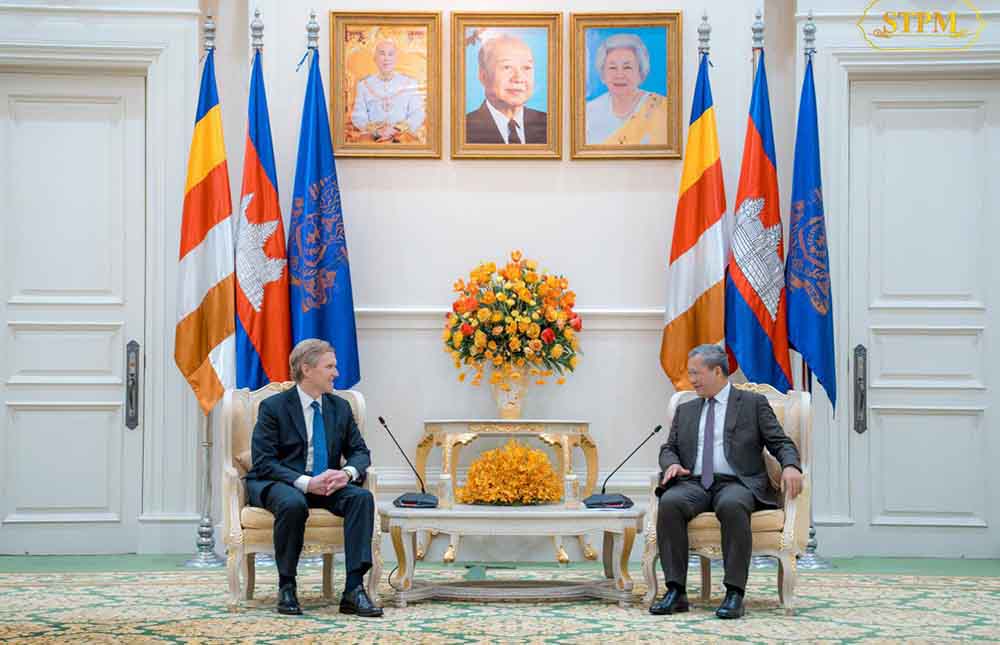 Under Secretary of Defense Elbridge Colby (left) met with Prime Minister Hun Manet in Phnom Penh. US embassy
#Opinion
Since Hun Manet assumed the premiership in August 2023, Cambodia’s relationship with the United States has shifted from years of tension toward pragmatic engagement. The son of longtime leader Hun Sen and a graduate of the US Military Academy at West Point, Manet has pursued a more balanced foreign policy.
While Cambodia maintains close ties with China, it has actively repaired and expanded links with Washington. This evolution has proven especially critical during the 2025 border conflict with Thailand, when US diplomatic intervention, economic leverage and subsequent support helped Cambodia defend its sovereignty against what Phnom Penh described as the Thai military occupation of Cambodian territory.
The long-running border dispute erupted into serious fighting in 2025. Clashes near Preah Vihear and other areas in July killed dozens and displaced hundreds of thousands. After a fragile ceasefire, hostilities reignited in December, with Thailand launching airstrikes and artillery barrages.
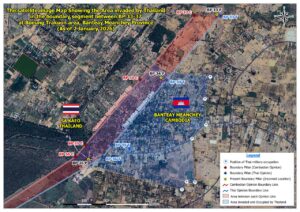
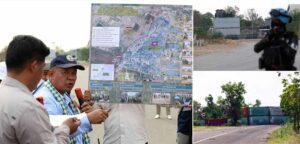
Cambodian officials reported Thai forces advancing into areas Cambodia regards as its sovereign land — beyond even Thailand’s own previous claims in some instances — setting up barriers of razor wire and shipping containers, and preventing thousands of Cambodian families from returning home.
Manet and senior officials repeatedly described these actions as violations of Cambodia’s territorial integrity and international agreements, insisting Thai troops remained deep inside Cambodian territory even after ceasefires. The fighting caused over 100 deaths across both rounds and displaced more than half a million people, underscoring the human cost of unresolved colonial-era boundary issues.
In this moment of vulnerability, the US administration under President Donald Trump played a decisive mediating role. Trump personally contacted leaders from both countries, linking progress on the conflict to ongoing trade discussions. His efforts contributed to the July 2025 Putrajaya ceasefire and the more detailed October Kuala Lumpur Peace Accord, signed in the presence of Trump and Malaysian Prime Minister Anwar Ibrahim.
Cambodia publicly credited the US president for helping restore peace and even nominated him for the Nobel Peace Prize. When fighting flared again, Washington continued to press for de-escalation. In early 2026 the US announced a $45 million assistance package for both countries: $15 million for border stabilisation and support for displaced communities, $10 million for demining and clearing unexploded ordnance, and $20 million to combat transnational crime including scam operations. This aid directly addressed the damage inflicted along the frontier and signalled concrete US backing for Cambodia’s security and recovery.
Military cooperation has deepened in parallel. After years of suspension, the two sides agreed to resume the Angkor Sentinel joint exercises in 2027 — the first such drills in a decade.
Washington lifted its arms embargo on Cambodia in late 2025, citing Phnom Penh’s pursuit of peace and renewed defence engagement. High-level visits followed, including meetings between Manet and senior US defence officials such as Under Secretary of Defense Elbridge Colby in August 2026.
American warships have made port calls, and discussions have expanded on training, professional military education, disaster response and demining. These steps give Cambodia access to US expertise and equipment while helping diversify its defence partnerships beyond exclusive reliance on any single power. For a smaller nation facing larger neighbours, such practical military ties strengthen deterrence and capacity without requiring Cambodia to abandon its non-aligned stance.
Economic support forms the other pillar of the relationship. The US remains Cambodia’s largest export market. In 2025 Cambodian exports to the US reached approximately $15.3 billion, driven largely by garments, footwear and travel goods that employ hundreds of thousands of workers. After initial high reciprocal tariffs were announced, negotiations produced a more manageable 19 per cent rate along with a reciprocal trade agreement under which Cambodia eliminated tariffs on US goods.
Additional steps include an Open Skies agreement, Cambodian purchases of Boeing aircraft and American investment interest in infrastructure such as Phnom Penh’s new international airport. These commercial links provide hard currency, jobs and technology transfer that complement Chinese investment while reducing over-dependence on any one partner.
Good relations with the US matter for Cambodia for several interlocking reasons.
First, they enhance sovereignty and security. When territorial integrity is challenged, as during the 2025 border crisis, access to a major power willing to mediate and provide tangible aid multiplies a smaller state’s diplomatic leverage.
Second, the US market remains indispensable for export-led growth and poverty reduction.
Third, balanced partnerships improve Cambodia’s bargaining position with all major powers, allowing Phnom Penh to extract better terms from Beijing, Tokyo and others.
Fourth, military and technical cooperation builds institutional capacity in areas such as demining, peacekeeping, and countering transnational crime that directly affect ordinary Cambodians.
Finally, engagement with the US, the world’s largest economy and a key Indo-Pacific player, signals that Cambodia is open for business and capable of managing complex relationships — an image useful for attracting diverse investment and tourism.
Challenges remain. Human rights concerns, governance issues, and the persistence of online scam networks continue to draw scrutiny. Yet under Manet the tone has become more pragmatic on both sides. Washington has prioritised regional stability and competition with China over pure democracy promotion, while Phnom Penh has shown willingness to cooperate on shared interests such as border peace and trade.
The 2025 border conflict tested Cambodia’s resilience and revealed the practical value of warmer ties with the United States. US mediation helped halt the fighting, financial assistance supported recovery and expanded military and economic cooperation offered tools for long-term strength.
For a nation determined to protect its legal territory and pursue independent development, cultivating this relationship is not a luxury — it is a strategic necessity. As Manet continues to navigate great-power competition and neighbourhood disputes, the Kingdom’s partnership with Washington provides an essential counterweight and a pathway to greater agency on the international stage.
Dr. Seun Sam is a policy analyst at the Royal Academy of Cambodia. The views and opinions expressed are his own.
-Phnom Penh Post-