When an economic engine begins to sink: Bangkok’s climate crisis and future of Thailand’s economy
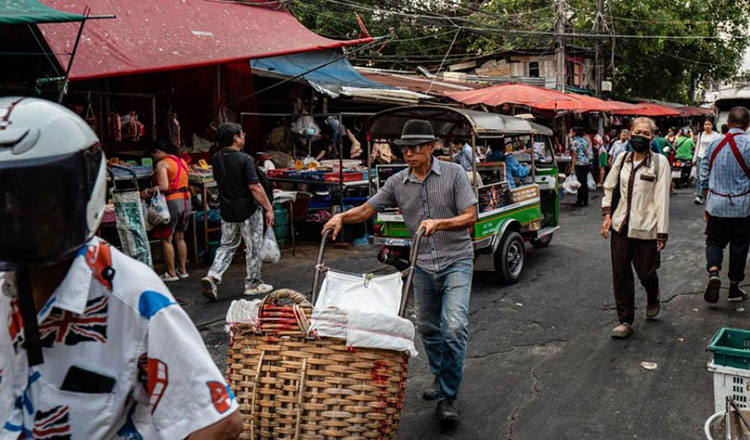 Photo: The Mahanak Market in Bangkok on April 20. AFP
#opinion
For decades, Bangkok’s annual floods have been viewed as little more than a seasonal inconvenience. Images of submerged streets, stalled traffic and overflowing canals have become so familiar that they are often accepted as an unavoidable feature of life in the Thai capital. Yet beneath these recurring floodwaters lies a far more profound challenge – one that is no longer simply an environmental issue but an economic one with potentially far-reaching consequences for Thailand and the wider Southeast Asian region.
Recent warnings from some of Thailand’s most respected scientists have dramatically heightened concerns about Bangkok’s future. According to statements reported in early July, Prof Suchatvee Suwansawat, together with leading experts Assoc Prof Supharathit and Chawalit Chantararat, warned that Bangkok’s sinking crisis may reach a critical stage in less than a decade, considerably earlier than earlier assessments that pointed towards the late 2030s.
Their warning deserves careful attention.
Contrary to sensational headlines, these scientists are not predicting that Bangkok will suddenly disappear beneath the sea within 10 years. Rather, they are warning that the city may soon reach a tipping point where existing flood-control systems can no longer cope with the combined effects of land subsidence, rising sea levels, increasingly intense monsoon rainfall and stronger tidal surges. In such a scenario, chronic flooding would become increasingly common, drainage systems would struggle to function effectively, and Bangkok would become ever more dependent on massive and costly engineering interventions simply to sustain normal urban life.
Bangkok’s predicament is the result of several powerful forces converging at the same time. The city sits atop the soft alluvial soils of the Chao Phraya Delta, where much of the land lies only one to two metres above sea level. Decades of groundwater extraction caused significant land subsidence, while global climate change is steadily raising sea levels. At the same time, warmer oceans are producing heavier rainfall and more powerful storms, placing unprecedented pressure on Bangkok’s already complex drainage system. Nature is effectively squeezing the city from above and below.
However, what transforms this environmental challenge into a national economic concern is Bangkok’s extraordinary importance to Thailand’s economy. The Bangkok Metropolitan Region and its surrounding provinces are estimated to generate approximately 40% of Thailand’s GDP. This remarkable concentration of economic activity makes Bangkok not merely the nation’s political capital but also its financial, commercial and industrial powerhouse. It hosts the headquarters of Thailand’s largest commercial banks, publicly listed corporations, multinational companies, government ministries, logistics operators, financial institutions and one of the world’s most vibrant tourism industries. The surrounding metropolitan area is also home to major industrial estates producing automobiles, electronics, processed food, petrochemicals and countless export-oriented manufactured goods that are deeply integrated into global supply chains.
In other words, Bangkok is the engine that powers nearly half of Thailand’s economy. This concentration has been one of Thailand’s greatest strengths, allowing businesses to benefit from economies of scale, sophisticated infrastructure, skilled labour and integrated logistics. Yet it also creates one of the country’s greatest structural vulnerabilities. When nearly half of national economic output is concentrated in a metropolitan area increasingly threatened by climate change and land subsidence, environmental risks inevitably evolve into macroeconomic risks.
When Bangkok functions efficiently, Thailand prospers. Conversely, when Bangkok slows down, the entire country feels the consequences. This is why the warnings from Thailand’s scientific community extend well beyond concerns about urban flooding. They raise important questions about Thailand’s long-term economic resilience. Should chronic flooding become more frequent during the coming decade, businesses are likely to experience repeated disruptions to operations. Roads, railways, airports, ports and logistics hubs could face increasing interruptions, complicating supply chains that rely upon precise timing and efficient transport. Manufacturing sectors operating under just-in-time production systems would become particularly vulnerable, while exporters could face higher transport costs and greater uncertainty.
Insurance costs are also expected to rise. As flood risks become more pronounced, commercial property owners and businesses located within vulnerable districts will likely face higher insurance premiums, larger deductibles and, in some cases, difficulty securing adequate coverage. These additional costs gradually erode business competitiveness and influence future investment decisions.
Meanwhile, public finances will come under increasing pressure.
The Thai government will almost certainly need to devote enormous financial resources towards constructing new flood barriers, expanding pumping stations, reinforcing drainage systems, building seawalls and modernising urban water management infrastructure. These investments are indispensable if Bangkok is to remain resilient. However, every additional baht allocated to defending existing infrastructure represents capital that cannot simultaneously be invested in education, healthcare, digital transformation, research, innovation or industrial upgrading.
Perhaps the most significant long-term consequence will be a gradual redistribution of investment.
Businesses seldom wait until disaster strikes before reassessing long-term risks. Increasingly, investors incorporate climate resilience alongside labour costs, taxation and market access when deciding where to establish future operations. If Bangkok becomes progressively more expensive to insure, protect and operate, new investment may increasingly gravitate towards Thailand’s Eastern Economic Corridor, inland provinces situated on higher ground, or even neighbouring ASEAN countries capable of offering resilient infrastructure and competitive business environments.
History provides a sobering reminder of what is at stake. The devastating floods of 2011 inflicted economic losses exceeding $45 billion and temporarily disrupted global automotive and electronics supply chains. Thailand recovered remarkably well, but the disaster demonstrated how events occurring within Bangkok and central Thailand can rapidly reverberate throughout international production networks.
The challenge now is fundamentally different. The concern is no longer a once-in-a-generation catastrophe. Rather, scientists fear that climate-induced flooding could become an increasingly regular feature of Bangkok’s future. If repeated disruptions become the norm rather than the exception, Thailand’s economic growth may gradually slow – not because the country loses its productive capacity overnight, but because an ever-growing share of national investment must be directed towards protecting existing assets instead of creating new ones. Productivity growth may weaken, infrastructure costs may escalate and investor confidence could gradually become more cautious.
Fortunately, Thailand enters this challenge with considerable advantages.
Its engineering expertise, institutional capacity and experience in water management remain among the strongest in Southeast Asia. The country possesses the technical capability to adapt, provided sufficient political commitment, long-term planning and sustained investment are maintained. Bangkok is unlikely to become an abandoned city within the next decade, but preserving its role as one of Asia’s leading economic centres will require adaptation on a scale not previously witnessed in Thailand’s modern history.
For neighbouring Cambodia, these developments also warrant close attention. As global investors increasingly evaluate climate resilience when allocating capital, opportunities may emerge for Cambodia to attract new manufacturing investment, logistics operations and regional supply-chain diversification. However, such opportunities will only materialise if Cambodia continues strengthening its own infrastructure, energy reliability, regulatory framework and skilled workforce.
Ultimately, Bangkok’s struggle is no longer merely Thailand’s problem.
It is becoming one of Southeast Asia’s defining economic challenges. The warnings issued by Thailand’s leading scientists should therefore not be viewed simply as environmental forecasts. They are, in reality, an economic early warning. When approximately 40% of a nation’s GDP is generated within a metropolitan region facing accelerating climate risks, protecting that city becomes synonymous with protecting the country’s future prosperity. The next decade may well determine whether Bangkok remains one of Asia’s great engines of growth – or becomes a cautionary example of what happens when climate change overtakes the capacity of even the most dynamic cities to adapt. The race has begun, and for Bangkok, time may now be the most precious resource of all.
The author is a Cambodian business strategist and public policy advisor with over 45 years of multinational corporate, trade, and investment experience across Southeast Asia. A pioneer in public–private partnerships and blended finance, he has helped shape Cambodia’s trade, transport, skills, and industrial development policies while advising governments, multilateral agencies and global corporations.
-Khmer Times-