The Stones Do Not Lie: International Law and Thailand’s Responsibility for Damaging World Heritage
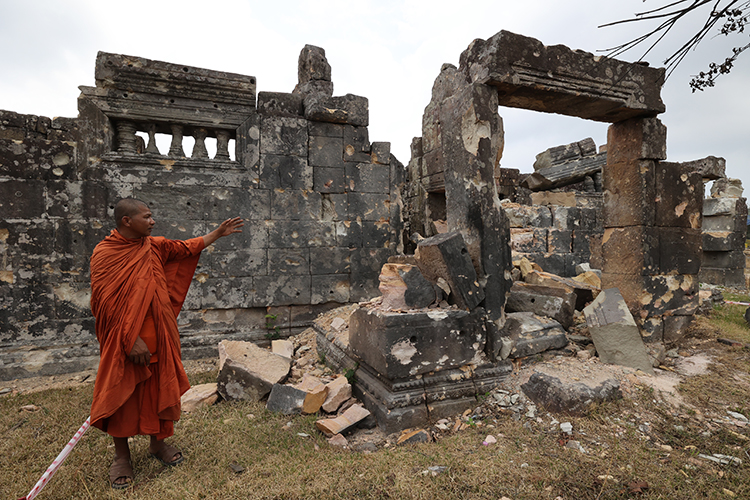 A Buddhist monk inspects the damage that was done to Preah Vihear Temple after it was shelled by the Thai military in December 2025. Supplied
When a state is confronted with evidence that military operations have damaged a UNESCO World Heritage Site, there are two possible responses. One is to acknowledge the facts, cooperate with independent investigations and demonstrate respect for international law. The other is to launch an information campaign designed to shift blame, create doubt and deflect international scrutiny.
Thailand’s latest statement, issued by its Joint Information Center, unfortunately falls into the latter category.
Rather than addressing the undeniable damage inflicted upon Preah Vihear Temple and other Khmer cultural heritage sites during recent military invasions, Thailand attempts to change the subject. It accuses Cambodia of providing “one-sided information” and repeats allegations that Cambodia used areas around cultural heritage sites for military purposes.
Witnesses including international journalists confirmed no military bases. Thailand only used this as pretext to justify their military invasions on Cambodian sovereignty.
Who destroyed parts of a World Heritage Site?
This is not a matter of competing political narratives. It is a question of objective fact.
The scars on the ancient stones of Preah Vihear are visible. Damage to the monument is documented. The world has seen photographs and videos showing the impact of Thai military attacks on one of humanity’s irreplaceable cultural treasures.
No press statement can erase physical evidence.
International law does not provide a licence to destroy cultural heritage
Thailand argues that its military operations complied with the principles of military necessity, distinction, proportionality and precaution.
These principles are indeed fundamental rules of international humanitarian law.
But invoking them in a press release does not automatically establish compliance.
International humanitarian law — including the 1954 Hague Convention for the Protection of Cultural Property in the Event of Armed Conflict and customary international law — places exceptionally high obligations on all parties to protect cultural property. Cultural heritage enjoys special protection precisely because it belongs not merely to one nation but to humanity as a whole.
Even where military necessity is claimed, it must be established through objective evidence and is subject to strict legal scrutiny. It cannot simply be asserted after damage has already occurred.
Nor can a state escape responsibility merely by alleging that the opposing side used areas near a cultural site for military purposes. Such allegations require credible evidence and independent verification. They cannot serve as a blanket justification for damage inflicted upon internationally protected heritage.
The burden lies with the state that used force
Thailand’s statement repeatedly asks Cambodia to disclose information. But this turns international law upside down.
When military operations result in the destruction of protected cultural property, the primary burden rests on the state whose forces conducted those operations to explain how such damage occurred and why it could not have been avoided.
That is the essence of accountability.
The issue is not which government issued the first statement or which side speaks louder in the media. The issue is whether military force was employed in a manner consistent with legal obligations to protect one of the world’s most important cultural monuments.
History cannot be rewritten
Preah Vihear Temple has stood for more than a thousand years.
It has survived changing kingdoms, colonial rule, regional conflict and the passage of time itself. It is recognised by UNESCO not because it belongs solely to Cambodia, but because it possesses outstanding universal value for all humanity.
When such a monument suffers damage during armed conflict, the international community has both the right and the responsibility to seek the truth.
Public relations campaigns cannot replace independent investigation. Political messaging cannot repair broken stone. Official denials cannot reverse physical destruction. History records actions, not slogans.
The world deserves facts, not narratives
Cambodia has consistently called for disputes to be resolved peacefully through international law and established legal mechanisms.
The same principle should apply to questions concerning damage to cultural heritage.
If Thailand is confident in its assertions, it should welcome an impartial international assessment by competent experts, rather than relying on unilateral public statements.
Transparency should never be feared by those convinced of their own compliance with international law.
Accountability cannot be avoided
The protection of World Heritage is a collective responsibility of the international community.
Every attack that damages an irreplaceable monument diminishes not only one country but humanity’s shared cultural inheritance.
The question before the world is therefore larger than the dispute between Cambodia and Thailand.
It is whether states can destroy or damage internationally protected heritage during military operations and then avoid responsibility simply by issuing statements that shift blame to others. The answer must be no.
The international legal order depends upon accountability, evidence and objective scrutiny- not political messaging.
The stones of Preah Vihear bear witness to what happened. The world should judge by those facts, not by carefully crafted press releases.
Because responsibility for the destruction of World Heritage cannot be erased by words. It can only be addressed through truth, accountability and respect for international law.
Roth Santepheap is described as a Phnom Penh-based geopolitical analyst. The views and opinions expressed are his own.
-Phnom Penh Post-