Senate official informs Francophone Parliament of Thai violations of Cambodian sovereignty
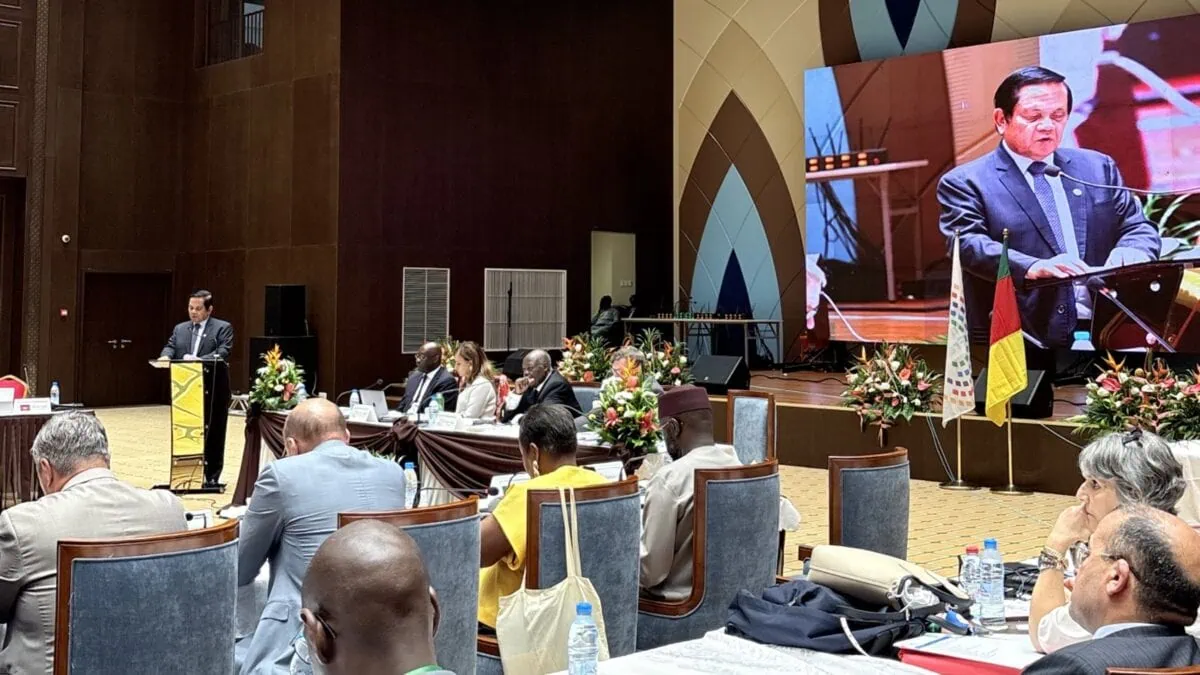 PHOTO: -Ouch Borith, first vice-president of the Cambodian Senate, describes the Cambodia-Thailand border situation during the Executive Committee meeting of the Parliamentary Assembly of the Francophonie (APF), held in Cameroon from July 7 to 12. Supplied
A Cambodian parliamentary leader has provided a detailed account of the Cambodia-Thailand border situation to the leadership of the Francophone Parliament, highlighting what he described as Thailand’s “dishonesty” in evading its duties to the Joint Boundary Commission (JBC) following Cambodia’s decision to seek a resolution via UNCLOS.
First vice-president of the Cambodian Senate Ouch Borith, who also serves as vice-president of the Parliamentary Assembly of the Francophonie (APF), detailed the current situation along the border — specifically what he referred to as Thailand’s attempts to create “facts on the ground” to seize Cambodian land since December 27. He raised these concerns during the APF Executive Committee meeting, held in Cameroon from July 7 to 12.
In a July 7 speech, Borith thanked the members of the APF Political Committee who had personally witnessed the scale of destruction, evidence of physical violations and the suffering of displaced persons during the committee’s meeting in Siem Reap last May.
He stated that following the ceasefire agreement signed on December 27, 2025 — achieved through regional mediation — Cambodia has fully respected every commitment it made.
Cambodia, he said, has consistently prioritised restraint, dialogue and de-escalation. Unfortunately, this will to reduce tensions has not been met with a reciprocal spirit from the other side.
He informed the assembly that immediately after the December 27 ceasefire took effect, Thai forces continued unilateral activities within areas under Cambodian sovereignty.
These actions include land clearing, the installation of razor wire and shipping container barricades, the surrounding of civilian villages, the reinforcement of military positions, the construction of permanent infrastructure, the organising of religious ceremonies at temples that are part of Cambodia’s cultural and religious heritage, and the destruction or replacement of religious statues.
“Despite Cambodia repeatedly lodging official protests, these activities continue to this day,” he added.
“These activities cannot be considered isolated incidents. Rather, they are part of a trend that could lead to a sequential change of the status quo in border areas before a final resolution to the border dispute is reached.
“These actions contradict Article 5 of the 2000 Memorandum of Understanding (MOU) and the commitment to de-escalate tensions stipulated in the Joint Statement of December 27, 2025. Furthermore, they are inconsistent with the legal framework of the border defined by the 1904 and 1907 Conventions and Treaties, as interpreted and confirmed by the International Court of Justice (ICJ) judgments of 1962 and 2013,” he continued.
Borith further noted that by attempting to create a “fait accompli” (an established fact that is difficult to undo), these actions undermine the integrity of the existing legal framework and damage the conditions necessary for a peaceful, just and sustainable resolution of border disputes.
He highlighted the suffering of the tens of thousands of innocent civilians who remain displaced and unable to return to their homes, and noted the destruction of Cambodia’s national heritage, including severe damage to the UNESCO-listed Preah Vihear Temple.
Regarding Thailand’s unilateral cancellation of the 2001 MOU on overlapping maritime claims, Borith explained that has Cambodia exercised its right to request the conciliation procedure provided for in the UN Convention on the Law of the Sea (UNCLOS) to ensure a peaceful and legal solution.
“However, this initiative has instead been used as an excuse to suspend meetings of the Joint Boundary Commission (JBC), a mechanism that is purely technical and should not be linked to any political considerations,” he said.
“Despite Cambodia’s persistent requests to convene the commission, its work has been unable to resume, which is steadily damaging bilateral cooperation mechanisms and eroding mutual trust,” he added.
He emphasised that Cambodia has always chosen to adhere to legal principles, dialogue and multilateral mechanisms for peaceful dispute resolution. Cambodia remains convinced that the ongoing commitment of the international community and the “Great Family” of the Francophone Parliament in supporting sovereignty, territorial integrity, the non-use of force, the sincere implementation of agreements and the peaceful settlement of disputes is vital support for this common goal.
He stressed that no border can be unilaterally altered by force or through the creation of a fait accompli.
“It is in this spirit of trust, transparency and responsibility that I once again appeal to your excellencies to pay close attention to the worrying situation that continues to persist along Cambodia’s western border,” he concluded.
-Phnom Penh Post-